The short answer. Su Shi (1037-1101) is the most complete literary figure of the Song dynasty: a poet, a prose master, a calligrapher, a painter, a statesman and, by his own cheerful admission, a cook. He was also the most exiled. The official history of the Song gives him a full biography; his own notebooks give us something rarer — a wild history written by the man himself. And a dish he supposedly invented, Dongpo pork, is still on menus today.
Who was Su Shi
Su Shi, courtesy name Zizhan and art name Dongpo Jushi ("Resident of the Eastern Slope"), was born in Meishan in Sichuan in 1037. He passed the highest examination in 1057 at twenty, was singled out by the great scholar Ouyang Xiu, and began a career in the civil service that would carry him across the country and, more often than he liked, away from the capital.
His political problem was the reform programme of Wang Anshi. Su Shi was not a doctrinaire conservative; he was a moderate who thought the reforms were being pushed too fast and too hard. He said so, and for that he was sent away. The pattern of his life was set: a posting, a disagreement, an exile.
Three exiles define him. From 1080 to 1084 he lived in Huangzhou on the Yangtze, where he farmed a slope east of town, took the name "Dongpo," and wrote the works that made him immortal. From 1094 he was in Huizhou in the far south. From 1097 he was on the island of Hainan, the harshest posting the Song could give a man. He survived all three and, briefly restored to favour, died in 1101 in Changzhou, Jiangsu.
What the standard history says
The primary record is his biography in the History of the Song (Song Shi), compiled in the fourteenth century from the dynasty's own archives. It confirms the outline: a brilliant examinee, a career of posts and exiles, a writer of extraordinary range. It also records that he opposed the New Policies as too hasty, and that this opposition cost him his standing at court.
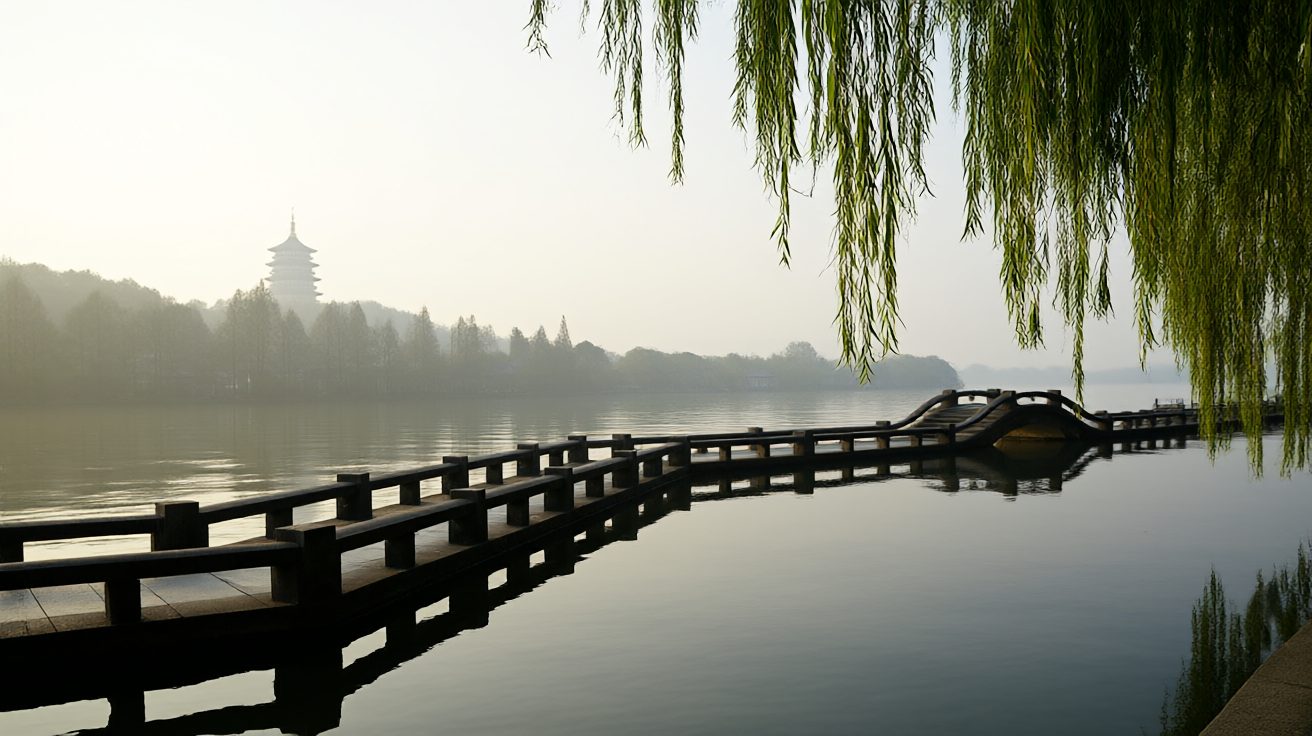
The standard history treats him as a moral figure as well as a literary one. He was remembered for speaking honestly, for governing where he was sent rather than merely serving, and for refusing to be broken by exile. The Su Causeway across West Lake in Hangzhou, built when he was governor there from 1089 to 1091, is his most visible monument — a real, dated construction that the history confirms and that still stands.
His literary standing is not in dispute. He is counted among the Eight Great Prose Masters of the Tang and Song, and among the Four Great Calligraphers of the Song. His ci poetry, his rhapsodies on the Red Cliff and his short prose pieces set the standard for the age.
Versions of Su Shi
Two other portraits of him survive, and both come unusually close to the man.
Version one: his own notebook
The Dongpo Zhilin, his collection of notes and jottings, is the closest thing to a self-portrait we have from any Song writer. It is a miscellany of anecdotes, opinions, dreams and small observations, written for his own amusement and read ever since as an informal companion to the official record. Here we meet Su Shi the observer: the man who notices how a cook braises pork, who jokes about his own exile, who is curious about everything. This is "wild history" in the most literal sense — an unofficial account written by the subject himself, and it is more alive than any court biography.
Version two: the food legend
Su Shi is credited with the braised pork dish Dongpo pork (Dongpo rou), a block of pork belly simmered slowly with soy, wine and sugar until it glazes. The famous recipe verse — "slow fire, little water, when the fire is right it is beautiful on its own" — is attributed to him, and the dish is named for him. Scholars, however, note that the verse is almost certainly a later addition. What is genuine is a poem of his from Huangzhou celebrating cheap pork there: in the provinces, he wrote, the good meat was so cheap that the rich would not eat it and the poor did not know how to cook it. The dish that bears his name grew out of that observation, whatever the exact recipe.
Sorting fact from legend
The clearest case is the Red Cliff. Su Shi wrote two rhapsodies and the poem "Nian Nu Jiao — Remembrance of the Red Cliff" at Huangzhou in 1082, all of them set at a cliff he visited by the river, and all of them about the great battle of 208 that had been fought nearly nine hundred years earlier. But the cliff at Huangzhou is not, by general scholarly agreement, the actual site of that battle. The real Red Cliffs are farther downstream, near today's Chibi city, and even there the exact location is debated. The poems are among the greatest in the language, and they are about a place Su Shi happened to be — not necessarily the battlefield. The literature is real; the battlefield is somewhere else.
The Su Causeway is the opposite case: fully verified. Su Shi organised the dredging of West Lake in 1089-1091 and used the excavated silt to build a long causeway, planting willows along it. It became one of the Ten Scenes of the lake, "Spring Dawn on the Su Causeway," and it is still walked today. Here the fact and the monument agree.
Why Su Shi still matters
Three things make him the most beloved of Song writers. First, his range: he wrote in every major form and excelled in each, and his Red Cliff pieces are school texts. Second, his resilience: he turned exile into a subject, and his poems from Hainan and Huizhou are among his most human. Third, his appetite — he is one of the few great writers whose food has outlived him, and Dongpo pork is a standard dish in the repertoire described in our guide to 10 must-try Chinese dishes.
For a traveller, the Su Causeway is the natural destination: our walking guide to West Lake follows the lake loop and crosses the causeway he built. And his calligraphy, one of the Four Great Calligraphers of the Song, belongs to the living tradition explained in our guide to Chinese calligraphy.
Frequently asked questions
Did Su Shi invent Dongpo pork? The dish is named for him, but the famous recipe verse is almost certainly a later addition. What is genuine is his poem from Huangzhou praising the cheap pork he found there. The dish grew from his association with pork, not from a documented recipe by him.
Where was Su Shi exiled? To Huangzhou in Hubei (1080-1084), then Huizhou in Guangdong (1094), then Danzhou on Hainan island (1097). The Hainan posting was the harshest; he survived it and returned north before dying in 1101.
Did Su Shi build the Su Causeway? Yes. As governor of Hangzhou from 1089 to 1091 he organised the dredging of West Lake and used the silt to build the causeway, now a listed "Spring Dawn on the Su Causeway" scene. It still stands and is walked today.
Why is Su Shi called Dongpo? Dongpo means "Eastern Slope." He took the name at Huangzhou, where he farmed a slope east of town during his first exile. It became his art name and the name by which he is best known outside China.
Sources
History of the Song (Song Shi), biography of Su Shi. Su Shi, Dongpo Zhilin (his own notebook). Su Shi, the Red Cliff rhapsodies and the poem "Nian Nu Jiao — Remembrance of the Red Cliff" (1082).
Current reporting: China Daily (Zhejiang) on Su Dongpo's inspection tours in Hangzhou (2022-12-26) and China Daily (Zhejiang) on Hangzhou in the eyes of foreigners (2016-09-05). Last checked 2026-11.