The short answer. Wu Zetian (624-705) is the only woman in Chinese history to rule as emperor in her own right, and she is also one of the most debated. The official histories of the Tang give her a full set of imperial annals — a position no other woman holds — yet those same histories, written centuries later, accuse her of crimes that modern scholars now largely doubt. The standard record and the scandalous record are two different women, and both are in the books.
Who was Wu Zetian
She was born Wu Zhao in 624, into a family of provincial officials, and entered the palace of Emperor Taizong at about the age of thirteen as a low-ranking consort. After Taizong died in 649 she went, as custom required, to a Buddhist convent. She returned to court as a consort of Taizong's son, Emperor Gaozong, and in 655 was made empress after Gaozong deposed Empress Wang.
From about 660 she shared power with Gaozong, the two ruling together and known to contemporaries as the "Two Sages." When Gaozong died in 683 she governed through two of her sons in turn, and in 690 she dispensed with them, took the throne herself and founded her own dynasty, the Zhou. She ruled until 705, when a palace coup forced her to abdicate in favour of her son, who restored the Tang. She died within the year and was buried in the Qianling mausoleum in Shaanxi, beside Gaozong — the only emperor and empress of the Tang to share a tomb.
Two administrative achievements stand out. She moved the effective capital to Luoyang and ran the government from there. And she expanded the civil service examination, holding the first palace examination in person and opening office to men of talent whatever their birth, a reform that weakened the old aristocratic monopoly on government.
What the standard history says
Three official works carry her record. The Old Book of Tang (945) is the earliest and the most measured. The New Book of Tang (1060) rewrites it with a harsher eye. And the Comprehensive Mirror (Zizhi Tongjian, 1084) by Sima Guang, a scholar who disapproved of women in power, is openly hostile. All three give her imperial annals — the formal record of a ruler — which is extraordinary for a woman in that period.
Read straight, the annals describe an effective administrator. She staffed the bureaucracy with men chosen by examination rather than birth, she kept the Tang's borders and its grain supply working, and she built an ambitious public works programme, including the great Buddhist caves at Longmen near Luoyang, where the colossal Vairocana Buddha still sits in the cliff face. The Tang did not fall during her reign; it grew stronger.
The same annals, however, also record a reign of political terror. Officials who opposed her were exiled or killed, often through the secret-police apparatus of Lai Junchen and Zhou Xing, whose methods gave Chinese the idiom "please step into the jar" (qing jun ru weng), after the story that a torturer was invited to test his own device. Even historians who defend her record do not deny that she ruled partly by fear.
Versions of Wu Zetian
Take away the annals and two other portraits remain, and they sit awkwardly beside the first.
Version one: the court of scandals
The most famous accusation is that Wu Zetian smothered her own infant daughter and framed Empress Wang for it, in order to topple her rival. The story appears in the New Book of Tang and in Sima Guang's Comprehensive Mirror, but not in the earlier Old Book of Tang, which treats the baby's death without the accusation. Most modern historians treat the smothering story as later propaganda: it appears first in sources written after the dynasty fell, by writers with every reason to blacken the woman who had usurped the throne. The case is unproven, and the charge belongs to the teller's politics more than to the record.
Related claims — that she had her own sons killed or demoted — face the same problem. Her eldest son died young; another was removed as heir. Whether she was personally responsible is genuinely unclear, and the later histories, hostile to her, are the ones that assert it most strongly.
Version two: the folk legend
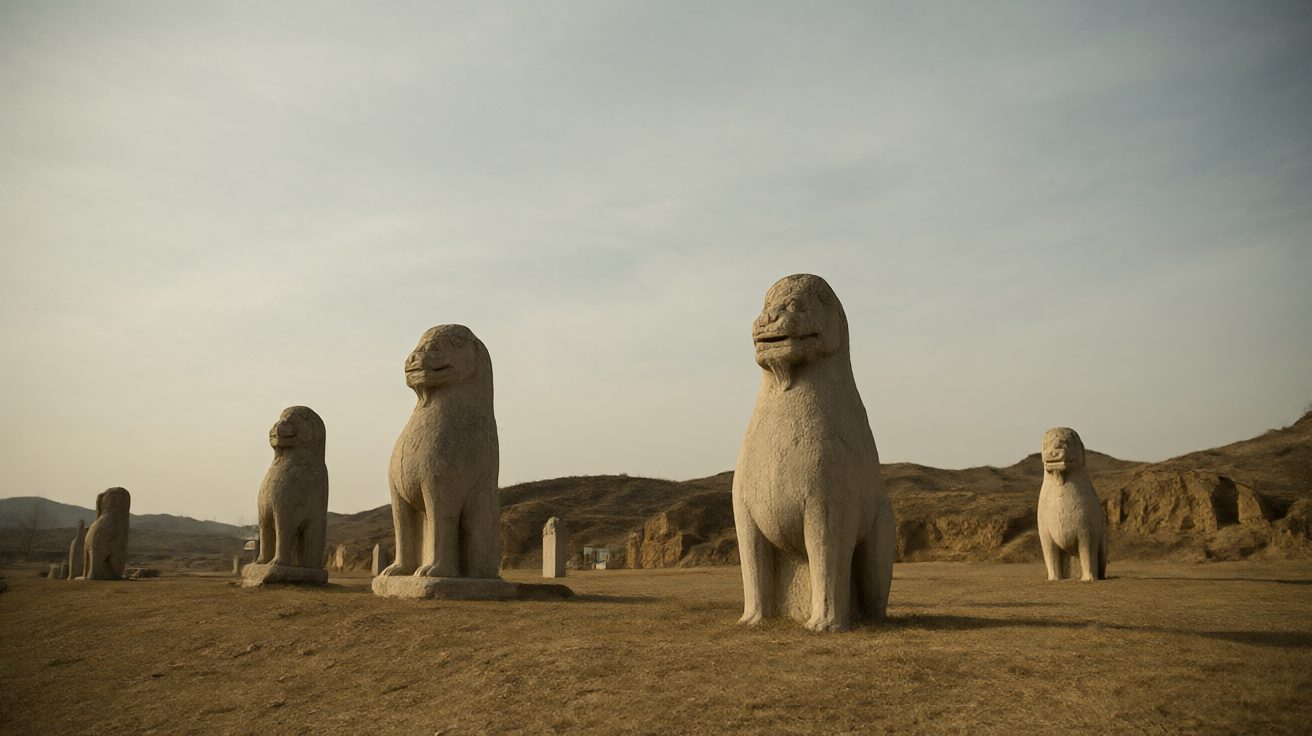
Her tomb at Qianling carries a stone stele that was left blank at the time of her death. Why blank? No contemporary source says. The common explanations are all later guesses: that she wanted no praise, that she knew history would judge her, or that her son who buried her simply left it unfinished. The blank stele is a real object; the reason for the blank is not recorded. Later, under the Tang, inscriptions were added to one face, and the stele still stands, half blank, as the single most visited symbol of her reign.
A second legend says the great Buddha at Longmen was carved with her face. This is a pleasing story and a persistent one, but it is not documented in any Tang source. What is documented is that she paid for Buddhist projects on a vast scale, using the Dayun Sutra to claim she was a reincarnation of the future Buddha Maitreya — a political use of religion that the legend then turned into a personal portrait.
Sorting fact from legend
Two things are worth keeping apart. First, the adopted character. Wu Zetian adopted a new character, zhao, made of the sun and moon over the sky, presented by the court official Zong Qinke in 689 and taken for her own name. This is not legend; it is recorded in the Comprehensive Mirror, and it shows a ruler who understood that language itself could be used to announce a new era. It is one of the clearest examples in Chinese history of a ruler rewriting the written language to fit a reign.
Second, the real balance of her rule. Stripping away the scandals, the picture that survives is of a woman who ran a large empire competently for fifteen years, who promoted talent over birth, and who left the Tang stronger than she found it. The terror was real; so was the competence. The reason she still fascinates is that both are in the same record, and no amount of retelling has reconciled them.
Why Wu Zetian still matters
Her reign is the standard reference point for any argument about women and power in China. For a traveller, she is best met through the objects she left behind. The Qianling mausoleum outside Xi'an is open to visitors and holds the blank stele and the tomb figures; the Longmen Grottoes near Luoyang hold the Vairocana Buddha her court funded. The Tang period she ruled and outlived is well represented in the National Museum of China, whose galleries carry the dynasty's goldwork, ceramics and tomb figures.
Her adopted character is also a way in. The calligraphy of her era, including the script used on the Longmen inscriptions and the famous Preface of the imperial collection, belongs to the same tradition described in our guide to Chinese calligraphy — a tradition she personally reshaped when she put a new character for her own name.
Frequently asked questions
Was Wu Zetian the first female emperor of China? Yes, in the sense of ruling in her own name. She founded the Zhou dynasty and ruled from 690 to 705. Earlier women such as Empress Dowager Lü of the Han ruled behind the throne; Wu Zetian ruled on it.
Did Wu Zetian really kill her own daughter? The accusation appears in the New Book of Tang and Sima Guang's Comprehensive Mirror, but not in the earlier Old Book of Tang. Most modern historians regard it as later propaganda, written after the Tang fell, and the case is unproven.
Why is her tomb stele blank? The stele at Qianling was left blank at her death in 705, and no contemporary source explains why. The common reasons given — humility, or a sense that posterity would judge her — are later guesses. Inscriptions were added to one face under the Tang.
What character is associated with Wu Zetian? In 689 the court official Zong Qinke presented her with twelve new characters, including zhao (sun and moon over the sky), and she took it for her own name. She also expanded the civil service examination and held the first palace examination.
Sources
Old Book of Tang (945), Basic Annals of the Empress. New Book of Tang (1060), Basic Annals of the Empress. Sima Guang, Comprehensive Mirror in Aid of Governance (Zizhi Tongjian, 1084). Dayun Sutra, cited in the Tang histories.
Current archaeology and reporting: China Daily on the Tang grottoes at Longmen (2025-05-19) and Qianling Museum (2025-02-13). Last checked 2026-11.