China's everyday social norms are practical rules a visitor meets from the first taxi ride: address people by surname plus title, expect a closer physical distance than in Western countries, share dishes from a common plate, give and receive with both hands, and avoid the number four, clocks, and green hats. Each rule has a reason and a correct way to do it.
What Are the Core Social Norms in China?
China's social norms centre on three things a visitor meets daily: respect for hierarchy in how people are addressed, shared dining where dishes are communal, and avoiding symbols of bad luck. These three areas cover most situations a foreign visitor encounters in restaurants, taxis, offices, and homes.
How should I address people in China?
Use a surname plus a title or job name. A teacher is 王老师 (Wang Laoshi, Teacher Wang), a manager is 李经理 (Li Jingli, Manager Li), and a doctor is 张医生 (Zhang Yisheng, Doctor Zhang). The Confucius Institute and standard Chinese language textbooks publish these address terms as part of the HSK curriculum.
For strangers and service workers, use 先生 (Xiansheng, Mr.) and 女士 (Nushi, Ms.) in formal settings. For taxi drivers, repair workers, and tradespeople, 师傅 (Shifu, master) is the respectful term. A younger person addresses an older person by surname plus 叔叔 (Shushu, uncle) or 阿姨 (Ayi, auntie) even when they are not related.
First names are reserved for close friends and family. Using a first name with a colleague you have just met can feel too familiar. When in doubt, use the surname plus title, and wait for the other person to suggest moving to first names.
In business settings, use the full title and surname. A company director is 王总 (Wang Zong, Director Wang). A department head is 刘主任 (Liu Zhuren, Director Liu). These titles are used in place of names in meetings and on business cards. The exchange of business cards follows a specific ritual: present with both hands, read the card, and place it on the table in front of you.
The Ministry of Culture and Tourism and the Confucius Institute both publish guidance on Chinese address terms. The rule is simple: the more formal the setting, the more formal the address. For a full list of address terms, see our guide to what to call people in China.
How much personal space should I expect in China?
Chinese cities are dense, so personal space is smaller than in most Western countries. On a Beijing or Shanghai metro during rush hour, shoulder-to-shoulder contact is normal. The Ministry of Transport publishes ridership figures showing Beijing Subway carrying over 10 million passengers on peak weekdays.
Same-gender friends often walk arm in arm or hold hands in public. This is a sign of friendship, not a romantic signal. Physical contact between opposite-gender strangers is avoided unless the situation requires it, such as in a crowded lift.
Queues in China can be tighter than in the UK or US. People stand closer together, and a gap in a queue is quickly filled. Do not push, but do not leave a large gap either — a visitor who leaves a gap may find people stepping in front of them.
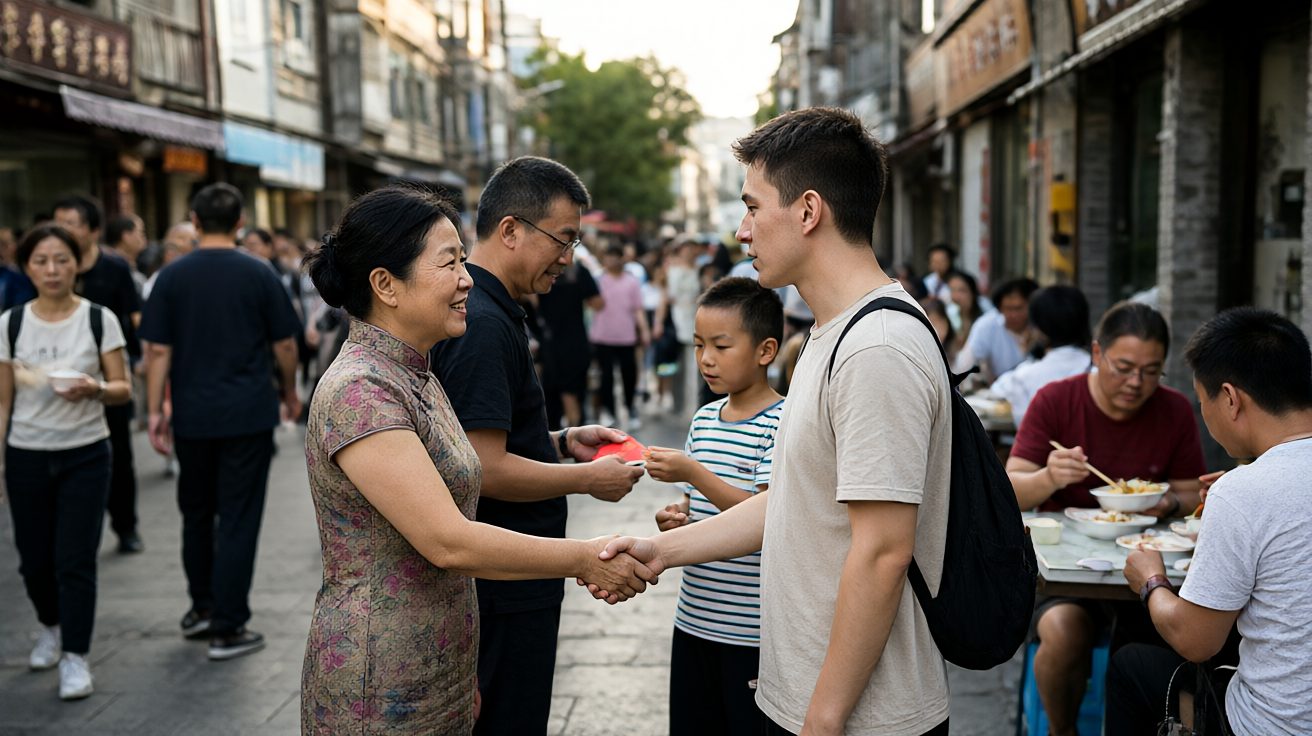
When handing something to another person, use both hands or support your right hand with your left. This applies to business cards, gifts, money, and documents. The gesture shows respect and is one of the first norms a visitor notices.
What are the key table manners in China?
Chinese meals are shared. Dishes are placed in the centre of the table and each diner takes from them with their own chopsticks or with a serving spoon. Do not take food from a shared dish with your personal chopsticks unless a serving spoon is provided. China Daily publishes dining etiquette guides covering these rules each year.
Never stand chopsticks upright in a bowl of rice. This resembles incense sticks placed at a funeral altar and is one of the strongest table taboos. Lay chopsticks on the chopstick rest or across the edge of the bowl when not in use.
Toasting is a key part of a formal meal. When someone raises a glass to you, raise yours and drink. If the other person is older or more senior, hold your glass slightly lower than theirs. The host or the most senior person at the table will usually make the first toast.
The host orders for the table and pays the bill. A guest does not order for themselves unless the host invites them to choose a dish. The guest of honour sits facing the door, which is considered the seat of honour in Chinese dining.
A formal Chinese meal has a set order: cold dishes first, then hot dishes, then a main dish such as fish, then soup, then rice or noodles, then fruit. The host will serve the guest of honour first. Do not start eating before the host invites the table to begin.
Do not take the last piece from a shared dish without offering it to others first. It is polite to ask, "Does anyone want the last piece?" before taking it. These norms are consistent across Chinese restaurants in mainland China.
For a fuller breakdown of table rules, see our guide to Chinese dining etiquette and table manners.
How Should I Behave in Public in China?
Public behaviour in China follows a few clear rules: let people exit lifts before you enter, give seats to the elderly on public transport, and keep noise moderate. Every metro station has a security check. Smoking is banned indoors. These rules are posted in stations and on government websites.
How should I behave on public transport and in elevators?
In elevators, let people exit before you enter. Stand to the side to allow others in. Hold the door for the next person if they are close behind. In residential buildings, it is common to greet neighbours with a nod or a short greeting.
On buses and metro, give up your seat to elderly passengers, pregnant women, and people with disabilities. Announcements on Chinese metro systems ask passengers to do this, and it is a social expectation, not just a courtesy.
Every metro station in major Chinese cities has a security check at the entrance. Put bags on the scanner belt and walk through the metal detector. Liquids over a certain volume and sharp objects are not allowed. Allow extra time for this at busy stations.
On high-speed trains, seat numbers are printed on the ticket. Passengers board in order of seat number at the platform. Do not block the aisle with large luggage — use the overhead racks or the luggage area at the end of the carriage. China Railway 12306 publishes these rules.
In taxis, sit in the back seat unless the driver invites you to sit in front. Many Chinese taxi drivers do not expect conversation beyond giving the destination. Pay the meter fare; tipping is not expected.
What are the noise and smoking rules in China?
Smoking is banned in indoor public places across China. The Ministry of Health issued regulations in 2011 covering restaurants, offices, and public transport. In practice, enforcement varies by city, but a visitor should not smoke indoors.
Noise levels in Chinese public spaces are generally higher than in Northern Europe. Loud phone conversations are common. Avoid shouting or public arguments, which draw attention. On high-speed trains, passengers are asked to keep phone calls quiet in the silent carriage.
Spitting in public is socially discouraged and fined in some cities. If you need to clear your throat, use a tissue. These rules are posted in public transport stations and on government health websites.
In restaurants, do not shout across the table. If you need the waiter, raise your hand or say 服务员 (fuwuyuan, waiter) in a normal voice. Loud calls across a restaurant are considered impolite.
What Are the Gift and Red Packet Rules in China?
Gift-giving in China follows a set of homophone rules: avoid clocks, umbrellas, and pears because their names sound like death or separation. Red packets are given at Spring Festival, weddings, and births, with amounts from 100 to 2,000 CNY depending on the relationship.
What are the gift-giving rules in China?
Give and receive gifts with both hands. Wrap the gift in red or gold paper — these are auspicious colours. White wrapping is used for funerals and should be avoided for gifts. The Ministry of Culture and Tourism documents these gift customs in its intangible cultural heritage listings.
Do not give a clock (钟, zhong). The word sounds like 终 (zhong), which means "end" or "death". Do not give an umbrella (伞, san), which sounds like 散 (san, to separate). Do not give pears (梨, li), which sounds like 离 (li, to leave). These homophone taboos are among the most common gift rules in China.
Do not give sharp objects such as knives or scissors. They suggest cutting the relationship. Do not give a green hat — the phrase "wearing a green hat" means a man whose partner is unfaithful.
Do not open a gift in front of the giver. It is polite to set it aside and open it later. This differs from Western custom and surprises many visitors. Thank the giver and mention the gift without opening it.
When visiting a Chinese home, bring a small gift such as fruit, tea, or sweets. Do not bring a gift that is too expensive, as the host may feel obliged to reciprocate. Fruit should be given in even numbers, but not four. Apples and oranges are common choices.
When giving money, put it in a red envelope. Avoid amounts containing the number 4. Even numbers are preferred over odd numbers. For business gifts, avoid expensive items that could be seen as a bribe — Chinese companies have strict anti-corruption rules.
When and how much should I put in a red packet?
Red packets (红包, hongbao) are given at Spring Festival (Chinese New Year), weddings, and births. At Spring Festival, married people give red packets to unmarried people — children, teenagers, and unmarried adults. The custom is documented by China Daily and the Ministry of Culture and Tourism every year.
The 2025 Spring Festival fell on January 29, 2025, the first day of the Lunar New Year. The 2026 Spring Festival falls on February 17, 2026. The date changes each year because it follows the lunar calendar. Red packets are given during the 15 days of the festival, with the first few days being the main period.
Typical amounts for children and non-family members are 100 to 500 CNY. For close family members, 500 to 2,000 CNY is common, and amounts can go higher. Amounts should be even numbers and should not contain the number 4. The number 8 is considered lucky because it sounds like "prosperity".
| Recipient | Typical amount (CNY) |
|---|---|
| Children and non-family | 100-500 |
| Close family | 500-2,000+ |
| Wedding guest (colleague) | 500-1,000 |
At weddings, red packets are given to the couple. The amount depends on your relationship and the city. In Beijing and Shanghai, 500 to 1,000 CNY is a common range for a colleague or casual friend. The exact amount is not fixed by law — it is a social convention.
Use new or crisp banknotes if possible. The Bank of China and other banks exchange new notes before Spring Festival. Put the money in a red envelope and give it with both hands. Do not give a red packet with one hand.
For the full festival calendar and what happens at each event, see our guide to Chinese New Year (Spring Festival) explained.
What Taboos Should I Avoid in China?
The main taboos in China involve the number 4, which sounds like death, and the colours white and black, which are funeral colours. Avoid writing in red ink, pointing chopsticks at people, and giving clocks or umbrellas as gifts. Each taboo has a clear reason.
What number and colour taboos should I know?
The number 4 (si) sounds like death (si) in Mandarin. Buildings often skip the 4th, 14th, and 24th floors. Avoid amounts containing 4 in red packets and gifts. The number 7 is associated with the Ghost Month, the 7th lunar month, when spirits are believed to roam. These number taboos are documented in Chinese cultural guides and reported by China Daily.
White and black are funeral colours. Red is the colour of celebration. Do not wear white to a wedding or a celebration. Do not wrap gifts in white or black paper. At a funeral, white is worn, and red is avoided.
Do not write in red ink. In Chinese tradition, writing a name in red ink suggests a death notice. Use black or blue ink for normal writing.
- Number 4 — sounds like death in Mandarin
- Clocks — the word sounds like "end"
- Umbrellas — the word sounds like "separate"
- Pears — the word sounds like "leave"
- Green hats — implies infidelity
What other social taboos should I avoid?
Do not point chopsticks at anyone. Do not point your finger directly at a person. Use an open hand or a nod to indicate a person. Pointing is considered rude in Chinese social interaction.
Do not stick chopsticks upright in rice, as mentioned in the dining section. Do not tap chopsticks on the bowl — this is associated with begging. Do not cross chopsticks on the table, which resembles funeral incense.
Do not put your feet on chairs or tables. Do not show the soles of your feet to another person. These are considered unclean in Chinese culture.
The 7th lunar month, known as Ghost Month, is when many Chinese avoid major events such as weddings, housewarmings, and business openings. During this period, some people avoid swimming at night, and burning paper money is common. These customs are documented in Chinese folk religion and reported by Xinhua News Agency.