The short answer. Two Cao Caos exist. One is the hero of the Records of the Three Kingdoms (Sanguozhi), the standard history that calls him "an extraordinary man and a great talent." The other is the scheming villain of the novel Romance of the Three Kingdoms, the version most readers outside China meet first. Both are built from the same man — a poet, a general and a political strategist who lived from 155 to 220. He unified northern China; the unification of the whole country was completed only later, in 280, by the successor state of Jin.
Who was Cao Cao
Cao Cao, courtesy name Mengde, was a warlord of the late Eastern Han dynasty. He came from a minor official family in Qiao county (today's Bozhou in Anhui) and by the time he died in 220 he controlled most of northern China. His son Cao Pi then founded the Wei dynasty, one of the three states of the Three Kingdoms period (220-280), and honoured his father posthumously as Emperor Wu of Wei.
His career turns on three dates every Chinese schoolchild learns. In 200, his smaller army beat the much larger force of rival warlord Yuan Shao at the Battle of Guandu, a victory that secured the north. In 208, he marched south and was stopped by the allied armies of Liu Bei and Sun Quan at the Battle of Red Cliffs, the defeat that split China into three. In 220, he died in Luoyang, leaving his son to found the dynasty.
He was also a serious writer. His poems "Short Song" and "Looking at the Sea" are school texts in China, and literary historians credit him with a plain, direct style that freed poetry from court ornament.
What the standard history says
The primary source is the Records of the Three Kingdoms (Sanguozhi), written by Chen Shou in the third century, in the section known as the Basic Annals of Emperor Wu. Chen Shou, who had no reason to flatter the Wei house, nonetheless rated Cao as "an extraordinary man and a great talent" and praised his ability to turn chaos into order.
Around 429, the scholar Pei Songzhi, commissioned by the Liu Song court to annotate the standard histories, added a layer of commentary that is now inseparable from the text. Pei quoted more than two hundred other works, many of them unofficial, so that a single sentence in the annals can carry a dozen footnotes of conflicting detail. This is the great gift of the Sanguozhi to anyone curious about the gap between record and rumour: the official line and the gossip sit on the same page.
The standard history records Cao's practical side in detail. He set up military farming colonies to feed his army, issued edicts that recruited talent on ability rather than birth, and ordered a frugal burial for himself — a tomb on unproductive high ground, with no mound and no treasures of gold or jade.
Three versions of the same man
Take away the standard history and three competing portraits remain. Each has a source, a tone, and a claim to be true.
Version one: the hostile biography
The Account of Cao Man (Caoman Zhuan) is an anonymous work quoted inside Pei Songzhi's notes. Written by someone in the rival south, it paints Cao as cunning, cruel and fond of jokes that went too far. Scholars treat it as partisan writing rather than neutral record, which is exactly why it is useful: read against the annals, it shows how far a hostile source will stretch a story.
Version two: the anecdote collections
A New Account of Tales of the World (Shishuo Xinyu), compiled by Liu Yiqing in the fifth century, keeps Cao as a character in short, sharp scenes. The famous stories are here: the "bedside sword-bearer" trick, in which he passed off a tall guardsman as himself when receiving a foreign envoy; the "plum grove ahead" that made a thirsty army salivate; and the line "I would rather betray the world than have the world betray me," spoken after he killed his friend Lu Boshe's family. These are entertainment, not evidence, but they became the raw material for every later retelling.
Version three: the novel and the opera stage
Romance of the Three Kingdoms, attributed to Luo Guanzhong in the fourteenth century, is the version that travelled. Here Cao Cao is the white-faced schemer of Chinese opera and television drama, the man who hunts down his rivals and declares he would rather wrong the world than be wronged. On the stage he wears the white face, the color of cunning in Chinese opera, where red faces mark loyalty; his entrance music announces a schemer before he speaks. The novel is great literature and very bad history, and it is where most Western readers, and many Chinese readers, meet Cao Cao first.
Sorting fact from legend
The clearest case is the legend of the seventy-two tombs. For centuries the story ran that Cao, fearing tomb robbers, had seventy-two decoy graves built so that no one would know where he lay. The 2008 excavation at Xigaoxue village in Anyang, Henan province, settled it: archaeologists found a single, deliberately modest tomb, with no mound and no treasure, matching his written orders. Inscriptions naming him as "King Wu of Wei" left little doubt. The site opened to the public as the Cao Cao Mausoleum Museum in 2023, and the seventy-two tombs turned out to be folklore, not fact.
His burial fits the record rather than the legend. The same history that criticises him elsewhere confirms that he asked to be buried simply, and the archaeology agrees with him.
Why Cao Cao still matters
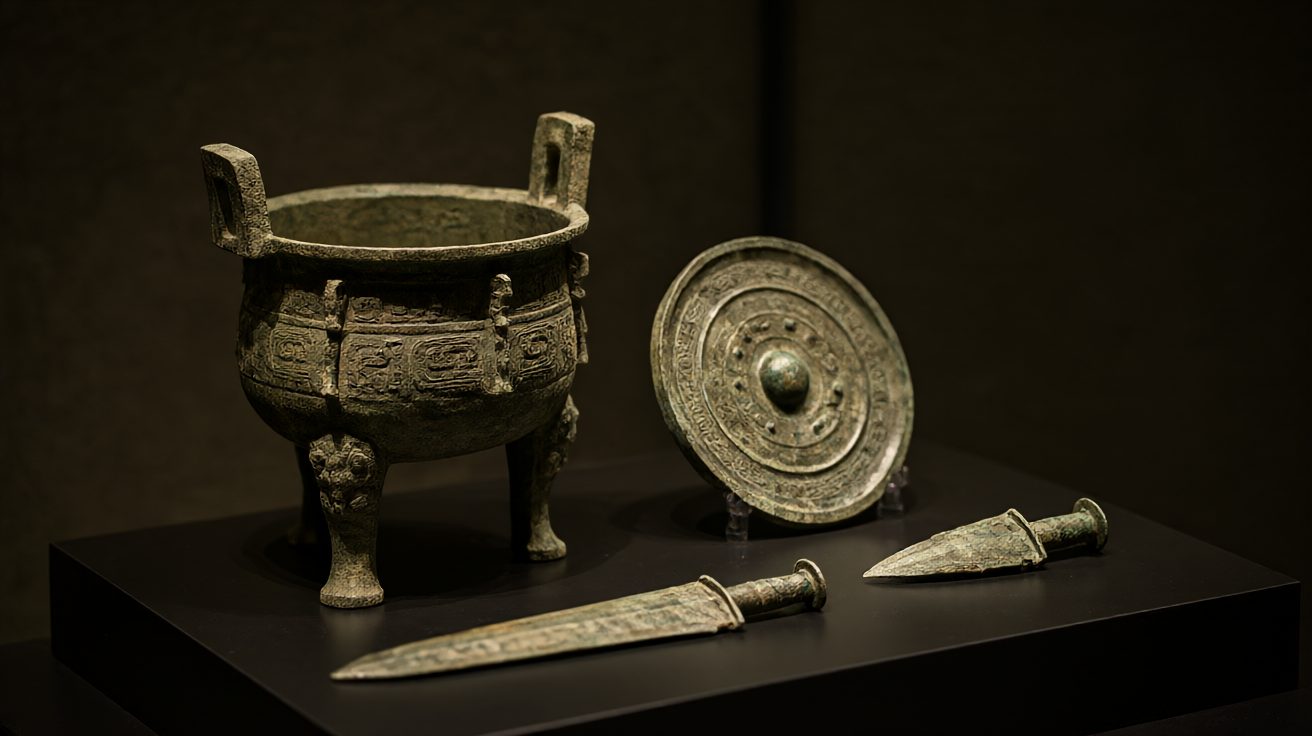
Three things survive him. His poems remain standard reading. His talent-first recruitment and his farming colonies became the template for later regimes rebuilding after war. And the objects of his age are displayed in the National Museum of China, whose permanent galleries hold the period's weapons, bronze vessels and tomb figures.
He was not the only writer in his family. With his sons Cao Pi and Cao Zhi he is counted among the "Three Caos" of Jian'an, and the plain, grave style they shared gave later criticism the term "Jian'an style" (Jian'an fenggu). His poems of war and wine sit alongside his son Cao Zhi's famous "Seven-Steps Poem," and the family is studied today as a single literary achievement.
For a traveller, the quickest way to meet him is through his name. In Chinese the surname comes first, so "Cao" is the family name and "Cao" is also the given name — an easy point of confusion for English speakers. See our guide to Chinese names in pinyin order for the rule, and how the same system renders other single-syllable names you will meet on the road.
Frequently asked questions
Did Cao Cao really have 72 tombs? No. A sealed tomb at Xigaoxue, Anyang was excavated in 2009. Bronze inscriptions reading "King Wu of Wei" and a frugal layout matched his burial orders. Mainstream archaeologists widely accepted it by 2014, though a few scholars still question it. The 72-tomb story is later folklore spread by the novel.
Was Cao Cao a villain or a capable ruler? The standard history calls him "an extraordinary man and a great talent." He unified northern China, rebuilt agriculture after war, and recruited officials on ability. The villain image is the invention of the fourteenth-century novel, not the third-century record.
What is Cao Cao's most famous poem? "Short Song" (Duan Ge Xing) and "Looking at the Sea" (Guan Canghai) are both school texts. Critics value his plain, direct style, a departure from ornate court poetry of the Han.
Where is Cao Cao's mausoleum? At Xigaoxue village, Anyang, Henan. Excavated from 2008 and opened as the Cao Cao Mausoleum Museum in 2023, it sits about a 40-minute drive from downtown Anyang, with the burial chamber replica and recovered relics on show.
Sources
Chen Shou, Records of the Three Kingdoms (Sanguozhi), Basic Annals of Emperor Wu, with Pei Songzhi's fifth-century commentary. Liu Yiqing, A New Account of Tales of the World (Shishuo Xinyu). Account of Cao Man (Caoman Zhuan), quoted in Pei's notes. Luo Guanzhong, Romance of the Three Kingdoms.
Current archaeology and reporting: China Daily on the Cao Cao Mausoleum Museum (2025-03-07). Last checked 2026-11.