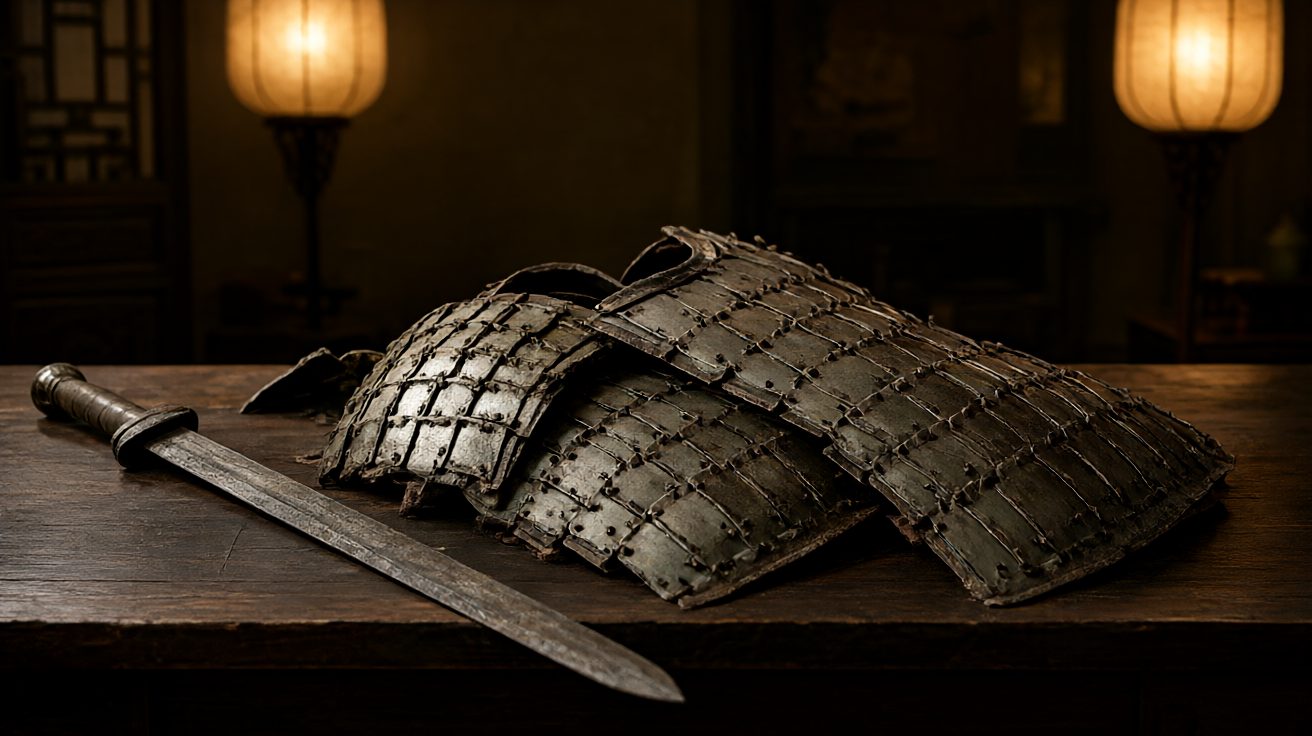
The short answer. There is no standard history of Mulan. She appears in no official dynastic record, and the only early source for her story is a short folk ballad, The Ballad of Mulan, that survives because a Song-dynasty editor happened to collect it. The poem gives her no surname, no dates and no birthplace. Everything else — the surname Hua, the hometown, the reward, even the war she fought — was added later, by playwrights, novelists and, in the twentieth century, a film studio in California.
Who was Mulan
Mulan is the heroine of a poem, not of a chronicle. In the version read in Chinese schools, she is a young woman who takes her elderly father's place in the army, fights on the northern frontier for "ten years," and comes home to find her family waiting. The poem ends with a couplet that became a Chinese idiom: when a hare sits still, male and female look almost alike, so how can anyone tell which is which? The point is that Mulan fooled the army the way the two hares fool the observer.
The poem is short — around sixty lines in its common form — and it reads like a song rather than a report. It opens with the sound of weaving (jiji, jiji, the shuttle going back and forth), then jumps to the draft notice, then to the war, then to the journey home, then to the family reunion. Its charm is in what it leaves out, and in the last four lines, which are the oldest joke about identity in Chinese literature.
What the standard history says
Nothing. That is the honest answer, and it is the reason the story has been so fertile. No official history of the Northern Dynasties mentions a woman warrior named Mulan, and no later court compilation of meritorious women includes her. The Ballad itself is anonymous, undated and unlocated.
The standard scholarly position is that Mulan is a literary figure. She may have been based on a real woman who served in the army, but there is no documentary or archaeological evidence for her. When historians write "the legend of Mulan," they mean precisely this: a story with a poem at its root and no chronicle behind it.
What we do know is when the poem was written down. It survives in the Yuefu Shiji, the great anthology of folk songs compiled by Guo Maoqian in the Song dynasty (960-1279). Guo was collecting a tradition of popular verse that court compilers had ignored. That Mulan was preserved by a folk-song collector, not by a court historian, tells you how she was regarded: as popular culture, not as state history.
Versions of Mulan
Once the poem existed, every later age added its own layer. Four versions matter.
Version one: the Tang poem
The Tang-dynasty poet Wei Yuanfu wrote a longer Mulan Song that expands the ballad into a moral tale about filial piety and loyalty. The story is the same, but the tone is now instructional: Mulan is held up as a model daughter and a model subject. This is the first sign of the story being used to teach a lesson rather than simply to entertain.
Version two: the Ming play
In the late sixteenth century, the dramatist Xu Wei wrote Ci Mulan, a zaju play in which Mulan is given a surname for the first time — Hua — and a hometown. Xu Wei is a great and unusual writer, and his Mulan is witty and self-aware. But the surname Hua is his invention, not part of the ballad.
Version three: the novel
A Qing-dynasty novel, The Romance of Mulan (Mulan Qinv Zhuan), turned the story into a full-length adventure with supernatural elements. Here Mulan is a warrior with divine aid, and the war is given a name and a cause. Scholars date this version to the seventeenth or eighteenth century, long after the poem.
Version four: the film studio
Disney's 1998 animated Mulan and the 2020 live-action film, starring Liu Yifei, made her a global figure. The films change a great deal — a dragon companion, a matchmaking scene, a battle with the Huns — and they are the version most Western audiences now meet first. That the films are merely the newest layer of a fifteen-hundred-year-old story is worth remembering.
Sorting fact from legend
Three common claims need checking.
The surname Hua. Not in the ballad. It appears first in the Ming play and later. Different regions attach different surnames — Hua, Mu, Zhu — and the very fact that they disagree is the strongest sign that none is original.
The hometown. Many places claim her. The best known are Huangpi in Wuhan, Hubei, and Yucheng in Shangqiu, Henan, which has a Mulan Temple. There are also claims in Bozhou, Anhui, and Yan'an, Shaanxi. When several towns each claim the same person and each can show a temple, the usual conclusion is that the person was honoured widely rather than born in one particular place.
The war. The ballad says only that she fought on the northern frontier. Later versions name the enemy, but the names change with the teller. The safest reading is that the poem comes from the era of the Northern Dynasties, when states on the northern frontier faced raids from the steppe, and that Mulan belongs to that world of border garrisons.
The archaeology is silent, which is a result in itself. No tomb, no inscription, no coin and no weapon has ever been credibly connected to a woman warrior named Mulan. Given how many towns claim her, the absence is striking.
Why Mulan still matters
Two things make her durable. First, the poem is a school text in China, and the idiom it produced is in daily use: pūshuò mílí, "so tangled you cannot tell them apart," said of anything confusing or ambiguous. That single phrase carries Mulan's story into ordinary conversation. Second, she is the clearest example in Chinese literature of a woman proving herself in a role her society had closed to her — and the story has been retold in every generation since, right up to the films.
For a traveller, the name is the entry point. In Chinese the surname comes first, and the puzzle of "Hua" — a surname added by a Ming playwright, not by the poem — is a useful illustration of the rule in our guide to Chinese names in pinyin order. And if you want to hear the idiom in use, our useful Mandarin phrases for travelers will get you started.
Frequently asked questions
Did Mulan really exist? No standard history mentions her. The only early source is an anonymous folk ballad first written down in the Song dynasty (960-1279). Historians treat her as a literary figure who may have been based on a real woman, with no confirming record.
What is Mulan's surname? The ballad gives none. "Hua" was added by the Ming playwright Xu Wei in the sixteenth century, and some traditions use "Mu" or "Zhu" instead — disagreement that shows the surname was a later addition.
Where was Mulan born? Unclear. Huangpi in Wuhan, Hubei, and Yucheng in Shangqiu, Henan (with its Mulan Temple) both claim her, as do Bozhou in Anhui and Yan'an in Shaanxi. Multiple claims usually mean a wide cult rather than one birthplace.
What does the idiom from the poem mean? The closing couplet about the two hares produced pūshuò mílí, "too tangled to tell apart," used of anything confusing or ambiguous. The poem's point is that Mulan fooled the army the way the hares fool the eye.
Sources
The Ballad of Mulan (Mulan Shi), anonymous, collected in Guo Maoqian's Yuefu Shiji (Song dynasty, 960-1279). Wei Yuanfu, Mulan Song (Tang). Xu Wei, Ci Mulan (Ming). The Romance of Mulan (Qing).
Current reporting and culture: China Daily on the Mulan story in a new picture book (2020-09-01) and China Daily Culturepedia. Last checked 2026-11.