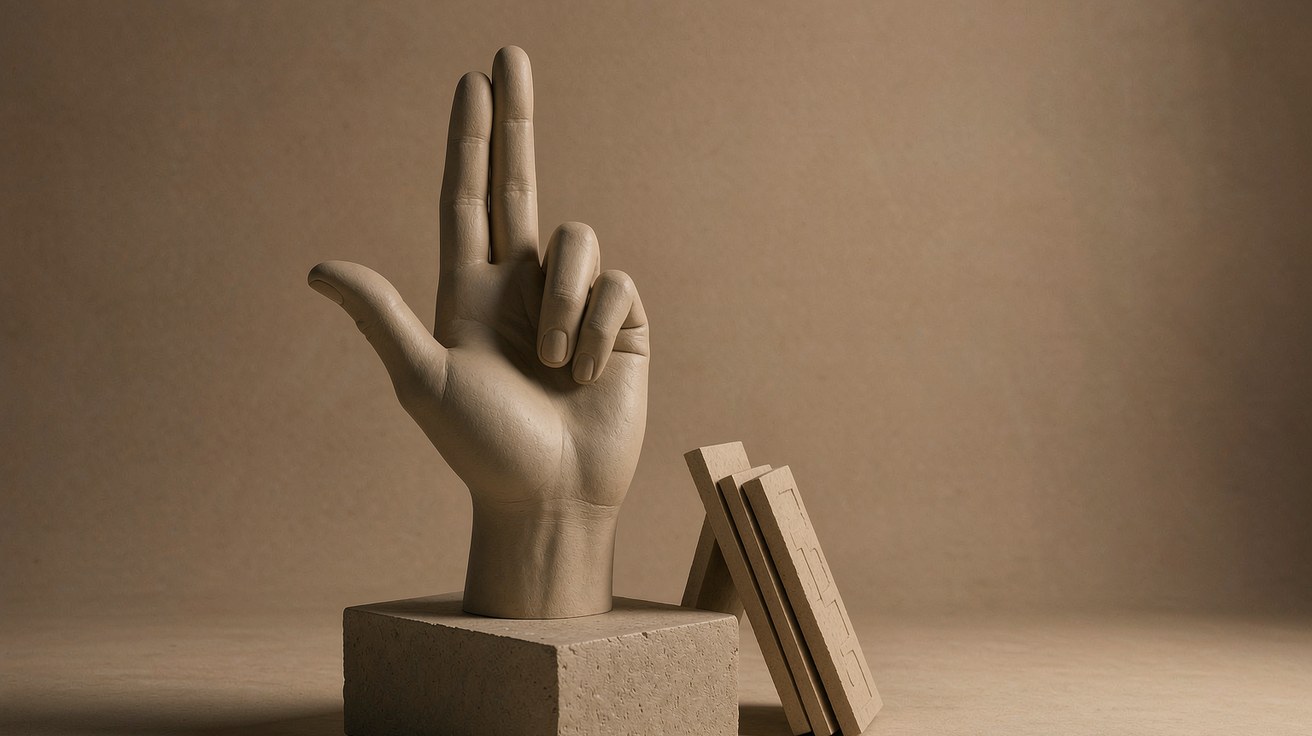
Chinese hand signs for numbers are the quickest way to settle a price when talking is impractical: a stall on the far side of a crowd, a counter behind glass, a workshop too loud for speech. The system takes about ten minutes to learn and one afternoon to trust, because two of the ten signs change meaning depending on where you are standing.
This guide covers the shapes for zero through ten, the regional split that flips 7 and 8, and the rules that keep a misread gesture from turning into a wrong payment. It describes usage, not etiquette folklore, and it treats the shapes as convention rather than as a codified standard.
What the signs are actually for
In daily use the gestures carry quantities and prices. A fruit seller holds up three fingers and says a number; a noodle shop cashier flashes a shape to confirm the total; a group leader counts heads before boarding. They also appear in settings where sound is blocked rather than absent: through a bus window, across a counter, at a distance where a spoken number would be lost.
They are not a language and are not taught as one. Nothing about the system encodes grammar, and it cannot express a sentence. That limits what it can do: it moves a number from one person to another, and everything else — what the number refers to, whether it includes tax, whether it is per person — still has to come from context or from a written total.
For a visitor the practical value is narrow but real. Prices in busy markets are often quoted at speed, and a number that is heard wrong is a payment that goes wrong. The gestures give a second channel for the same information, which is why they are worth learning even when your Mandarin is good enough to order a meal. If you are already ordering at a table through a screen, the number goes into a field rather than into the air, and the signs matter less.
Zero to five: the easy half
The first six numbers are simple finger counting and need almost no explanation. The only wrinkle is 3, which has more than one accepted formation; both are read as three, and either is accepted.
| Number | Pinyin | Usual hand shape | What it carries |
|---|---|---|---|
| 0 | líng | Thumb and index forming a circle, or a closed fist | Rare as a gesture; say it or write it |
| 1 | yī | Index finger raised | One portion, one ticket, one person |
| 2 | èr | Index and middle fingers raised | Two of anything; also a photo pose |
| 3 | sān | Any three adjacent fingers, often index–middle–ring, sometimes thumb–index–middle | Three people, three cups, three yuan |
| 4 | sì | Four fingers up, thumb folded across the palm | Four seats, four items |
| 5 | wǔ | Open hand, all five fingers | Five yuan, five portions |
Two notes on this half. First, a raised index finger is also how people point, so keep it aimed at the object or the price board rather than at a person; a finger held up in someone’s direction reads as a gesture at them, not at a number. Second, an open hand can mean five or can mean stop; in a market the setting usually settles it.
Six to ten: where the shapes begin
From six upward the hand stops counting and starts drawing. Each sign is a picture of something the number resembles, which is why they are easier to remember than to derive.
| Number | Pinyin | Usual hand shape | The shape it borrows |
|---|---|---|---|
| 6 | liù | Thumb and little finger extended, middle three folded | A telephone handset |
| 7 | qī | Thumb, index and middle fingertips brought together | Three fingers pinching a point |
| 8 | bā | Thumb and index extended, the rest folded | The character 八, or a letter L |
| 9 | jiǔ | Index finger bent into a hook | A hook, one short of ten |
| 10 | shí | A closed fist, or two index fingers crossed | The crossed pair draws 十 |
The mnemonics that work are subtraction and picture-making: 9 is a hook one finger short of ten, 8 looks like the written character, 6 looks like a phone. Treat the table as convention rather than codification — these are the shapes you will meet most often, and households differ on how they form 3 and on whether 10 is a fist or a cross.
Why 7 and 8 get confused
Seven and eight are the pair that causes real trouble, because in at least one province the two shapes are used in the opposite order. A 2013 report on the education channel of People’s Daily (人民网) described the split directly: in most regions, 7 is made by bringing the thumb, index and middle fingertips together, and 8 by extending the thumb and index finger. In Fujian, the report said, the shape that elsewhere means 8 is used for 7, and 8 becomes thumb, index and middle extended.
The report framed this as folk usage rather than as a rule, and quoted users describing the mismatch as a source of confusion when they travelled outside their own province. That framing matters for how you read the table above: the shapes hold within a region and drift across regions, which is not something a dictionary can settle.
The practical rule follows from that. For 1 through 6 and for 9, a gesture alone is usually enough. For 7, 8 and 10, add the spoken number: qī for seven, bā for eight, shí for ten. One syllable removes the ambiguity that a hand cannot.
Zero, ten and the closed fist
The closed fist is the second ambiguity, and it is not regional — it is structural. A fist can stand for 10, and it can stand for 0, and in a price conversation the two are far apart. The circle made with thumb and index is offered as 0 by some speakers, but it is not universal: plenty of people simply write the figure instead.
The safe procedure is to avoid gesturing zero at all. Say líng, or write the figure, or show the total on a screen. Where a fist is used for ten, pair it with the crossed-finger version or with the spoken word, so the other person has two signals instead of one.
This is not Chinese Sign Language
Chinese Sign Language is a full language with its own grammar and vocabulary, used by Deaf communities in China; it is not a set of number gestures and it is not a pantomime aid for hearing travellers. The market signs described here belong to hearing commerce and carry only quantities. Assuming a Deaf shopkeeper will read them, or that they amount to sign language, is a common mistake: if a conversation needs signing, use a phone screen and typed text instead.
How to confirm an amount without a scene
Three checks remove almost all risk, and each takes a few seconds.
Say and show at the same time. Speak the number while making the sign. Two channels that agree are unambiguous; two channels that disagree tell you immediately that the gesture is being read differently from the word.
Put the number on a screen. Type the amount into a calculator or the payment app’s amount field and turn the phone around. This works when pronunciation fails, when the accent is unfamiliar, and when the sign itself is the disputed part. The same habit applies to quantities: type “3” rather than holding up fingers across a counter.
Pay against a displayed total. Where a till, a scale or a QR screen shows the amount, pay the displayed figure rather than the gestured one, and check the number before confirming the transfer. In a market where nothing is displayed, agree the total first and then pay, so the gesture is confirmed twice.
Mistakes worth avoiding
Gesturing a price before it is agreed. A raised hand can read as a counter-offer. Ask the price, then confirm it; do not open with your own number unless you intend to bargain.
Using 7 or 8 alone for money. This is the one pair with documented regional reversal. Say the word, or write the figure.
Reading a fist as zero. A fist is more often ten. If zero matters, say it.
Pointing a raised index finger at a person. The index finger carries 1 and 9 and also does the pointing; aim it at the goods.
Assuming one region’s shapes travel. The signs are stable locally and inconsistent nationally. When a shape is not recognised, switch to writing rather than repeating it more emphatically.
If the other person misreads you
Correct by substitution, not by repetition. Make the same number a different way — spoken word, then written figure, then phone screen — and the misunderstanding resolves without either side having to explain the gesture system. Repetition tends to be read as insistence on the wrong number, which in a price conversation is worse than the original error.
One last framing point. These gestures are a convenience for commerce, not a cultural test. A visitor who says the number and shows a screen is usually understood anywhere; a visitor who masters the ten shapes will occasionally still be misread in Fujian. Learn them for speed, and keep a written number as the fallback.
Rules of this kind — what is fixed by a calendar or a custom, and what merely varies — run through the rest of the site’s culture coverage, from festival dates to table manners; the culture hub collects them. If you are ordering and paying at a table, the numeric route is described in QR code ordering in China, and the seating and toasting conventions that decide who speaks first are in Chinese dining etiquette.
Source note: the regional split between the 7 and 8 shapes is taken from the 2013 People’s Daily education-channel report linked below, which describes it as folk usage rather than as a standard. No official standard for these gestures was located, so the shapes in this guide are presented as observed convention.
人民网 · 民俗大不同:用手势比划7、8 福建与其他省不同(People’s Daily, 20 August 2013)