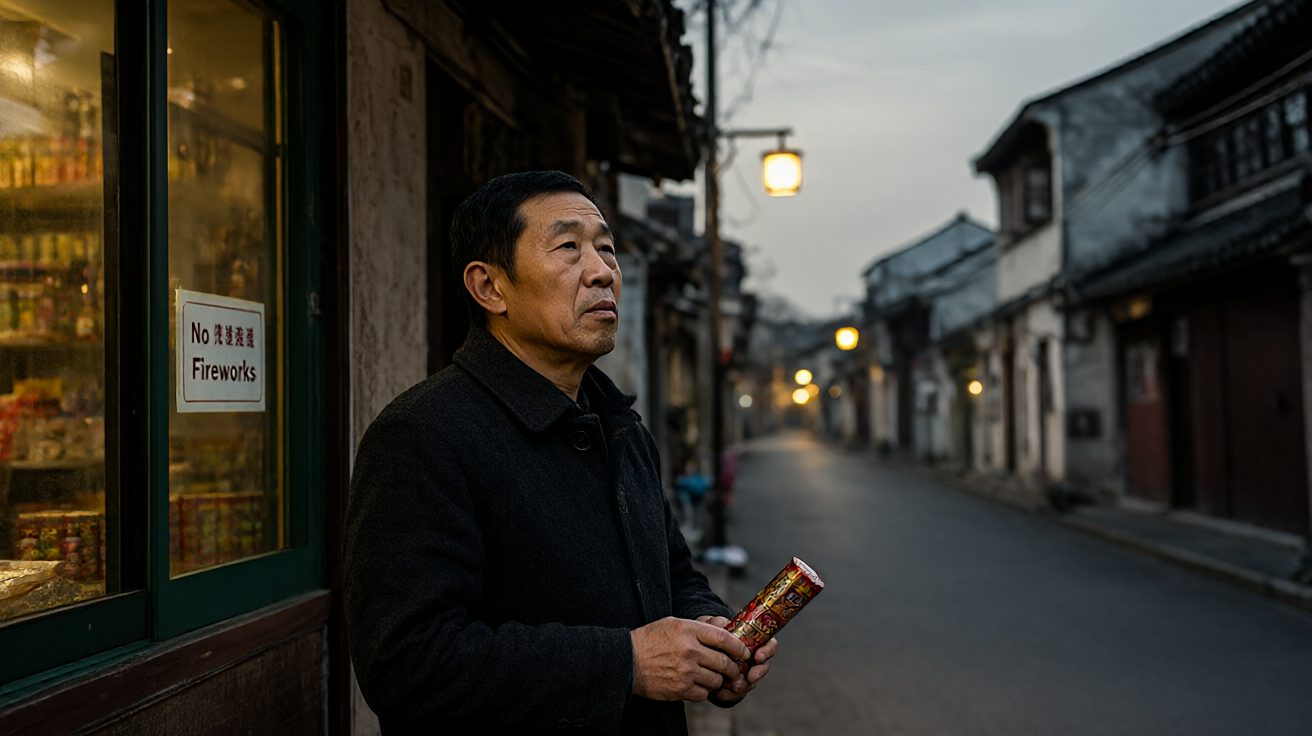
The short answer. Fireworks are legal in mainland China only where local rules allow them. The national State Council decree on fireworks safety bans them outright in seven kinds of place, including stations, airports, hospitals, schools and heritage sites. Setting one off where it is banned draws a fine of 100 to 500 yuan under the text in force as of 2026-11; carrying fireworks onto a train or a plane is a separate offence with a fine of 200 to 1,000 yuan.
Official channels. gov.cn — State Council Decree No. 455 — the full text governing the sale, transport and setting off of fireworks; gov.cn — 2027 public holiday notice — the official Spring Festival dates for 2027. Last checked (2026-11) · Source: gov.cn.
The decree runs to 46 articles. Articles 8 to 26 regulate producers, wholesalers, retailers and road transport; the articles that decide a visitor’s evening are 27 to 31, with the penalties in 41 and 42. A local layer sits over all of them, and that is the layer which changes from city to city.
What the national rule covers
Article 2 applies the decree to production, sale, transport and setting off. Article 3 then places production, sale, transport and any large fireworks display under a licence system: without a permit, no unit and no individual may make fireworks, sell them, move them or stage a display. A stall selling fireworks without a retail permit is therefore not offering a grey-market version of a legal product; it is trading outside the licence system altogether.
A licensed shop is a different thing on paper as well as on the street. Its retail permit has to name the operator, the address, the trading period, the types of firework on sale and the quantity the shop may hold (Article 19). If a seller cannot say what the permit covers, that is the moment to walk away.
Seven kinds of place where fireworks are banned nationwide
Article 30 lists the places where setting off fireworks is prohibited across the country, on any date and in any weather. The list is short enough to read before you pick a spot.
| Entry in Article 30 | What it covers |
|---|---|
| Protected cultural-relic sites | Sites carrying protected status, such as listed temples, palaces and old quarters |
| Transport hubs | Stations, ports and airports, plus the safety zones along railway lines |
| Flammable and explosive facilities | Sites that produce or store flammable or explosive goods |
| Power transmission facilities | The safety zones around them |
| Medical, childcare and school sites | Hospitals, kindergartens, primary and secondary schools, and homes for the elderly |
| Key fire-prevention zones | Hill, forest and grassland areas designated as key fire-risk zones |
| Anything the local government adds | Places designated by a county-level or higher government |
Two entries on that list catch visitors out. "Protected cultural-relic site" is a formal status, and a temple, a palace or an old quarter that carries it falls inside the entry: a firecracker in a listed courtyard is a banned firecracker at any hour, including midnight on New Year’s Eve. "Transport hub" reaches the safety zone along a railway line, not only the platform you stand on.
Why your city’s rule matters more than the national one
Article 28 gives governments at county level and above the power to restrict or prohibit fireworks by time, by place and by type. That one sentence sits behind the confusion a visitor meets. The national text sets a floor; each city, district or county adds a season, a boundary, a product list and a set of hours over it. A city that permits fireworks may permit them only between certain dates, and sometimes only in open areas outside the built-up core.
The city notice is a public document, and it is dated. Search the city government portal for 烟花爆竹 together with 燃放, and read the notice for the current season rather than the first result: a notice from an earlier year is not the rule in force now. Where a city publishes nothing about one particular spot, that silence is not permission — the Article 30 list still applies, and staff on site can still stop you.
What you can legally buy
Two articles shape the retail shelf. Article 16 bars wholesale sites from urban districts and requires retail outlets there to be sited under a controlled plan rather than wherever a trader likes. Article 20 forbids a retailer from selling products that national standards require professional crews to set off. The consumer range is limited by law rather than by shop preference, and the large aerial shells used in public displays are not part of it.
The same article closes the usual workaround. A retailer may not buy or sell fireworks that were produced or traded illegally, and wholesale firms may not supply the professional-grade stock to retailers. For a buyer the check is simpler than the supply chain: a shop whose permit names its stock is inside the system; a blanket spread on a pavement is outside it.
Trains, planes and post
Article 27 is short and carries no exception. Fireworks may not be carried on public transport. They may not be posted, and they may not be hidden inside checked luggage, parcels or mail. Article 41 attaches the consequence: the public security authority confiscates what it finds and may add a fine of 200 to 1,000 yuan.
Note the wording — public transport, not rail only. The same article covers the metro, the bus, the train and the flight, and it covers the suitcase as well as the pocket. A box of sparklers bought legally in one city and packed for the trip home is the case the article was written for.
What it costs to set one off where it is banned
Article 42 sets out two consequences, and they differ by an order of magnitude. Setting off fireworks in a prohibited place or during a prohibited period, or in any way that endangers public safety or property, is met with an order to stop and a fine of 100 to 500 yuan under the current text (as of 2026-11). Where the same conduct also breaches public-security administration, the authority handles it under that law as well, which is the route to detention rather than to a receipt.
Staging a display is treated separately. Article 33 requires the organiser to apply to the public security authority, which has 20 days to decide, and Article 42 puts the fine for an unlicensed display on the organising unit at 10,000 to 50,000 yuan. The permit belongs to the organiser and the licensed crew, not to the audience and not to the shop that supplied them.
Spring Festival 2027: the dates that set the season
The State Council’s 2027 holiday notice places Spring Festival from Friday 5 February, New Year’s Eve (除夕), to Saturday 13 February, nine days in all. Sunday 31 January and Sunday 14 February are worked as make-up days, which is why travel peaks sit on either side of the holiday rather than inside it.
The night of 4 to 5 February is when the new year is welcomed, and it is the hour when local rules are tested hardest. What happens across those days — the reunion dinner, the couplets, the red envelopes, the temple visit on the first morning — is set out in the Spring Festival guide. What this page adds is the part that is law rather than custom.
Common misconceptions
Five assumptions worth dropping before the first week of February.
- "If a shop sells it, I can set it off." Sale and setting off are governed by different articles. Article 3 controls the shop; Articles 28 and 30 control the park you carry the box to. A legal purchase says nothing about the place.
- "Small fireworks are exempt." The national ban list works by place, not by size. Article 30 carves out no small-product exception, and a sparkler in a hospital courtyard sits inside the same prohibition as a shell.
- "A balcony is private, so it is fine." The decree does not mention balconies, and that silence is not permission. Article 31 requires fireworks to be set off according to the instructions on the product and forbids any method that endangers public safety; a city notice may ban rooftops and balconies outright.
- "I can put a few in my suitcase." Article 27 bars fireworks from public transport without exception, and Article 41 makes carrying or concealing them a matter of confiscation plus a fine of 200 to 1,000 yuan.
- "A display permit means anyone can buy the big shells." The permit under Article 33 goes to the organising unit and its licensed crew, while Article 20 keeps those products off the retail shelf entirely.
What-if cases the text actually settles
Three situations are worth checking against the articles rather than against local habit.
- A wedding or a shop opening. The decree contains no ceremony exemption. The place and time rules in Articles 28 and 30 apply to a wedding firecracker exactly as they apply to a New Year one.
- Your own display. A private display large enough to count as a fireworks show needs the permit in Article 33 and a licensed crew; without them the fine in Article 42 runs from 10,000 to 50,000 yuan on the organising unit.
- Children setting them off. Article 29 puts the duty to teach minors how to set off fireworks safely on their guardians, which is a duty to supervise rather than a permission for the child to handle whatever is on sale.
What this page does not settle
Two things sit outside the national text. The first is the city rule itself: the decree delegates the season, the boundary and the product list, and no single page can carry them for every city. The second is the spot in front of you — a courtyard, a river bank, a hotel car park — where the answer comes from the local notice and from the staff on duty. Where neither has been checked, the reading the articles support is the strict one: the Article 30 list applies everywhere, and the case for a place being permitted sits with whoever is holding the lighter.
Official channels
Two sources carry everything above, and both are published by the central government. State Council Decree No. 455 is the full text of the fireworks regulation, in force since 21 January 2006; Articles 2, 3, 16, 19, 20, 27, 28, 29, 30, 31, 33, 41 and 42 are the ones quoted on this page. The 2027 public holiday notice fixes the Spring Festival dates. Both were read in November 2026. This page links to no ticket seller, reseller or agent. The city notice you need is published by the city itself, on its own government portal.
The wider set of festival and custom rules this one belongs to sits in the site’s China culture section.