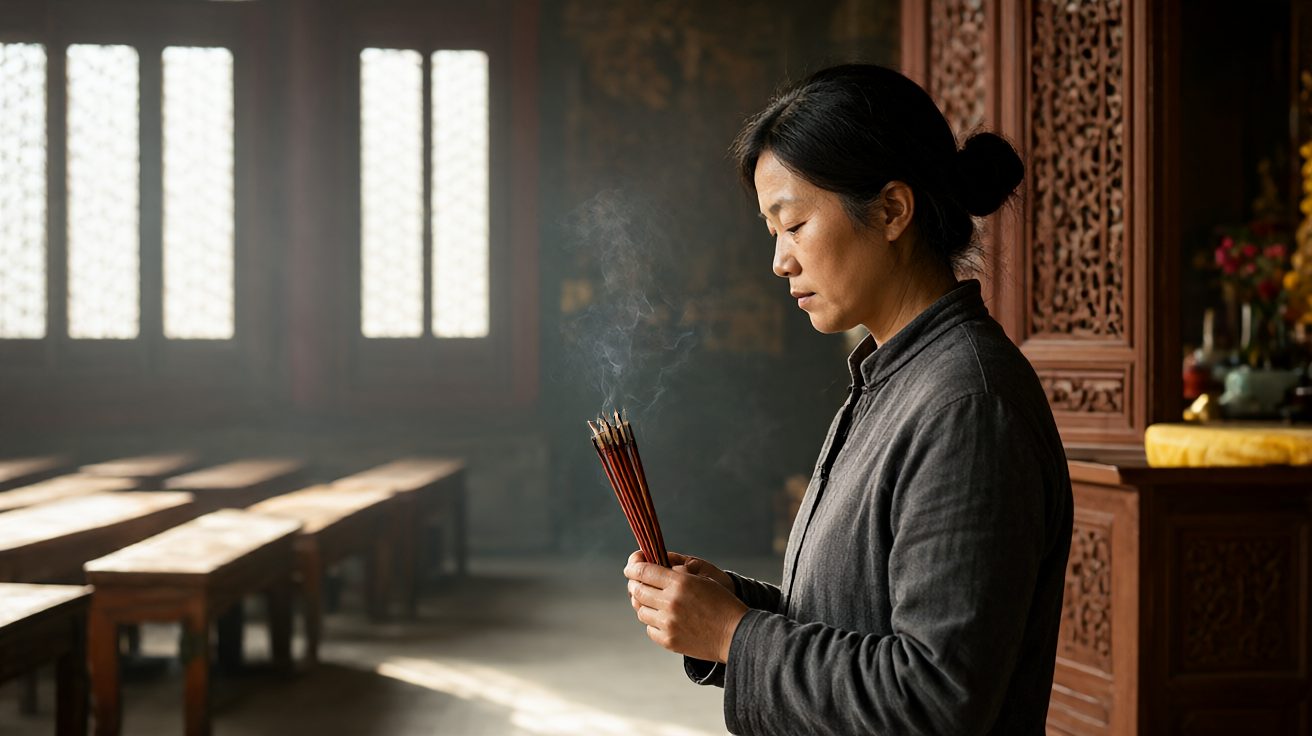
Yonghe Temple in Beijing publishes its visitor rules in two short notices, one for opening hours and one for tickets. Between them they answer the practical questions a first-time visitor asks: when the gate shuts, what the ticket costs, how many sticks of incense to carry, and why the halls are closed to cameras. The answers are specific, and several of them are not what visitors assume.
This page works through those rules in the order a visitor meets them, and marks the two questions the temple publishes nothing about. Every figure below comes from the temple's own pages, read in November 2026. Notices of this kind get revised, so treat the temple's pages as the authority and this page as a map of what to check before you travel.
Two seasons, two closing times
Yonghe Temple runs two timetables rather than one. From 1 November to 31 March it opens at 09:00 and closes at 16:30, with ticket sales stopping at 16:00 and the site cleared at 16:30. From 1 April to 31 October the day stretches by 30 minutes: 09:00 to 17:00, last ticket at 16:30, cleared at 17:00.
The half hour matters more than it looks. The 16:00 and 16:30 figures are cut-offs for buying a ticket, and the temple states separately that the site is cleared at closing time. An arrival at 16:05 in winter is an arrival after the ticket window has shut, whatever the courtyard clock suggests. Plan the visit around the ticket cut-off, not around the closing time.
There is no evening opening and no weekly late night; the two seasonal timetables are the whole published schedule. Heavy days come with separate reception notices, and the temple posts those ahead of the Spring Festival and the New Year holiday on its news page. A visitor planning a temple stop across a public holiday should read the dated notice first and the two standing notices second.
What the ticket costs, and who does not pay
A full ticket is 25 yuan and a half-price ticket is 12 yuan as of 2026-11, and the temple's ticket notice is where a change would show up first. The half-price list is narrower than the word student suggests. It covers minors from 6 to 18, students in full-time programmes at undergraduate level and below, visitors aged 60 and over, and Beijing residents holding a social-security benefit certificate. Postgraduate students, adult education, evening courses and correspondence courses are named in the notice as excluded.
Free admission is a longer list, and it is checked at the gate rather than bought. It covers children aged 6 or under, or 1.2 metres or shorter, on production of a document; holders of a second-generation disability certificate; retired veteran cadres holding a senior-cadre retirement certificate for pre-1949 service; serving and retired military personnel, civilian personnel of the armed forces, and family members of martyrs and deceased service members holding the corresponding certificates; fire and rescue personnel and cadets; and holders of a Beijing civil-affairs preferential card. On 1 August, Army Day, family members of serving personnel enter free with supporting documents.
Those categories decide what happens at the window. A visitor who arrives expecting a student discount and holds a postgraduate card is sold a full ticket instead of the reduced one, and the same applies to a part-time degree. Reading the list before joining the queue is the difference between the two prices.
Booking, and the limits that come with it
Tickets go on sale both at the window and online. The online channel is the temple's own WeChat service account, and it carries three limits that decide how a group has to split up. Each valid identity document may buy one ticket per day, and that ticket admits one person once. One WeChat account may buy up to five tickets per day. The name and identity-number fields are optional for a full-price ticket and mandatory for a half-price one.
Foreign visitors take a slightly different route through those rules. Holders of a passport, or of a Hong Kong, Macao or Taiwan travel document, can buy a full-price ticket online and enter by scanning the booking's QR code at the gate. A half-price ticket for the same visitor cannot be completed online: the temple asks them to bring the original document to the ticket service centre and buy a paper ticket there. A family of four where one member qualifies for the reduced rate therefore ends up in two transactions, one on a phone and one at a counter.
The same notice carries a warning worth repeating. The temple states that it has not authorised any third party to sell or resell its tickets. A ticket bought from an agent, a hotel desk or a resale listing sits outside the temple's own system, and when the QR code fails at the gate there is no booking behind it to appeal to.
Cancelling a ticket you cannot use
An unused ticket can be cancelled from the booking itself. Where the window has passed, the notice directs visitors to the service line instead. Two numbers in that paragraph make the process checkable: refunds are executed within 5 days of the request, and the refund function runs from 06:00 to 21:00. A request made outside those hours waits until the function reopens, and a refund that has not arrived after 5 days is a reason to call the temple's service numbers rather than to book a second ticket.
Incense: three sticks, and the wind rule
The conduct clause opens with a number. Three sticks of incense are described as the appropriate offering, not a bundle. That line settles the question that goes wrong on arrival, because the size of a bundle is exactly the thing people guess at when nothing is written down.
Then the clause takes the fire out of the halls: incense is not to be burned inside them. A separate line covers weather. When the wind is strong, burning stops altogether and visitors are asked to offer the incense without lighting it, so the gesture stays and the flame does not. Smoking is banned in the courtyard, and the clause closes with the two obligations that matter in a compound built largely of timber: protect the relics, and keep the place clean.
Cameras, and what the halls prohibit
The photography rule is one sentence long and narrower than it first appears: no photography and no filming inside the halls. It does not say no cameras on site. Courtyards are not named in the clause, but individual halls and the temple's own museum displays can carry their own signs, so the workable habit is to look at the doorway of each hall rather than to rely on a single blanket permission read at the gate.
Grouping photography with incense burning is practical rather than stylistic. Both bring heat, smoke or a flash into a wooden hall whose paint and textiles are the reason the building is protected in the first place, and the temple's answer is to stop them at the threshold instead of policing them inside.
What the notices do not say
Two questions come up before almost every temple visit, and neither is answered in these notices. There is no published dress code: no clause on shorts, sleeveless tops, hats or shoes. A visitor arriving from a summer itinerary will find no written requirement to change, and equally no written assurance that anything is acceptable. The honest summary is that the temple publishes no dress rule, that a working religious site is not a theme park, and that a light layer to cover the shoulders is the cheapest hedge available.
Nor is there a published bag rule. The site plan numbers 37 points, including the ticket office, a visitor service centre, toilets and a counter selling Buddhist goods, but nothing in the standing notices covers lockers, bag sizes or what may be carried in. A visitor travelling with a large pack has no clause to check in advance, which makes the visitor service centre on that plan the place to ask on the day.
Common misconceptions
- Half price for every student. The notice lists full-time programmes at undergraduate level and below, and names postgraduate, adult-education, evening and correspondence study as excluded. A student card is not by itself a discount.
- Children enter free. Only children aged 6 or under, or 1.2 metres or shorter, are on the free list. A seven-year-old pays the half-price ticket, and above 18 that route closes.
- A reseller is a shortcut past the queue. The temple states it has authorised no third party to sell its tickets, so a resold ticket has no booking attached to it at the gate.
- Indoor photography is fine without flash. The clause bans photography and filming inside the halls and makes no exception for a phone or for a switched-off flash.
- Incense is judged by volume. Three sticks is the published amount. A larger bundle is not a fuller offering under the temple's own wording.
What-if edge cases
You booked a full-price ticket on a passport and now qualify for half price. The online route cannot complete a reduced-rate booking for a passport holder, so the paper ticket at the ticket service centre is the only path, and it needs the original document rather than a photograph of it.
You used all five tickets on one WeChat account. The limit is daily, so the counter reopens the next day. A group of six is better split across two accounts on the day of booking than at the gate.
The wind picks up while you are holding lit incense. Burning is suspended in those conditions and the temple asks for the incense to be offered unlit. The rule comes from the temple, not from the visitor's judgement, so it applies to everyone in the courtyard at the same moment.
You arrive at 16:05 in winter. The last ticket is sold at 16:00 from November to March, so the visit ends at the ticket window rather than in the courtyard. In summer the same 16:05 arrival still clears the 16:30 cut-off, with 25 minutes to spare.
You request a refund at 22:00. The refund function runs 06:00 to 21:00, so the request waits for the morning, and the five-day clock runs from the point the request actually goes through.
A sequence that works
- Check the season first, because 1 November and 1 April move both the closing time and the ticket cut-off by 30 minutes.
- Read the half-price and free lists before paying, and put the qualifying document in the bag you will actually carry.
- Buy through the temple's own WeChat service account, one ticket per document, and keep the QR code reachable offline.
- If anyone in the group holds a passport and qualifies for half price, budget time at the ticket service centre for a paper ticket.
- Carry three sticks of incense, or none, and leave the bundle at home.
- Look at the doorway of each hall before raising a phone, and treat the hall itself as the place photography stops.
These are one temple's rules
A temple is not a museum with an incense burner in the courtyard, and the two publish different things. Booking quotas, ticket categories and the incense clause are set temple by temple, and a page written for one will misdescribe another. What transfers is the checklist: seasonal hours, last-ticket time, reduced-rate list, per-document quota, what the halls prohibit, and what the notice silently leaves out.
For the wider calendar that decides when temples are busiest, our culture section keeps rule-based guides rather than souvenir lists, including the eight festivals and what happens at each. Where the visit is to a state museum rather than a working temple, the National Museum of China's booking and bag rules cover the other half of the same set of questions.
The temple's own pages are the authoritative version of everything above: opening hours and conduct, ticket prices, free and half-price categories, online booking and refunds, and the numbered site plan that marks the ticket office and visitor service centre. Last checked (2026-11) against those pages; hours, prices and quotas may change, so confirm before travelling.