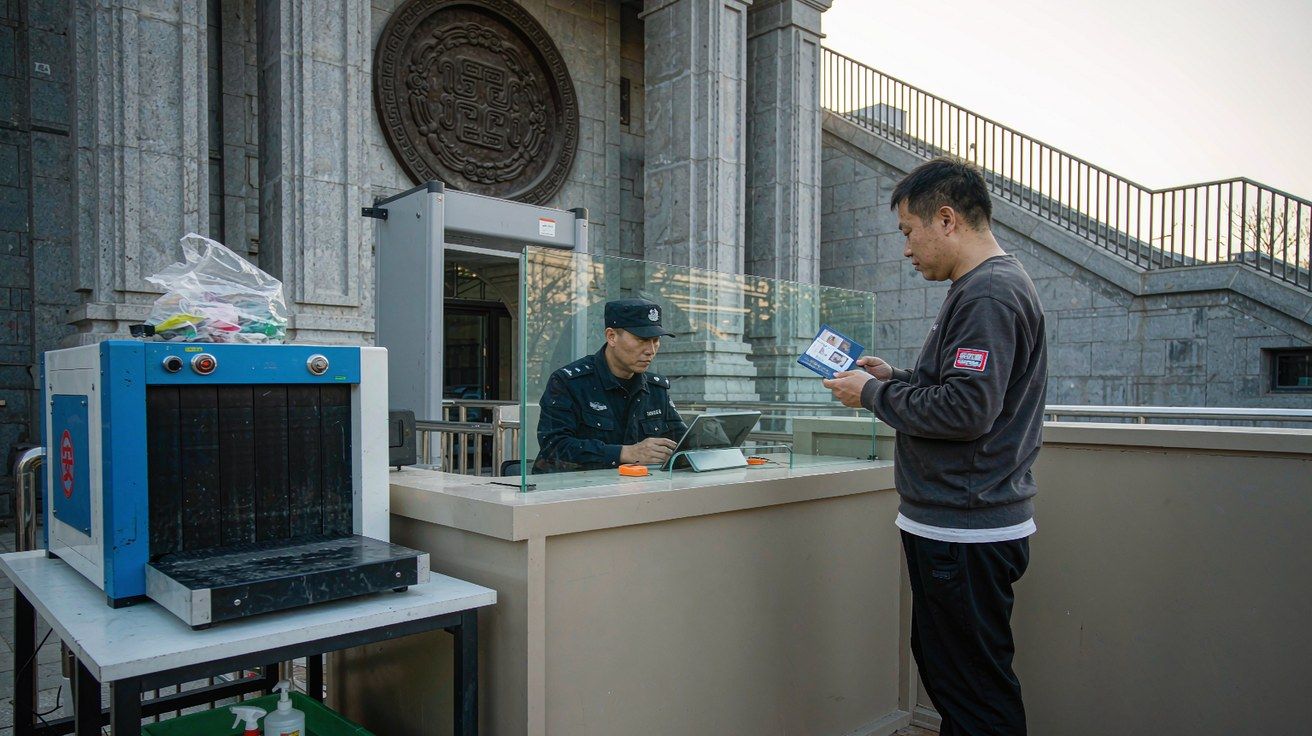
Admission to the National Museum of China is free, but getting through the door is not automatic. The museum on the east side of Tiananmen Square, at No. 16 East Chang'an Avenue in Beijing's Dongcheng District, runs a real-name, timed booking system, and whether you enter is decided by five clauses: the daily release time for tickets, the weekly quota per account, the document you booked with, the prohibited-items list, and the 40 cm line at the cloakroom.
What follows works through those rules in the order a visitor meets them, from opening hours to the photography rules inside the galleries. Every figure is taken from the museum's own published notices, read in November 2026. Notices of this kind get revised, so treat the museum's pages as the authority and this page as a map of what to check before you travel.
Opening hours, and the Monday that catches people out
The museum opens at 09:00 and closes at 17:00, with last entry at 16:00. On Mondays it is closed, with one exception written into the notice: statutory public holidays. Peak season lengthens the day by half an hour, so from 1 June to 31 October the museum stays open until 17:30 and the last entry moves to 16:30.
Two details are easy to miss. The 16:00 figure is a cut-off for entering the building, not an announcement that the galleries are winding down, so a 16:10 arrival ends at the security gate whatever your booking says. And the Monday exception is narrower than it sounds: it covers statutory holidays, not the make-up workdays China uses to stitch long weekends together. A holiday block that runs across a Monday opens the museum; a Saturday converted into a working day changes nothing here, because the museum is open at weekends as usual and still closes on the Monday. China's holiday calendar lists both the holiday blocks and the make-up days, and it is worth reading the two together.
Booking: seven days ahead, one release time, three slots
Bookings open seven days in advance through the museum's website, its official booking mini-program, its WeChat mini-program and its WeChat account. Fresh tickets are released at 17:00 each day, which makes late afternoon the moment that matters. The practical move is to be on the booking page a few minutes before 17:00 on the day your visit enters the seven-day window, rather than to check at midnight and conclude that the museum is full.
A booking is not a day pass. The day is divided into three entry slots: 09:00 to 11:00, 11:00 to 13:30, and 13:30 to 16:00, with the third slot running to 16:30 between 1 June and 31 October. The slot governs entry. Arriving outside it is treated as having no booking, and the gate check fails even though the confirmation is on your phone.
Plans change, and the notice allows for it: a booking can be cancelled until 15:00 on the day of the visit. What it does not allow is treating a cancellation as cost-free. A cancelled ticket still counts against the quotas described below.
The quotas that block visitors who book early
The numbers are small and they accumulate. One account may make one booking per week, for up to five visitors at a time. A single identity document is limited to four bookings a month and one a day. An account may store up to ten frequent contacts, and a contact added today cannot be edited for 30 days.
Read together, those four rules set the shape of a group visit. Five people fit into one booking; a sixth needs a second account, and that account then spends its single weekly booking. A family that books on four separate days for the same trip reaches the monthly ceiling without noticing. And because cancellations still count, a speculative booking held and released later costs exactly what a used one costs.
Missing a visit carries its own penalty. Three accumulated no-shows on one document suspend booking rights for 30 days. If a trip is coming apart, cancelling before 15:00 is the cheaper option by a wide margin.
The document question foreign visitors run into
Booking requires an account verified against a valid identity document, and entry requires the original of the document the booking was made with. For a visitor travelling on a passport, that is where the published notice stops. It states the real-name requirement and the need to bring the original document, but it does not set out a separate passport procedure or publish the list of document types the booking system accepts.
Rather than assume, check the accepted-document list on the booking page before you build a plan around it, and carry the same document on the day. A name that does not match the booking is one of the stated reasons for refusal, alongside arriving without a booking and arriving outside your slot. Children aged 14 or under are booked by an adult and verified together with that adult at the gate.
At the north gate
Entry is at the north gate, by the visitor entrance. Bring the original document used for the booking and the booking confirmation, arrive inside your slot, and expect the document to be matched against the booking. The nearest metro is Tian'anmen East on Line 1, exits C and D.
The notice also sets out a green channel, used inside the booked slot, for visitors aged 60 and over, people with disabilities, active and retired military personnel, families of martyrs, and firefighters. It requires the original booking document, the confirmation, and the document that establishes eligibility. The channel shortens the queue; it does not waive the booking.
What you cannot bring in
The museum publishes a prohibited and restricted items list, and it is enforced at the entrance before you reach the galleries. The categories most likely to affect a traveller:
- Power banks. A single power bank may not exceed 20,000 mAh, and it must carry a legible capacity label and a certification mark. Damaged, wrapped, unlabelled or over-capacity units are refused, and the notice asks visitors to deal with them before arriving rather than at the gate. Using a power bank inside the exhibition halls is separately prohibited.
- Camera support. Floor-standing tripods, sliders and booms are classed as commercial equipment. A selfie stick is allowed only if it extends to 1.3 m or less.
- Food that heats itself. Self-heating meal kits are on the list, and eating and drinking are confined to dining areas rather than the halls.
- Wheels. Luggage carts, picnic carts, scooters, balance boards, bicycles and roller skates are all excluded. Wheelchairs and pushchairs needed by the visitor they carry are not, and the museum says it provides alternative arrangements for people who arrive with electric mobility devices.
- Animals. The list covers all animals, assistance dogs included, and adds that the museum makes arrangements for service animals. A handler should contact the museum in advance rather than negotiate at the door.
- Things that fly or get thrown. Drones, kites, balloons, balls, rackets and skipping ropes all appear on the list.
- Fire and fumes. Lighters, matches, aerosol sprays including sunscreen spray, alcohol and paint are prohibited.
The cloakroom, the 40 cm line and 2 yuan
Anything larger than 40 cm must be deposited, and so must suitcases and trolley bags. The cloakroom is not free: a bag under 30 cm costs 2 yuan, one between 30 and 60 cm costs 5 yuan, and anything over 60 cm, or logged on the museum's property form, costs 10 yuan, charged per item per deposit.
Timing is the part that catches people. Stored items must be collected before 17:00, and nothing is handed back after the museum closes. An item left overnight is charged again for each additional eight-hour period, and anything unclaimed for more than a week is treated as abandoned and destroyed. Replacing a lost claim tag costs 20 yuan. Cash, jewellery and other valuables are not accepted for storage at all.
Photography and behaviour inside the galleries
Photography is allowed in the museum's own displays, with three exclusions that apply everywhere: no flash, no selfie stick, no tripod. Temporary exhibitions are decided case by case under the loan agreement, and where a show cannot be photographed the museum posts signs at the hall entrance and inside the hall. Where a sign says otherwise, the sign wins.
The conduct notice reads like a list of small things and functions as a list of reasons to be asked to leave. Slippers, clothing the notice describes as overly revealing, and visible intoxication are grounds for refusal at the door. Inside, loudspeakers and running are out, as are touching exhibits, leaning over barriers, eating and drinking in the halls, and smoking anywhere in the building. Lectures, performances, interviews, commercial photography and livestreaming all require prior approval, which is the same rule as the camera-support ban seen from the other side.
A sequence that gets you in
- Seven days before the visit, open the booking page a few minutes before 17:00.
- Book everyone in one transaction; five visitors fit into a single booking.
- Take the 09:00 to 11:00 slot if you want a full day inside.
- Leave the suitcase at the hotel. If it has to come, budget the deposit fee and collect it before 17:00.
- Clear the bag of lighters, sprays, self-heating food and any power bank above 20,000 mAh before you queue.
- Carry the original document you booked with, not a photograph of it.
- If the trip collapses, cancel before 15:00 rather than after.
These are one museum's rules
Timed, real-name booking has spread across large Chinese museums, but the details are set venue by venue. Quotas, deposit prices, prohibited items and photography rules all differ, and a page written for one museum will not describe another. The transferable part is the checklist: release time, entry slots, per-document quota, no-show penalty, bag size, power bank limit, camera support. That is the list of questions to put to any museum notice you read.
For the culture behind the objects, our culture section collects the rule-based guides rather than the souvenir lists, including the festival calendar that decides which Mondays count as holidays. If a gallery label names a script style and you want to know what you are looking at, the calligraphy primer explains the five scripts and the tools behind them.
The museum's own notices are the authoritative version of everything above: the visitor booking notice, the prohibited and restricted items list, the cloakroom notice, the photography notice and the conduct notice. The holiday dates behind the Monday exception are in the 2027 public holiday breakdown.