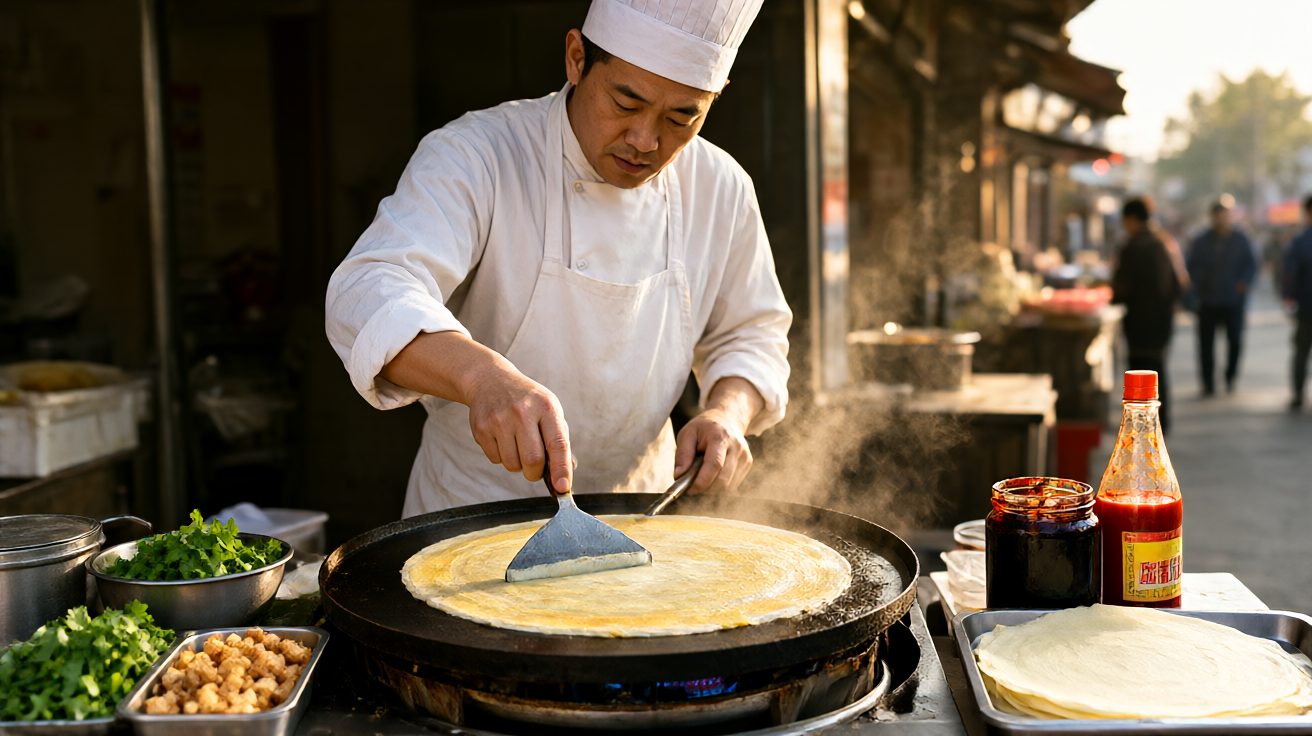
The short answer. Jianbing (煎饼) is a thin batter pancake cooked in front of you on a round griddle, brushed with sauce and folded around a crisp, then handed over in a paper bag. You order by pointing and saying 一个 (yí gè, one). The price lines are governed by State Administration for Market Regulation Order No. 56, in force since 1 July 2022, which requires a marked name, price and unit of pricing.
Official channels. State Council Gazette — the full text of Order No. 56, which sets what a marked price has to show; 12315.cn — the national platform run by the State Administration for Market Regulation for price and consumer complaints. Last checked (2026-11) · Source: gov.cn, 12315.cn.
What a jianbing is, and what it is not
Jianbing is breakfast sold from a cart, a window or a shopfront built around one piece of equipment: a round, flat griddle kept hot from early morning. There is no menu in the restaurant sense, no table and no waiter. The whole transaction happens in the time it takes to cook one, which is why the useful thing to learn is not a recipe but the order of the decisions, and where your chance to make each one falls.
The base is a batter, not a dough. It is ladled onto the hot plate and spread thin with a flat scraper, and that is the step that separates jianbing from the flaky pancakes sold from the same carts: those begin as a pre-formed disc of layered dough lifted out of a stack, while jianbing begins as liquid and only becomes solid on the metal. Both may sit behind the same glass, and both may be called 饼 (bǐng, pancake) on the sign, so watch what goes onto the plate rather than what the name promises.
The names on the cart vary more than the food does. 煎饼 is the general word. 杂粮煎饼 puts a word in front of it for a mixed-grain flour. 煎饼果子 is a name you will see on the version wrapped around a 油条 or a 薄脆. The labels are descriptive rather than regulated, and the same build can appear under two of them, so read the sign as a note about the batter and the filling, and ask if the difference decides your order.
The six steps you will watch, in order
Knowing the sequence is worth more than knowing the vocabulary, because each step is a pause point. Whatever you have not said by the time a step is finished, you have effectively chosen by default.
- Batter. A ladleful goes onto the griddle and is spread into a thin circle. This takes a few seconds and is not the moment to open a discussion about ingredients.
- Egg. An egg is cracked over the still-wet surface and spread across it. At some carts one egg is part of the base price and further eggs are a separate line; at others the egg is an add-on you have to ask for.
- Aromatics. Chopped spring onion (葱, cōng) and coriander (香菜, xiāngcài) are scattered on. This is the first point at which you can say 不要香菜 (no coriander) or 不要葱 (no spring onion), so say it before the hand reaches the bowl.
- The turn. Once the sheet has set it is flipped so the egg side cooks against the metal. After this point the surface is sealed and nothing new can be spread onto it.
- Sauce. A sweet bean sauce (甜面酱, tiánmiànjiàng) is brushed over the cooked side. Chilli sauce (辣椒酱, làjiāojiàng) is added if you ask for it, which makes heat a choice made at the cart rather than a property of the dish.
- The fold. A sheet of 薄脆 (báocuì, a thin fried crisp) or a 油条 (yóutiáo, a fried dough stick) is laid across the middle, and the whole sheet is folded into a rectangle and slid into a paper bag. Add-ons such as lettuce, a sausage or a slice of tenderloin go in at this point.
Read that list backwards as an ordering script: the number first, egg and heat before the turn, crisp and add-ons before the fold, takeaway at the end. Everything you need to say fits inside that window.
The decisions you make in about a minute
Six decisions cover almost every cart, and each one can be settled by pointing rather than by pronouncing a sentence perfectly.
| Decision | What you may be offered | What to say | What to check |
|---|---|---|---|
| How many | One or more, cooked one at a time | 一个 (yí gè), 两个 (liǎng gè) | Whether the price is per piece or per portion |
| Egg | Inside the base price, or charged as its own line | 加一个蛋 (add one egg), 不要蛋 (no egg) | Whether the marked price already includes it |
| Crisp | 薄脆 or 油条, occasionally both | 要薄脆 / 要油条 | Which one is still in stock at that hour |
| Heat | No chilli, a little, or a lot | 不要辣 (no chilli), 微辣 (mild), 多放辣 (more) | Whether the chilli is a separate paste or already mixed |
| Add-ons | Lettuce, sausage, tenderloin, an extra crisp | 加生菜 / 加肠 / 加里脊 | Each add-on's own marked price line |
| Takeaway | Eaten standing, or carried away | 带走 (take away), 打包 (bag it), 切两半 (cut in two) | Whether the bag is already the default |
What the price board has to tell you
Street food is still priced, and pricing in China is governed by a national rule that applies to carts as much as to restaurants: the Provisions on Marking Prices Clearly and Prohibiting Price Fraud, issued as State Administration for Market Regulation Order No. 56, published on 14 April 2022 and in force since 1 July 2022. Five of its articles are worth knowing before you point at anything.
Article 7 requires that goods on sale carry the name of the item, its price and its unit of pricing, and that a service state what it includes and how it is priced. On a cart that means the sign, the sticker or the board should tell you what the thing is, what it costs, and what the cost is measured in — one piece, one portion, or a weight. The last of those is the one visitors misread: 元/个 is a price per piece, 元/份 is a price per portion, and 元/斤 or 元/500克 is a price per weight, so a figure that reads as cheap per piece can be a different order of magnitude once it is per jin.
Article 8 is the sentence to hold on to when the total at the end does not match what you read: an operator may not sell above the marked price, and may not charge any fee that was not marked in advance. An egg, an extra crisp or a bag that costs money has to show up as its own marked line rather than appear for the first time in the total.
Article 9 is the reason you cannot count on English. Prices are to be shown in Arabic numerals with the RMB amount, and other price information in standard Chinese characters; a foreign language may be added alongside, for the operator's own convenience. English is therefore optional rather than obligatory, and the number is the part of the sign that is both legible and binding (Article 9, gov.cn).
Article 12 widens what counts as marking a price: a tag, a board, a printed price list, an electronic screen, or a display of the goods themselves, models or photographs. A photograph with a figure under it is a recognised form of price marking, which is why a picture board can do the work of a price list.
One limit is worth stating plainly, because it decides how to read an empty cart. Article 5 allows market regulators at municipal level and above to designate goods, services, industries or venues that need not mark prices, in view of local trading habits. A cart with no visible tag is therefore not automatically in breach. What you can rely on is that once a price is marked, Articles 8 and 9 apply to it, and that you are free to ask before committing.
When the number you are asked for is not the number you read
Order No. 56 names the pattern directly. Article 19 lists the conduct that counts as price fraud, and the second item on that list is luring a buyer in with a low price and settling at a high one. Refusing to honour a stated price, or putting up a misleading figure, is covered by other items in the same list, and Article 22 provides that breaches of the marking rules are dealt with by the market regulator at county level or above under the Price Law and the accompanying penalty provisions.
The practical sequence is short and needs no argument. Point at the marked price and say the number before the batter goes down. If the total differs, point at the board again and ask 多少钱 (duōshǎo qián, how much). If the answer still differs from what is marked, you have the choice of paying and reporting it afterwards, or walking away before the food is made — which is the reason to settle the price first rather than at the bag.
Paying: two routes, one check
Payment at a cart goes one of two ways: a printed QR code taped to the cart, which opens a transfer page on your phone, or cash. The QR route has a detail that matters more here than in a shop. When you scan a small-merchant code you type the amount yourself, so the figure on the board is the figure you enter, and nobody checks it for you on the way through. Read the board, then type.
Cash has its own rhythm. A cart that has been taking transfers all morning may not keep a float of change, and the person cooking may not be the person holding the money. Both questions have the same deadline — before the first ladle goes down. 可以扫码吗 (can I scan?) and 收现金吗 (do you take cash?) are short enough to ask while you are still deciding about the egg.
Eating it: a paper bag and a few minutes
A cart is a standing purchase, and the bag is the plate. That is the format rather than a defect, and it sets the timing. The crisp is the part that changes fastest: dry and brittle when it goes in, softening as the sauce and the steam from the egg reach it. A jianbing eaten at the corner is a different texture from one carried across two blocks, which is why the sensible order is to buy it where you mean to eat it.
If you want it carried further, say 带走 (dài zǒu, take away) or 打包 (dǎ bāo, bag it) when you order rather than after the fold, and ask for 切两半 (qiē liǎng bàn, cut in two) if you are splitting it, since a folded sheet is awkward to divide once it has been bagged. Oil will mark the paper; nothing about the format is designed to prevent that.
What varies from cart to cart, and how to check each one
Almost everything except the sequence is a local or personal choice, so the honest way to write about it is to give you the questions rather than an average cart that may not exist where you are standing.
- The batter. Wheat flour, or a mix that may include other grains. If you avoid a particular grain, ask what is in it; a sign reading 杂粮 does not have to list the grains.
- The size. A larger griddle makes a larger sheet, and a larger sheet may be priced as two portions rather than one.
- Whether the egg is included. Read the marked lines. An egg listed separately means the base price is without it.
- The crisp. 薄脆 and 油条 are not interchangeable in texture, and whichever is made in smaller batches runs out first.
- The heat. The chilli may be a sauce brushed on, a paste added by spoon, or a jar of pickled chilli you are offered. Ask which.
- The hours. Batter is made in batches and a cart closes when the batch is finished rather than at a posted time, so treat any closing hour you are told as a ceiling.
- The price display. A board, a sticker on the glass, a photographed list, or nothing. The first three are markings you can point at.
- Cash. Ask, and do not assume either way.
What-if edge cases
- No price is displayed anywhere. Ask 多少钱 before ordering, and treat the answer as the price you agreed. Article 5 leaves room for local exemptions, so a missing tag is a reason to ask rather than proof of a breach.
- The board says one figure and you are asked for another. Point at the marked price. If it is not honoured, Article 19's list covers the low-price, high-settlement pattern, and 12315 is the channel that exists for exactly that.
- You do not eat egg. Say 不要蛋. Expect a question back, because the egg is what binds the sheet together and some stalls will say the result falls apart without it. If that is the answer, a different item at the same cart is the honest choice.
- You cannot take chilli at all. Say 不要辣 before the sauce step, and ask whether the sweet bean sauce has chilli in it, because at some carts the two are mixed in the same container.
- The crisp has run out. You will be offered 油条 instead. It is a different texture, chewy rather than brittle, and it is not a substitute to accept blind if the crisp was the point of the order.
- You are given the wrong add-on. This is a made-to-order item, so the mistake is visible in the fold. Say so before it is bagged; after that the practical remedy concerns the price rather than the food.
- The cart is closing. A cart that has run out of batter stops selling whatever the hour. Asking 还有吗 (is there any left?) saves you joining a queue that is only finishing other people's orders.
Common misconceptions
- "The price on the board is the final price." An extra egg, an extra crisp or a paid bag should appear as its own marked line under Article 7, and Article 8 forbids charging anything that was not marked. The rule protects you from an unmarked surcharge; it does not make every add-on part of the base price.
- "The English line is the official name." Article 9 makes the Chinese characters and the numerals the operative marking and treats a foreign language as an addition. Where the two disagree, the Chinese text and the figure are what the rule is about.
- "A photo without a figure is a price." Article 12 lets a photograph serve as the form of marking, but a price still has to be marked. A picture wall with no figures is decoration, not a price list.
- "No tag means the stall is breaking the law." Article 5 lets local regulators exempt categories and venues. Ask, agree a figure, and keep the complaint channel for a marked price that was not honoured.
- "You pay after you eat." This is a pay-first purchase. Article 15's requirement to issue a settlement list before payment applies to services billed after consumption, which is the restaurant pattern rather than the cart pattern.
Official channels
- State Administration for Market Regulation Order No. 56, Provisions on Marking Prices Clearly and Prohibiting Price Fraud, published 14 April 2022, in force 1 July 2022 — full text in the State Council Gazette: gov.cn.
- National 12315 platform, operated by the State Administration for Market Regulation, for price and consumer complaints: 12315.cn.
Last checked (2026-11); the wording quoted here is the text in force as of 2026-11. The regulation is stable; what a cart sells, charges and stocks is not, which is why every check in this guide is one you make at the cart.
Where this sits in the food section
This is the single-item end of the series: one breakfast, bought from one cart, with the pricing rules that apply to it. For the dishes themselves there is the menu decoder; for the general mechanics of ordering without the language there is the ordering guide; and for the evening equivalent of this purchase, with the same stall-by-stall decisions, there is the night market guide. The rest of the cluster sits under the food section.