Last April I spent ¥90 at a four-table Sichuan kitchen in Chengdu with no English menu, no signage, just a chalkboard and a queue of six locals. I ordered by pointing. What I got — 冒菜 (màocài), a spicy broth loaded with pickled greens, beef tripe, and tofu skin — was the best meal I'd eaten that month. This is the reason most lists of the best cities for food in China fall short. They name the cities. They rarely tell you what the ¥60 meal looks like on a Tuesday at 7pm. Here are the ten I'd send a friend to, ranked, with what to actually order, budget figures current as of 2026-10-21, and seven questions I get asked more than once a month.
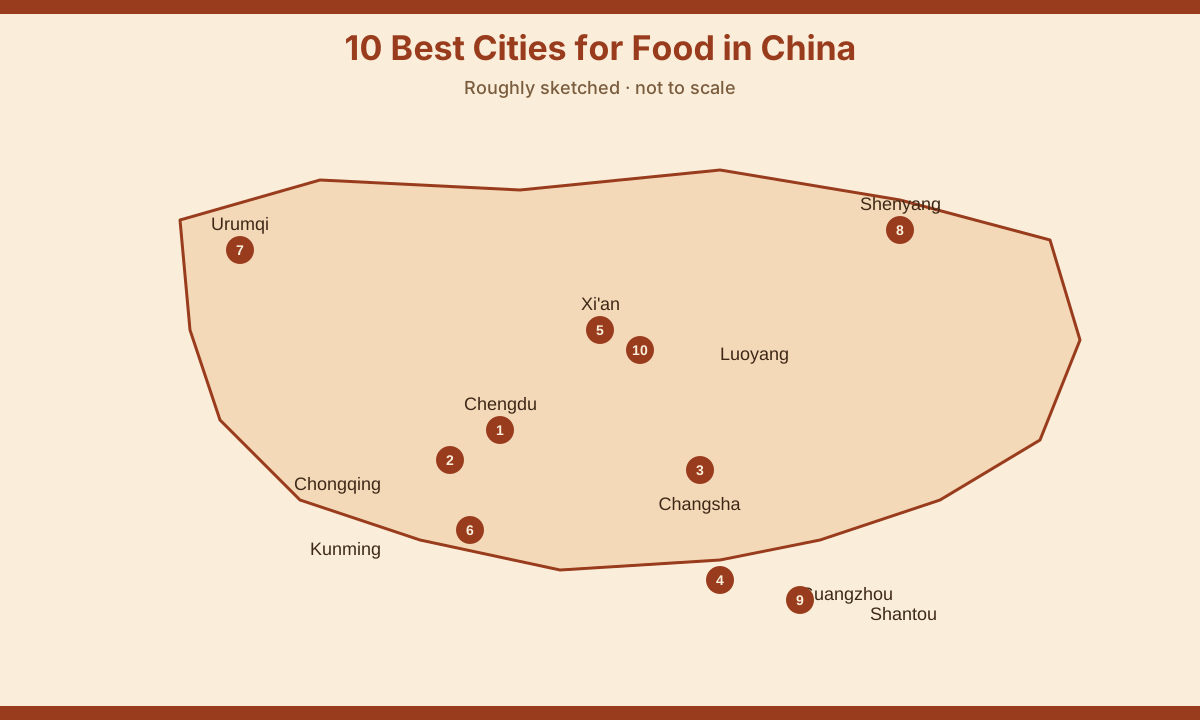
1. Chengdu (成都) — the actual Sichuan answer
Chengdu carries one of China's four UNESCO City of Gastronomy titles (UNESCO Gastronomy Network) and people expect the hot pot cliché. Skip it for now. What actually earns the rank is the 苍蝇馆子 (cángyī guǎnzi) — "fly restaurant," a four-to-eight-table hole where a Sichuan grandmother runs the wok and the chalkboard changes daily. Order 冒菜 (¥18-25, the "solo hot pot" of cold cut pickles and boiled meat in a personal bowl), 串串 (chuànchuàn, ¥1-3 per skewer, grab 15 and count sticks at the counter), and a slice of 蛋烘糕 (egg pancake, ¥6) on the walk home. Chengdu runs cheap and wide: ¥50-80 a day covers three real meals plus dessert. Skip the tourist hot pot chains and you'll find the city's actual best food in the 玉林路 or 建设路 back streets. I wrote about the hot-pot scene in How to Order Hot Pot if you want to come back to it later.
2. Chongqing (重庆) — mountain heat
Two hours north of Chengdu, and it feels like a different country because it was. Chongqing's food runs hotter, oilier, and heavier than its neighbour — the same Sichuan peppercorn, but a mountain-city diet built around fat to fight damp. Order 小面 (xiǎomian, ¥8-12, the small noodles you'd grab for breakfast; the chili oil is what matters), 毛血旺 (maoxuewang, ¥32-48, blood-and-intrals stew with pork tripe, duck blood, and dried chili), and one 九宫格火锅 (jiǔgōnggé huǒguō, ¥70-90 a person, the nine-grid hot pot with different compartments for spice). Chongqing is on the hillside, so restaurants are stacked vertically — the tenth floor might be the first. See Chengdu vs Chongqing for the full comparison. The two are only two hours apart by train; do both in one trip.
3. Changsha (长沙) — where young food lives
Changsha is the youngest food city on this list, in the sense that the food is genuinely built for people under 30 who stay out past midnight. Order 口味虾 (kǒuwèi xiā, ¥80-120 per pound, crayfish in a chili-and-sichuan-pepper broth — a seasonal thing, best June to August), 糖油粑粑 (tángyóu bāba, ¥5-8, a honey-fried glutinous rice ball sold from sidewalk carts), and a 茶颜悦色 milk tea (¥15, the city's signature chain that only exists in Changsha and refuses to expand). Changsha runs ¥40-70 a day, one of the cheapest cities on this list. It's also where the street food culture runs longest into the night — see China Night Markets FAQ for what to expect between 9pm and 2am. I don't recommend Changsha for a family trip, but for a solo or friend trip it's unbeatable.
4. Guangzhou (广州) — breakfast is dinner
Guangzhou's food is not really about the Cantonese cuisine as a whole — that's what you'll find in any Chinatown restaurant worldwide. Guangzhou's specific gift is the 早茶 (zǎochá) morning-tea tradition, sometimes called "yum cha." The ritual is 一盅两件 (yī zhōng liǎng jiàn) — one pot of tea, two small dishes — and it runs from 7am to 11am on weekdays, longer on weekends. Over 400 dim sum varieties are served across the city's oldest teahouses, from 虾饺 (xiājiǎo, shrimp dumplings, ¥14-18 a plate) and 烧卖 (shāomài, pork-and-shrimp dumplings, ¥16-20) to 肠粉 (chángfěn, rice noodle rolls, ¥8-15). Guangzhou is also the natural counterpoint to Changsha's noisy night food: quieter, older, more formal. If you want the wider context, my Cantonese vs Chinese Food piece goes into the family tree. Guangzhou runs the most expensive of the ten at ¥80-150 a day.
5. Xi'an (西安) — the carb capital
Xi'an is the city where one meal is three carbs stacked on top of each other, and the classic 三秦套餐 (sānqín tàocān, ¥20-35) sums it up: 肉夹馍 (ròujiāmó, pork sandwich in flatbread, ¥12-15), 凉皮 (liángpí, cold skin noodles with chili oil, ¥8-10), and 凉粉 (liángfěn, cold jelly, ¥5-8). Add 羊肉泡馍 (yángròu pàomó, lamb bread-in-soup, ¥25-40) and you're in the Muslim Quarter's actual food territory. Xi'an runs ¥40-70 a day, one of the most generous values on this list. I'd point you to the Chinese Menu Decoder if the ordering feels overwhelming — the noodle names alone are a lesson in Chinese. Xi'an is not the hottest city on this list; it's the densest for carbs.
6. Kunming (昆明) — spring and mushrooms
Kunming is the Spring City — year-round temperatures between 8°C and 25°C — and the food reflects that mildness. Order 过桥米线 (guòqiáo mǐxiàn, "crossing-the-bridge rice noodles," ¥35-55, a big bowl of piping broth with raw sliced ingredients you cook at the table), a box of 鲜花饼 (xiānhuā bǐng, ¥10-15, rose-petal-flower cake to take home), and — if you're there between July and October — 野生菌火锅 (yěshēngjūn huǒguō, ¥120-200, wild-mushroom hot pot with dozens of foraged species). The mushroom season is real, not a marketing story; I went in early September 2025 and the shops closed out by early October. Skip Kunming in January — the city's cold is dry but the hot pot menus shrink. Kunming is the city most English-language travel guides under-rank for food.
7. Urumqi (乌鲁木齐) — Silk Road lamb
Xinjiang's capital is the least tourist-friendly city on this list, which is exactly why it's on it. Order 大盘鸡 (dàpán jī, ¥55-80, "big plate chicken," a whole chicken braised with potatoes and chili oil, finished with a mountain of hand-pulled noodles), 拌面 (bànniàn, ¥15-25, hand-pulled wheat noodles with stir-fried toppings — this is the real Xinjiang dish, not the hot pot version), and 羊肉串 (yángròu chuàn, ¥5-8 per skewer, lamb kebabs from the open air). Urumqi is where Central Asia's cooking meets the Sichuan peppercorn on the other side of the map. I've eaten Xinjiang cooking in three cities and Urumqi is the only one where the lamb skewers actually taste like the region. Skip the tourist 大巴扎 if you can; the real food is in 二道桥's back streets. See Lonely Planet's China food guide for a broader regional map.
8. Shenyang (沈阳) — cold country cooking
Shenyang is the Northeast food capital, and Northeast food is the least represented in English travel writing. Order 烧烤 (shāokǎo, ¥60-100 a person, the open-air barbecue — beef, lamb, chicken, corn, tofu, skewers all on one grill for two hours), 锅包肉 (guōbāoròu, ¥28-40, sweet-sour crispy pork cutlet, the Northeast signature that's completely different from what you'd find in Chengdu), and 炸酱面 (zhájiàngmiàn, ¥15-25, sesame bean paste noodles — Shenyang's version is a Northeast variant, not the Beijing one). Shenyang runs ¥40-70 a day and the food is denser than the price suggests. The winters here are brutal — -20°C in January — but that's when the barbecue gets better, not worse. Shenyang is the city where you eat warm food for nine months of the year.
9. Shantou (汕头) — sea and beef
Shantou, in the Chaoshan region of Guangdong, is where Cantonese food goes to get more specific. This is 潮汕 (Cháoshǎn), a whole sub-cuisine built around fresh seafood and hand-cut beef. Order 牛肉火锅 (niúròu huǒguō, ¥120-180 a person, hand-cut beef hot pot where the meat is sliced from a whole cow on-site and cooked for 8-15 seconds per cut), 生腌 (shēngyán, ¥25-40, raw-marinated seafood in garlic-and-soy — eat only at shops that turn stock over daily, this is a reputation game), and 粿条 (guǒtiáo, ¥12-18, flat rice noodles in a clear beef or pork broth). Shantou is the least known city on this list and the one I'd most defend. Skip it only if you're done with seafood and beef. Guangzhou gets the credit; Shantou does the actual cooking.
10. Luoyang (洛阳) — Tang dynasty on a plate
Luoyang was the capital of the Tang dynasty from 618 to 904, and the food still carries that old-capital sensibility. Order 洛阳水席 (luòyáng shuǐxí, ¥150-250 for a full 24-dish banquet, a floating banquet where every dish is soup-based and served in sequence — the original Buddhist vegetarian feast), a plate of 牡丹燕菜 (mǔdān yàncài, ¥28-45, a cauliflower soup carved to look like a peony blossom — this is what Luoyang is famous for), and a bowl of 洛阳不翻汤 (bùfān tāng, ¥12-18, "non-flip soup," a 300-year-old thin pancake in beef broth). Luoyang is not as spicy as Sichuan, not as formal as Guangzhou, and it's not a tourist hotspot — which is the whole point. It's the city that gets left off the "top food cities" lists because everyone defaults to Beijing and Xi'an. Do Luoyang if you want a meal that reads like history.
At a glance
| City | Signature dish | Daily budget (¥) | Best season |
|---|---|---|---|
| Chengdu | 冒菜, 串串 | 50-80 | Apr-May, Sep-Nov |
| Chongqing | 小面, 毛血旺 | 50-90 | Oct-Apr |
| Changsha | 口味虾, 糖油粑粑 | 40-70 | Jun-Aug (crayfish) |
| Guangzhou | 早茶, 400+ dim sum | 80-150 | Oct-Mar |
| Xi'an | 肉夹馍, 三秦套餐 | 40-70 | Apr-May, Sep-Nov |
| Kunming | 过桥米线, 野生菌 | 50-90 | Jul-Oct (mushrooms) |
| Urumqi | 大盘鸡, 拌面 | 50-80 | May-Sep |
| Shenyang | 烧烤, 锅包肉 | 40-70 | Oct-Feb (winter) |
| Shantou | 牛肉火锅, 生腌 | 60-120 | Oct-Mar |
| Luoyang | 水席, 牡丹燕菜 | 60-110 | Apr-May (peonies) |
Prices are per-person daily estimates from trips I've made since 2023, and they'll move. The Chengdu-Beijing train line and the Chongqing-Chengdu high-speed rail both cut food-city pairings into natural two-city weekends — that's my favourite way to sample these.
7 FAQs first-timers ask
Which is the single best city for food in China?
Chengdu, if you want the widest range on one visit and the deepest bench of cheap good food. It holds one of UNESCO's four City of Gastronomy titles in China, has both Sichuan peppercorn heat and a huge dim-sum-adjacent breakfast scene, and prices run ¥40-90 a day for three solid meals. If you're already done with Sichuan, Guangzhou's dim-sum tradition is the runner-up. I've written about the Sichuan question in Chengdu vs Chongqing and about Guangzhou's teahouses in Cantonese vs Chinese Food.
How much should I budget per day for food?
In the ten cities on this list, ¥50-120 a day covers three decent meals with room to spare, based on prices I've seen across 2026 trips. Chengdu and Changsha run on the cheap side (¥40-80 a day is fine). Guangzhou's dim sum and Shantou's beef hot pot run the most (¥80-150 a day). Anything under ¥30 a day is possible if you're careful, but you'll skip the good things. Prices current as of 2026-10-21.
Are street food stalls safe for tourists?
Mostly yes, and safer than the internet claims. Pick stalls with visible steam, live cooking, and Chinese customers eating. Skip anything sitting at room temperature past noon in summer. Carry 藿香正气水 (Huoxiang Zhengqi water) — a ¥10 bottle handles the stomach surprises. For night-market specifics, see China Night Markets FAQ.
Do I need a food tour, or can I eat well on my own?
You can eat very well alone in eight of these ten cities. A tour helps most in Guangzhou, where dim-sum ordering has its own vocabulary and a paper pad replaces the waiter. It's also useful for wild-mushroom season in Kunming, since shops don't advertise availability. Everywhere else, follow the queue, speak two words of Mandarin, and be willing to point.
What's the best season to visit food cities?
March to May and September to November for the whole ten. Wild mushrooms in Kunming are July to early October only, and that's a reason to time a trip. Winter in Shenyang is cold but the barbecue gets better. Guangzhou in July is humid enough to eat off a spoon. For more city-by-city season notes, see Lonely Planer's what-to-eat guide.
Can I eat vegetarian or vegan in Chinese food cities?
Yes, and easier in some places than others. Chengdu, Guangzhou, Xi'an and Kunming have dense vegetarian (素食) scenes with dedicated restaurants. Luoyang's water feast was originally a Buddhist vegetarian banquet — the whole thing was designed for people not eating meat. Xinjiang's Urumqi is the toughest: lamb and beef are in almost everything, so look for the 素 dumpling shops instead.
Are food cities friendly to solo travellers?
Most of them, yes. Chengdu, Xi'an, Changsha and Chongqing have plenty of one-seat noodle bars and single-portion dim-sum counters. Guangzhou can feel less welcoming to a single person at peak hour, since dim sum is meant for a group — go at 9am or 3pm. Changsha's night markets are the most solo-friendly on this list; you eat what's in front of you and move on.