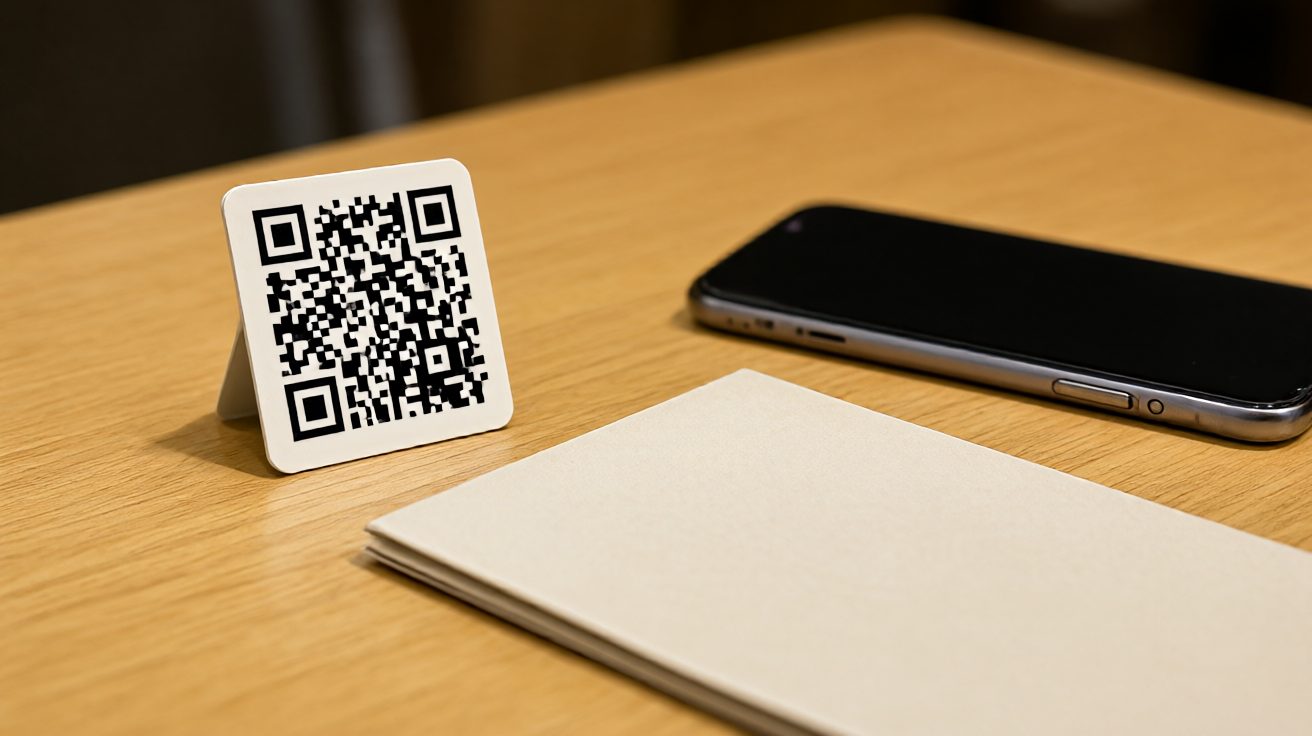
In mainland China, sit-down restaurants commonly take orders by QR code, but the platform listing rules in force since 1 June 2026 require the shop name, food business licence, shopfront photo and actual address to be displayed (source).
Short answer: in most sit-down restaurants in mainland China nobody hands you a menu. The menu is a sticker on the table, and the sticker is a QR code. You scan it with WeChat or Alipay, a small app opens inside the chat app, the dishes appear in Chinese with prices, you tap what you want, pick a portion size, and submit. Whether you pay at that moment or at the end depends on the shop. None of this is compulsory: a paper menu (纸质菜单, zhǐzhì cài dān) still exists, and staff will take a verbal order. But knowing the sequence removes most of the friction, including the small charges that turn up on the bill after the food is gone.
What the code on the table actually opens
A table code is not a website. It launches a mini-program (小程序, xiǎo chéngxù), which is an app that runs inside WeChat or Alipay without being installed. The code usually carries two pieces of information: which restaurant chain it belongs to, and which branch and table you are sitting at. That is why the first screen you see often already says your table number, and why the kitchen can send the right dish to the right place without anyone writing anything down.
Two variants exist and they behave differently. One is the restaurant's own system, built for that chain alone: the menu matches the branch, prices match the branch, and the bill is generated by the shop. The other is a listing inside a platform such as Meituan or Dianping, where you order through the platform and the shop confirms. The shop's own program is the more common arrangement at the table; platform ordering is more common for delivery. If a code opens a chat window instead of a menu, it is usually an invitation to follow the shop's official account, not an ordering screen, and there is normally a menu button inside it.
The program may ask for your phone number before showing the menu. That request is a membership sign-up, not a payment step. You can decline it and continue as a guest; look for 跳过 (tiàoguò, skip) or 游客 (yóukè, guest) near the permission prompt. Declining costs you nothing except the shop's loyalty points.
From scan to plate: the six screens you will see
The flow is stable across most chains, and the labels repeat, so learning them once covers a whole trip.
1. 菜单 (cài dān, menu). Dishes are grouped by category along the upper edge or side: 招牌 (signature), 热菜 (hot dishes), 凉菜 (cold dishes), 主食 (staples), 汤 (soup), 饮品 (drinks). Photographs are common, so you can order without reading a word, but the photograph is the shop's own styling and the plate you get is usually plainer.
2. 规格 (guīgé, specification). This is the portion control. 小份 / 中份 / 大份 (small, medium, large) or, at noodle shops, 一两 / 二两 / 三两 (one, two or three liang of noodles, where one liang is 50 g). At hot pot the same screen asks for 半份 (half portion), which is the single most useful button in the app if you are ordering for two.
3. 口味 (kǒuwèi, flavour). A spice scale runs 不辣 / 微辣 / 中辣 / 特辣 (not spicy, mildly spicy, medium, very spicy). The default is sometimes 中辣, so tap deliberately rather than accepting what is already selected. This screen is also where 少油 (less oil) and 少盐 (less salt) appear.
4. 加料 (jiā liào, add-ons). Extra noodles, extra rice, an egg, tofu skin, a soft drink. Each add-on has its own price and is itemised separately on the bill, so it is easy to see what you actually added.
5. 备注 (bèizhù, notes). A free-text box that reaches the kitchen. This is where dietary requests go: 不要香菜 (no coriander), 不要葱 (no spring onion), 不要蒜 (no garlic), 花生过敏 (peanut allergy). The box is read by a person, so write it plainly; a request that depends on a whole recipe being rebuilt is a conversation, not a note.
6. 提交订单 (tíjiāo dìngdān, submit). After submitting, you either see 立即支付 (pay now) or the order goes straight to the kitchen and you settle later with 买单 or 结账 (mǎi dān / jié zhàng). At every step the running total sits at the bottom of the screen, and it is the number to watch, because it is the number the final bill is built from.
Where the extra lines on the bill come from
Dish prices are not the whole bill. Four charges account for most of the gap, and all four are visible before you commit if you know where to look.
茶位费 (chá wèi fèi), tea and seat charge. A per-person charge, common in Cantonese and Hong Kong-style restaurants and in tea houses, covering the tea, the pot, the refills and the seat. It is normally printed on the menu or listed on the ordering screen as a per-head item, and it is charged per person rather than per table. Amounts differ by city and by venue, so read the line rather than assuming a figure.
服务费 (fú wù fèi), service charge. Found in hotel restaurants and higher-end dining rooms, listed as a percentage of the food total. If it applies, it is on the menu; if it is not on the menu, ask before ordering.
打包费 (dǎ bāo fèi), packaging fee. A small per-container charge when you take food away, and one of the few charges that only appears if you ask for a box.
最低消费 (zuìdī xiāofèi), minimum spend. Attached to private rooms (包间, bāojiān) rather than to tables in the main room. Ask when you book, because it is a condition of the room rather than a price on a dish.
These are commercial practices set by the venue, not a national rate, which is why two restaurants on the same street can differ. The practical move is to look at the first screen of the ordering app, where the per-head charges are usually itemised, and add them to your head before you tap. A charge that appears on the bill but nowhere on the menu is worth querying at the counter while you are still standing there.
Deposits when you book ahead
Two different words, two different outcomes. 押金 (yā jīn) is a refundable holding deposit: you pay it to secure a table or a room, and it comes back, or is deducted from the final bill. 定金 (dìng jīn) is a commitment payment: it is meant to be forfeited if you cancel late, which is precisely why venues ask for it on busy nights and set menus.
Before paying either one, ask 可以退吗 (kěyǐ tuì ma, is it refundable) and get the answer in writing if it is a large sum, in the chat thread or on the receipt. A deposit paid inside the restaurant's mini-program normally shows up in the order history and is applied to the bill automatically; a deposit paid by transfer to a personal account is the arrangement to avoid, because there is no record that ties it to your table.
Ordering through an app instead of a table code
Delivery and pickup run on a different set of rules from a table-side code, and those rules are published. The Provisions on Supervision and Administration of Food Safety Responsibility for Online Catering Service Operators, issued by the State Administration for Market Regulation as Order No. 123 on 27 January 2026 and in force since 1 June 2026, sets out what a listing has to show. It replaced the 2017 online catering rules.
Three of its provisions are directly useful when you are deciding whether to order. First, the shop's name on the platform has to match the name on its physical shopfront sign, and the listing has to display its food business licence, a photo of the shopfront and its actual trading address (articles 11 and 23). Second, a shop that does not serve customers on the premises has to carry a 无堂食 (no dine-in) label on its main page (articles 12 and 24). Third, food for delivery has to be packed and sealed so that the seal cannot be restored once opened (article 27), which is the seal to check at the door before you accept the bag. Order records must be kept for at least three years (article 15), so a complaint about a specific order has something behind it.
One honest limit on all of this: the regulation is written for food ordered through a third-party platform or through a shop's own website or app. A code stuck to a table inside the dining room is a different arrangement, and the definition in article 2 does not obviously reach it. So use those provisions as a test for delivery listings, and treat the same information on a table code as a good sign rather than proof.
If your phone will not cooperate
Three failures cover most of it. No data. Ask for the Wi-Fi password (Wi-Fi 密码, mìmǎ) at the counter; the code works over any connection. No Chinese mobile number. Some programs want a phone login before the menu appears. Try the guest route first, and if there is none, tell the staff 没有中国手机号 (méiyǒu Zhōngguó shǒujī hào, I do not have a Chinese mobile number) and they will usually enter the order on their own device. A code that will not load. Stickers get scratched and old tables keep old codes, so a code that belongs to a table you are not sitting at is a real risk: your dish arrives somewhere else. If the table number on the first screen is not your table, stop and call someone over.
One more trap: submitting twice. The screen may not block a second identical order, and a double order at a busy lunch looks exactly like a single order until two plates arrive. After you submit, the order appears under 已下单 (ordered); check that list before tapping again.
The five phrases that carry the whole conversation
扫码点单 (sǎo mǎ diǎn dān) — order by scanning the code. 纸质菜单有吗 (zhǐzhì cài dān yǒu ma) — do you have a paper menu. 有没有茶位费 (yǒu méiyǒu chá wèi fèi) — is there a tea and seat charge. 可以付现金吗 (kěyǐ fù xiànjīn ma) — can I pay in cash. 打包 (dǎ bāo) — please pack this up. Each one is a question with a yes or no answer, which is what you want when the reply comes back in fast local speech. For the vocabulary on the menu itself, the cooking-word decoder covers the characters that repeat across dishes, and the hot pot guide handles the one cuisine where the ordering screen does half the work for you.
None of this requires fluency. The screen shows pictures, the total sits at the bottom, and the staff can see which table has not ordered yet. What it does require is reading the first and last screens, because that is where the table number and the per-head charges live. Everything between them is tapping. When you want the wider context on how bills get settled in this country, the food and ordering section collects the guides that sit next to this one.