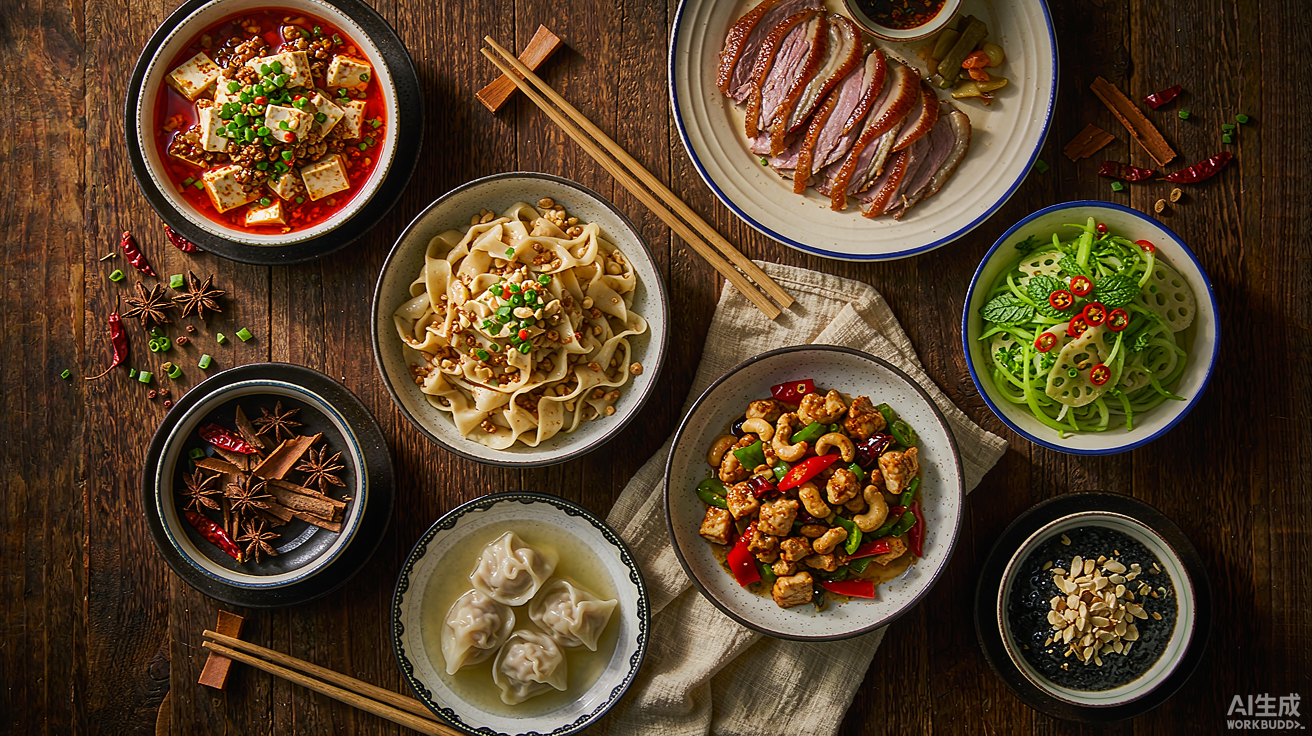
I went through my own recipe library and counted. Eighteen regional cuisine files, 215 dishes, and every dish carries its ingredients, steps, and cooking time. Before I started, I assumed the word "cuisine" was really carried by a handful of signature dishes. It isn't. Each regional style has its own measurable preferences in seasonings and techniques, and those preferences can be counted.
First, the sample. Across the 215 dishes the average is 6.3 steps, 13.4 ingredients, and 81 minutes, with a range from 15 minutes to 360. The difficulty split is 41 easy, 99 medium, and 75 hard. Every number below comes from the fields of this dataset, not from an estimate.
If the taste labels like "numbing, fresh, fragrant, salty" still feel abstract, the place to start is the dishes first-time visitors order most — the ten dishes that show up on most first menus — before coming back to the numbers here.
The numbers below come from one consistent source: my own bilingual recipe library, where each dish carries the same fields - ingredients with gram-level quantities, a numbered method with heat and timing, a technique tag, and a difficulty rating. The recipes were checked against four kinds of references: classic published cookbooks, intangible-heritage listings for the dish or its region, the published methods of named chefs and lineage holders, and regional culinary-association standards. Keeping all four matters because the aim is to catch the version of a dish locals would recognize, not a generic web rewrite.
1. The skeleton: four hard metrics across 18 regional cuisines
The table below gives the average steps, average ingredients, and how many dishes in each cuisine can be finished in 30 minutes.
| Cuisine | Avg steps | Avg ingredients | Done in 30 min |
|---|---|---|---|
| Sichuan | 5.3 | 14.2 | 7 |
| Shandong (Lu) | 5.3 | 10.3 | 7 |
| Cantonese (Yue) | 5.9 | 10.7 | 4 |
| Jiangsu (Huaiyang) | 5.2 | 12.4 | 4 |
| Zhejiang | 5.7 | 8.5 | 4 |
| Fujian (Min) | 4.3 | 11.7 | 4 |
| Hunan (Xiang) | 5.6 | 11.9 | 4 |
| Anhui (Hui) | 4.8 | 10.4 | 2 |
| Northeastern | 6.1 | 15.8 | 1 |
| Beijing | 7.3 | 15.8 | 1 |
| Jiangxi (Gan) | 6.0 | 11.3 | 4 |
| Yunnan | 7.3 | 12.7 | 1 |
| Guizhou | 7.3 | 17.8 | 2 |
| Henan (Yu) | 6.8 | 18.2 | 0 |
| Hubei (E) | 7.3 | 14.3 | 3 |
| Shanghai (Benbang) | 6.0 | 13.5 | 1 |
| Shaanxi (Northwest) | 9.1 | 18.3 | 0 |
| Taiwan | 7.8 | 14.1 | 6 |
A few things stand out immediately. Fujian is the only one of the 18 with fewer than 12 dishes, at 11; every other cuisine has 12. On ingredients, Zhejiang sits at the bottom with an average of 8.5, while Shaanxi (18.3) and Henan (18.2) sit at the far end, a gap of 9.8 items. On steps, Fujian (4.3) and Anhui (4.8) form the light end, while Shaanxi (9.1) stands alone at the heavy end. For dishes you can finish in 30 minutes, Sichuan and Shandong each have 7, Taiwan has 6, and Henan and Shaanxi have 0.
An average of 6.3 steps and 13.4 ingredients is a very concrete feeling in the kitchen: most everyday dishes are not complicated, but the prep side is. When a dish needs a dozen or more items, what really matters is whether you have them all and the order you add them.
2. How universal are the seasonings
Below are the 10 most frequent seasonings in the dataset. "Cuisines covered" means how many of the 18 regional styles use that ingredient at least once.
| Seasoning | Dishes | Cuisines covered |
|---|---|---|
| Salt | 185 | 18 |
| Ginger | 161 | 18 |
| Scallion | 154 | 18 |
| Sugar | 120 | 18 |
| Garlic | 102 | 17 |
| Light soy sauce | 101 | 17 |
| Cooking wine | 79 | 17 |
| Vinegar | 74 | 18 |
| Chili | 72 | 14 |
| Starch | 62 | 17 |
Salt leads with 185 dishes across all 18 cuisines. Ginger (161), scallion (154), and sugar (120) also cover every one of the 18. Vinegar (74) does too, which is a little counterintuitive — several cuisines are not known for sourness, yet vinegar shows up everywhere. Garlic (102), light soy sauce (101), cooking wine (79), and starch (62) all cover 17 cuisines. The dividing line appears at chili: it drops from 17 cuisines to 14, at 72 dishes.
Two more rows are worth listing on their own. Doubanjiang (13 dishes) and douban (13 dishes) each cover 6 cuisines — the dataset records "douban" and "doubanjiang" as two separate spellings, so they were counted as written. Oyster sauce (13 dishes, 6 cuisines) ties with doubanjiang.
The seasoning columns also show that "regional" is not the same as "distinct." Salt, ginger, scallion, and sugar are the universal base, so every cuisine starts from the same four. The divergence only appears once you move past them. That is why a first-time cook can move between cuisines with one pantry, but a cook chasing a Sichuan numbing heat or a Fujian wine-scented broth has to add a small, specific set of items.
3. Four markers that pin a dish to a region
Beyond the universal seasonings, four ingredients are confined to 1–2 cuisines.
| Marker | Dishes | Cuisines |
|---|---|---|
| Red distiller's lees (hongzao) | 4 | Fujian |
| Sha cha sauce | 1 | Fujian |
| Fermented chili (zaolajiao) | 3 | Guizhou |
| Vermicelli | 3 | Guizhou + Shaanxi |
Fujian takes two of these: hongzao (4 dishes) and sha cha sauce (1). Guizhou has fermented chili (3 dishes), and vermicelli is shared between Guizhou and Shaanxi (3 dishes total). Table 3 also shows three other tightly clustered flavors: doubanjiang (13 dishes, 6 cuisines), douban (13, 6), and oyster sauce (13, 6); yellow wine (32) spans 8 cuisines and chili oil (33) spans 11. In other words, to identify a dish's regional origin at a glance, these four are more discriminating than chili — chili spread to 14 cuisines, while hongzao stays in Fujian.
4. Technique and time: how fast a dish comes off the fire
Breaking the "method" field apart, the top techniques are:
| Technique | Dishes | Cuisines |
|---|---|---|
| Boil | 103 | 18 |
| Toss / mix | 68 | 17 |
| Steam | 50 | 15 |
| Deep-fry | 48 | 17 |
| Braise | 42 | 17 |
| Lu (spiced brine) | 29 | 15 |
| Stew | 28 | 13 |
Boiling is the shared base — the only technique that covers all 18 cuisines. Below it is where the divergence starts. Steam (50 dishes) shows up in the signature steamed fish of Cantonese and Hubei; deep-fry (48) includes Beijing's zhajiang noodles. The further down you go toward compound flavors, the faster coverage narrows: sweet-and-sour (6 dishes, 5 cuisines), red-braised (5, 3), flash-fry (5, 4), dry-fry (3, 3), and small-stir-fry (1, 1). The more specific a technique, the more regional it is — an even sharper divide than with seasonings.
The time distribution is: under 30 minutes, 55 dishes; 30–60 minutes, 80; 60–120 minutes, 40; over 2 hours, 40. That means 135 dishes are on the table within an hour — more than 60% of the library. Fifteen cuisines have at least one dish topping 120 minutes, with only Sichuan (90), Hunan (90), and Anhui (120) as exceptions. Fujian and Taiwan both run 15–360 minutes, the only two cuisines to push the ceiling to 360.
One caveat is worth stating plainly: these are averages over a curated set, not a census of everything ever cooked in China. The 215 dishes are the ones worth knowing - signature plates, common home dishes, and the regional specialties a first-time visitor is likely to order. A cuisine with fewer entries is not "simpler"; it simply means we kept that region shortlist tighter. So the per-cuisine table is best read as "what this region leans toward" rather than a ranking of cooking complexity.
5. What this dataset is actually good for
First, deciding what to cook tonight. There are 55 dishes under 30 minutes across the library; Sichuan and Shandong each offer 7, so a table of options is easy to build. For something slow, the 40 dishes over 2 hours include Shaanxi's 60–240-minute range, while a dish like Buddha Jumps Over the Wall pushes the ceiling to 360 minutes.
Second, stocking the pantry. Eighteen seasonings appear in more than half the cuisines — salt, ginger, scallion, sugar, vinegar, garlic, light soy, cooking wine, chili, starch, Sichuan pepper, dark soy, cilantro, dried chili, chili oil, stock, rock sugar, and chicken stock. Keep those on the shelf and you can cover most home cooking across all 18 styles without a special trip. To see a specific regional dish in detail, start with Sichuan's 12 dishes or browse the full library sorted by cuisine — a decoder for the cooking terms helps when a name is unfamiliar.
This is also why the "15 ingredients" number matters more than the "6 steps" number. A dish like mapo tofu lists Sichuan pepper, chili oil, doubanjiang, starch, and garlic alongside the tofu and ground pork — the steps are short, but the pantry has to be stocked. When I sorted the 215 dishes by ingredient count, the shortest list was 4 items and the longest was 26. The ones at the top of that range are not harder to cook; they are harder to assemble, because the extra items are almost always seasonings rather than main ingredients. If you are cooking in a kitchen far from a Chinese grocery, that distinction changes which recipe you pick.
Third, watching for hidden flavors. Stock (28 dishes, 14 cuisines), chicken stock (14, 10), and oyster sauce (13, 6) rarely appear in a dish's name, yet they are the base of many broths and glazes. Non-meat eaters should check these before ordering — the real difference between Cantonese and other Chinese food often comes down to what goes into the sauce, not the headline ingredient.
Fourth, reading a region's taste through its actual dishes. Fengxin county alone turns one grain into three distinct flavors — huangnian miguo, fengxin rice noodles, and niangfanduo — the same kind of layering you see here at the cuisine level, applied to rice.
There is one more use that surprised me, and it is about the range rather than the average. The 215 dishes span 15 to 360 minutes, but that range is not evenly spread. The 55 dishes under 30 minutes cluster around quick stir-fries and cold dishes, while the 40 dishes over 2 hours are almost all braises, stews, and steamed whole dishes. In between, the 30–60 minute band is the largest single group at 80 dishes. So if someone tells you "Chinese cooking is slow," the dataset says the opposite for most of the library: two-thirds of it is on the table inside an hour, and the slow end is a deliberate, small set of celebration dishes rather than the norm.
If you want one rule of thumb from the whole dataset, pick your time budget first and let the region narrow the choice. Under 30 minutes, Sichuan and Shandong each offer 7 dishes. Under an hour, 135 of the 215 are on the table. When you want the dish a region is famous for instead, go to the slow end - and expect a celebration plate, not a weeknight one.
Put together, the order inside these 215 dishes is not complicated: 18 seasonings appear in more than half the cuisines, 4 are confined to 1–2, boiling is the base technique and specificity narrows from there, and more than 60% of the dishes are done within an hour. If you want to cook, pick one from the library.