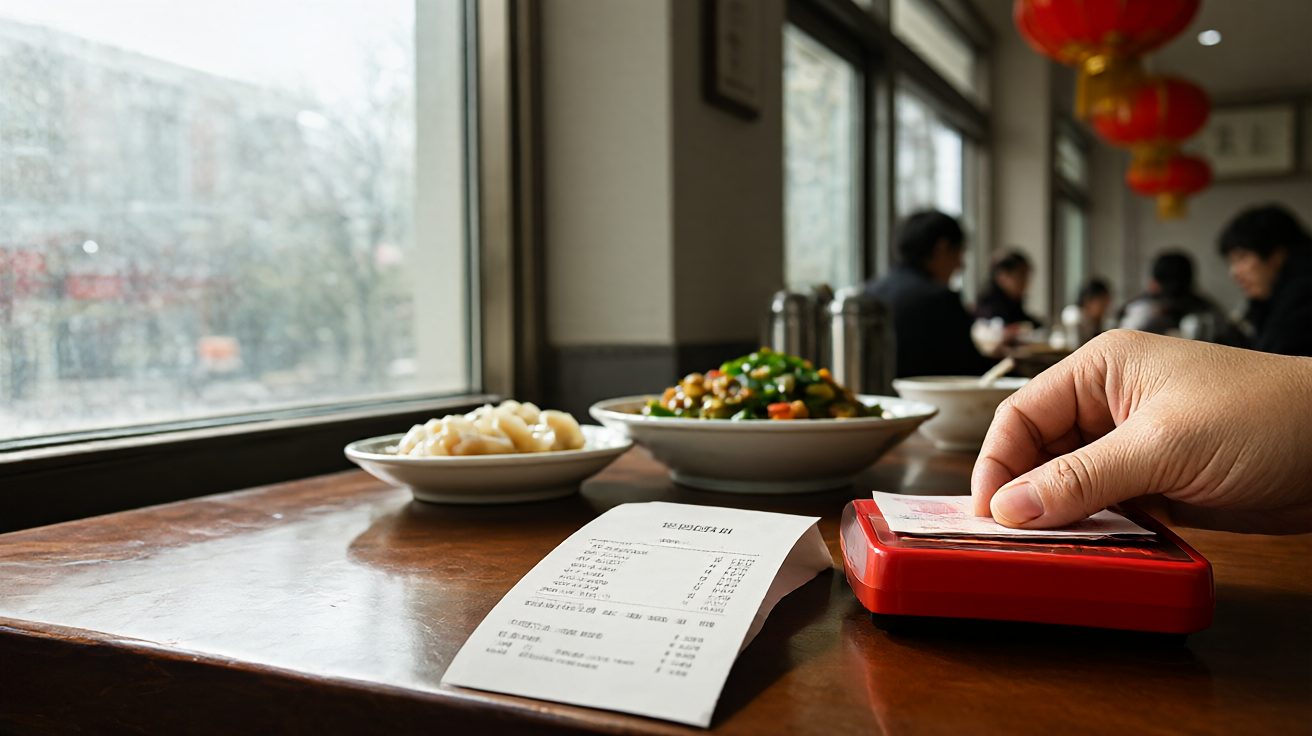
Short answer: no tip is expected in a Chinese restaurant, and the total printed on the bill is the amount you owe, because the national price-marking rules forbid charging anything that has not been marked (Article 8, Order No. 56 of the State Administration for Market Regulation, in force since 1 July 2022). A service charge or a per-person tea fee is allowed, but it has to be visible in the menu or the price list before you order, and where you eat first and pay afterwards the restaurant must give you an itemised bill before you settle. Payment happens at the table by QR code, at a till, or to the waiter holding the slip: the route changes, the number does not.
Is tipping expected in Chinese restaurants?
No. A Chinese restaurant bill has no tip line, and nothing in the price rules creates one. The figure on the slip is the marked price of the food plus any marked extras, and that is the whole amount due. Staff in noodle shops, canteens, hot pot chains and everyday sit-down restaurants do not expect extra money, and a note left on the table reads as a mistake rather than a compliment.
That is the practical problem with tipping here: it creates work. If you leave twenty yuan under a plate and walk out, a waiter may follow you to hand it back, because the till has already closed the table at the exact amount. The gesture is not offensive, it is simply outside the transaction. Pay the printed total, take your change, and use the money on the next meal.
Two settings do involve money beyond the bill, and both announce themselves in writing: a service charge in hotel and higher-end restaurants, and organised group tours sold to foreign visitors, where guide and driver tipping is set out in the tour documents. Where neither the menu nor the paperwork mentions it, nothing is expected. If nothing is written down, nothing is owed.
What the law says a bill must show
The rules are unusually concrete, which makes them usable at the table rather than in a lawyer's office. They come from the Provisions on Marking Prices Clearly and Prohibiting Price Fraud (SAMR Order No. 56, published 14 April 2022, effective 1 July 2022):
- Article 7 — goods must be marked with the product name, the price and the unit of pricing; a service must be marked with the service item, what the service includes, and the price or the method for calculating it.
- Article 8 — a business may not sell above the marked price, and may not charge any fee that has not been marked.
- Article 9 — prices are generally shown in Arabic numerals in renminbi, with other price information generally in standard Chinese characters; foreign-language text may be added alongside.
- Article 12 — marking may take the form of a price tag, price board, price list, display panel, electronic screen, actual goods or models, or a photograph.
- Article 15 — where a service is consumed first and settled afterwards, the business must issue an itemised settlement list (结算清单) before payment, listing the items consumed, their prices and the total charge.
Three consequences matter to a visitor. First, a photograph with a price under it is a legal price mark, so a picture menu is the price list, not an illustration — you can point at a picture and know the number. Second, a bill you cannot reconcile against marked prices is exactly the situation Article 8 exists for, and the argument is factual rather than cultural: which menu did the number come from? Third, "eat first, pay later", which is how nearly all sit-down restaurants operate, is the case where Article 15 requires an itemised slip before you pay, not a single total typed into a card machine.
Service charge, tea fee, takeaway box: which lines are legitimate
A service charge (服务费) is not a tip and should not be treated as one. It is a priced item, and a priced item has to be marked before you order — printed in the menu, on a card at the table, or on a sign at the entrance. Where it exists in a form that satisfies the rules, the menu states it as a percentage of the food total, and the bill applies that percentage to the same base. Where it appears for the first time on the slip, Article 8 is the argument: a fee that was never marked may not be charged.
The same test settles the per-person tea charge (茶位费) that turns up in Cantonese restaurants and in much of Guangdong. The rule does not care what a charge is called. It cares whether the charge was marked, and whether the marked amount is the amount collected. A tea charge printed in the price list as a per-head figure is a normal marked item; the same figure appearing only on the bill is the other kind of item.
Takeaway boxes (打包费) work the same way. The container is a priced good or a priced service, so it belongs in the price list, and a shop that adds it silently at the counter has skipped Article 7 rather than invented a fee. In practice this is where the smallest arguments happen, because the amount is small enough that most people let it go — which is precisely why it is worth knowing the rule instead of arguing the amount.
Two further lines are worth separating out. A deposit (定金) on a booked table or a private room is a payment against the final bill, not a fee, so check that it is deducted, not added; keep the receipt until the table is closed. And where a dish is sold by weight, the marked unit of pricing is what makes the total checkable, which is why Article 7 asks for the unit at all: a price per 500 g with the weight on the slip is arithmetic you can verify, while a total with no unit is not.
Three ways to settle a bill
How the money leaves your hands varies more than what you owe. The table below covers the three patterns you are likely to meet, and what to check in each.
| Settlement style | Where you pay | Where you meet it | What to check |
|---|---|---|---|
| Pay first, then eat | Counter or self-service kiosk, before the food arrives | Noodle shops, canteens, food courts, fast-food chains | The printed ticket is both order and receipt — keep it until the food is on the table |
| Order and pay by table QR code | Your phone, at the table | Mid-range chains, hot pot, barbecue, newer sit-down places | The app's running total, dishes added after the first order, and whether a service charge line appears |
| Eat first, settle at the end | At the table, or at a till near the door | Most sit-down restaurants, including family-run places | The itemised settlement list required by Article 15, before any payment |
The middle row is the one that has changed fastest, and the change is not about food. When ordering and payment share one screen, the final total is whatever the app says at the moment you press pay, so added dishes, cancelled dishes and per-head charges all land in the same place. If you ordered twice, read the list twice. The mechanics of that screen are covered in our guide to QR code ordering in Chinese restaurants, and the payment side — which wallets work, which cards fail — sits in the paying-in-China FAQ. This article stays with the bill itself.
How to split a table's bill
A Chinese restaurant bill is a table bill, not a person bill. The till settles the table once, and staff are not set up to divide a single slip line by line, so the "four cards, four amounts" routine familiar from other countries usually ends in a shrug. Two methods work.
The first is one payer and instant transfers. One person pays the whole table, and everyone else sends their share by WeChat Pay or Alipay while still sitting down, which takes about as long as the argument about who pays. This is close to the local habit known as AA, and it is the method that survives a busy Saturday.
The second is separate orders on a table QR app, where the app supports it. Each person orders and pays for their own items in the same table session, and the kitchen receives one combined order. It works in chains that built the app for exactly this, and it fails in places where the session is tied to one phone. Ask before ordering rather than after eating; the answer is visible in whether the app shows a per-person cart.
What does not work reliably is asking the cashier to split a card payment across several foreign cards. Small tills may accept no foreign card at all, and even where one card works, a split payment is two transactions with two chances to fail. One payer plus transfers keeps the number of card attempts at one.
Five lines to check before you pay
- Per-head charges. A tea charge, a sauce or pickle charge, or a seat charge multiplied by the number of people at the table. Check the headcount first — it is the most common honest error.
- Takeaway boxes. Boxes requested at the end of the meal sometimes reach the bill before they reach the table. Count the boxes.
- Quantity against what arrived. Two orders of the same dish when one plate came out, or a dish that was cancelled at the table but never in the system.
- Unit price against the menu. This is where a picture menu earns its keep: the price under the photograph is the marked price, and the bill should match it exactly.
- Discounts and vouchers. A coupon or a set-menu price that was quoted but not applied. Article 8 forbids charging above the marked price, and Article 19 treats refusing to honour an agreed discount as price fraud.
None of this requires suspicion. It requires the slip. In a country where the marked number is legally binding, reading the bill is the same act as reading the menu, and it takes under a minute once you know which five lines move.
When a charge was never on the menu
Start with the document, not the dispute. Ask for the price list or menu (价目表) and for the itemised settlement list (结算清单) that Article 15 requires before payment. If the charge is in neither, the point to make is short and factual: under Article 8 of Order No. 56, no fee may be charged that was not marked. The waiter cannot resolve this, so ask for the manager (经理) rather than repeating the sentence louder.
If it is still unresolved, the complaint channel is the local market regulator. The national consumer platform is 12315, run by the State Administration for Market Regulation, with a hotline of the same number and a mini-program inside WeChat and Alipay. Article 22 of the same order puts enforcement of the marking rules in the hands of market regulators at county level and above, which is the chain a complaint follows.
Two practical notes. Keep the slip and photograph the menu price before you leave the table — a complaint without the marked price is a story, and a complaint with it is a case. And weigh the amount: a few yuan of tea charge is rarely worth twenty minutes, but a percentage service charge that was never marked is a pattern rather than a rounding error, and that is the one worth raising.
Receipts, tax invoices and what the paper is not
The slip that arrives with the bill is a settlement record, not a tax invoice. If you need something for an expense claim, ask for a 发票 (fā piào) at the counter; larger restaurants issue them at the till or through the same app that took the order, and they will want a title (抬头) — a company name, or your own name for a personal claim. Ask before you pay if the restaurant is busy, because the invoice is easier to issue while the table is still open.
Keep both papers if the meal is a business expense: the itemised slip proves what was consumed, and the invoice proves what was paid. Photograph them in the restaurant, since neither survives a suitcase well and the invoice is the harder one to obtain afterwards.
Phrases that do the work at the till
Bill conversations are short and repetitive, which makes them easy to prepare. Say 买单 (mǎi dān) or 结账 (jié zhàng) to ask for the bill and raise your hand at the same time; both mean "settle up" and neither needs a full sentence. 一共多少钱 (yī gòng duō shao qián) asks for the total, 打包 (dǎ bāo) asks for a box, and 发票 (fā piào) asks for the tax invoice. If you are paying separately, 各付各的 (gè fù gè de) means each pays their own, though pointing at the arithmetic on the slip usually finishes the conversation faster.
For the ordering side of the meal — dishes, quantities, spice level, the words that appear on a menu — the phrase work is different, and it is covered in the Chinese menu decoder. Here the vocabulary is about money, which is the easier half: numbers are on the slip, and the slip is in front of both of you.
Five things that cost travellers money
- Leaving a tip as cash on the table. It will be returned or it will confuse the close of the table. Pay the total; if you want to spend that money, spend it on the next meal.
- Paying a percentage that was never on the menu. Ask for the price list before paying. A marked service charge is normal; an unmarked one is the Article 8 case.
- Planning to split across several foreign cards. Small tills may take no foreign card, so a split becomes several failed attempts. One payer, then transfers.
- Adding dishes through the table app and paying the first total. The app recalculates; the old number on your screen does not. Read the final list.
- Treating the payment slip as an invoice. It is not one. Ask for the 发票 before you leave the table, with the title you need.
None of these are tricks aimed at visitors. They are the ordinary friction of a system where the marked price is the contract, and where the paper trail is generated at the table rather than mailed afterwards. Once the bill is the price list plus arithmetic, paying in China becomes the least interesting part of the meal, which is the correct outcome.
Where this sits in the food section
This is the money end of a restaurant visit: what the total is allowed to contain, who you hand it to, and what to do when a line does not belong. The rest of the sequence — decoding a menu, ordering without a shared language, dealing with a table code — is linked from the food section, which is where the other guides in this series live.
Sources
- State Administration for Market Regulation, Order No. 56, Provisions on Marking Prices Clearly and Prohibiting Price Fraud, published 14 April 2022, effective 1 July 2022 — full text in the State Council Gazette: gov.cn/gongbao/content/2022/content_5699926.htm (Articles 7, 8, 9, 12, 15, 22).
- National 12315 platform for consumer complaints, operated by the State Administration for Market Regulation: 12315.cn.
Prices, service-charge percentages and per-head charges are set by each restaurant and change; the rules above do not. Check the marked price on the day you eat.