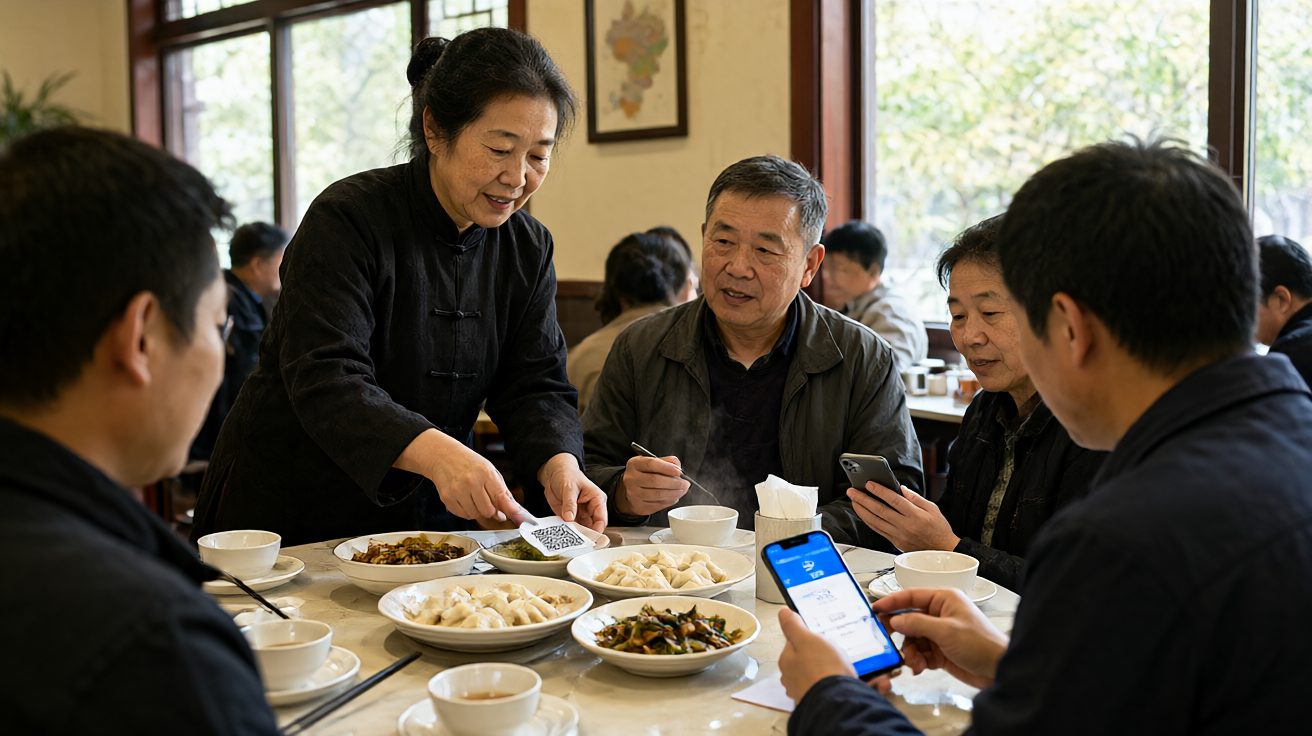
Dining out in China follows a fixed workflow: scan the table QR code to order and pay via WeChat or Alipay, or point to photos on a menu; tipping is not expected because China has no mandatory service charge; the bill is settled by mobile payment at the table or at a cashier counter. All figures below trace to Chinese government or payment-platform sources.
What is the basic workflow for eating at a restaurant in China?
The basic workflow is: enter and wait to be seated by staff, scan a table QR code or read a paper menu, order by phone or verbally, eat, then pay by mobile app at the table or at a counter. This sequence is standard across most sit-down restaurants in mainland China, according to the China Cuisine Association, the national restaurant industry body.
QR-code ordering is now standard in major-city mid-range and chain restaurants. Adoption varies by city: first-tier cities such as Beijing, Shanghai, Guangzhou and Shenzhen use it most widely, while smaller cities and traditional banquet restaurants more often use paper menus and a server.
Payment is the step visitors most often get wrong. China's two dominant mobile payment platforms are Alipay (operated by Ant Group) and WeChat Pay (operated by Tencent). Both accept foreign-issued Visa and Mastercard cards linked inside the app, a service Alipay and WeChat Pay announced in 2023. Cash in renminbi (CNY / ¥) remains legal tender and must be accepted, but many small restaurants have limited change on hand.
You read a Chinese restaurant menu by looking for the dish photo, the price in CNY, and the cooking-method characters beside the dish name; a menu decoder app or a printed phrase card covers the rest. Most menus in China are organised by category: cold dishes (凉菜), meat (肉类), seafood (海鲜), vegetables (蔬菜), soup (汤), staples such as rice and noodles (主食), and drinks (饮料).
Prices are printed as a number followed by 元 or the ¥ symbol; a dish listed at 38元 costs 38 CNY. Some menus show a weight-based price such as 68元/斤 (68 CNY per 500 g), which means the final charge depends on the weight the kitchen selects. The 斤 (jin) is 500 g, not the 600 g imperial pound.
For visitors who cannot read Chinese characters, the practical options are: a translation app with camera OCR, pointing at a dish photo, or using a printed phrase card. Our guide to ordering food in China without speaking Chinese covers the phrase-card method and the pointing etiquette in detail. A companion Chinese menu decoder lists 32 common cooking words (for example 炒 stir-fried, 蒸 steamed, 炸 deep-fried, 烤 roasted) that let a visitor tell how a dish is cooked before ordering.
How do you order at a Chinese restaurant using a table QR code?
You order at a Chinese restaurant by scanning the QR code sticker on the table with WeChat or Alipay, which opens the restaurant's mini-program menu, then selecting dishes and confirming the order on your phone. The order goes directly to the kitchen; no server needs to take it.
The scan is done inside the WeChat or Alipay app, not with the phone's default camera. In WeChat, tap the plus icon and choose Scan (扫一扫); in Alipay, tap the scan icon on the home screen. The mini-program then asks for a table number, which is printed on the QR sticker or the table tent.
The full step-by-step process, including the Chinese-language buttons and the payment confirmation screen, is set out in our guide to QR code ordering in China restaurants. Two practical checks apply before relying on it:
- The mini-program is usually in Chinese only; a translation app with screen OCR is the workaround.
- Some restaurants require a deposit (定金) or prepayment at the order stage, especially for hot pot and large banquet dishes.
Not every restaurant uses QR ordering. In smaller cities, family restaurants and banquet halls, a server takes the order verbally and writes it on a paper pad. Visitors can ask 可以扫码点餐吗 (can I order by scanning the code?) to check.
Tipping is not normal in Chinese restaurants and is not expected. Mainland China has no mandatory service charge and no tipping culture in the everyday restaurant sector; the price printed on the menu is the full amount the customer pays for the dish.
There are two narrow exceptions. First, some high-end hotels and fine-dining venues in Beijing, Shanghai and Guangzhou add a service charge of 10% to 15%, and this is printed on the menu or stated at booking, not left to the customer's discretion. Second, a few international-brand hotels include a service charge in banquet and room-service bills. Outside these cases, leaving extra money on the table is not a Chinese restaurant custom and staff may return it, assuming the customer overpaid.
For delivery, the platforms Meituan and Ele.me include a delivery fee (配送费) set by the platform and shown before checkout; this is a platform charge, not a tip. The full breakdown of what a restaurant bill covers is in our guide to tipping and paying the bill in China.
How do you pay the bill in a Chinese restaurant?
You pay the bill in a Chinese restaurant by scanning a payment QR code at the table or at the counter with Alipay or WeChat Pay, or by handing cash in CNY to the cashier. The two mobile apps are the standard methods; cash is legally required to be accepted but is used far less often.
Payment follows a fixed sequence at most restaurants:
- Ask for the bill — say 买单 (mǎi dān) or 结账 (jié zhàng). At QR-ordering restaurants the bill appears in the mini-program.
- Check the items — the printed or on-screen bill lists every dish and its price in CNY; confirm nothing was added twice.
- Pay by scan — the cashier shows a QR code. In Alipay, tap 扫一扫 (Scan) and enter the amount; in WeChat, tap the plus icon, then 扫一扫. The payment clears in seconds.
- Confirm the receipt — the app shows a payment-success screen (支付成功); the restaurant's till prints a receipt (小票) on request.
Alipay and WeChat Pay both support foreign-issued Visa and Mastercard cards linked inside the app, a service the two companies announced in 2023 to serve inbound visitors. The People's Bank of China, the central bank, has also required merchants to keep cash acceptance available for foreign visitors and the elderly, a policy stated in its 2024 guidance on payment convenience. Visitors should therefore carry some CNY cash as a backup, though most city restaurants will not need it.
Splitting the bill is uncommon in the Chinese restaurant system. The bill is normally paid once, by one person, and groups often settle among themselves afterwards. If a group wants to split, the practical route is for each person to transfer their share to the payer by WeChat or Alipay after the meal, rather than asking the cashier to divide it.
How do you order hot pot in China without over-ordering?
You order hot pot in China by choosing one or two broth bases, then a fixed set of raw items by category, and ordering in rounds rather than all at once. The broth (锅底) is charged separately, usually 30–80 CNY depending on the base and the number of diners, and the raw items are priced per plate.
Hot pot is a category of its own: the diner cooks the food at the table, so the order is a list of raw ingredients rather than finished dishes. The standard categories are meat (beef, lamb, pork), offal, seafood, vegetables, tofu and soy products, and staples such as noodles or rice cakes. A split pot (鸳鸯锅) gives one mild and one spicy broth, which is the usual choice for mixed groups.
Ordering in rounds is the practical rule: order a first round of six to eight plates, eat, then add more. The full method, including the broth and dipping-sauce steps and the per-plate pricing logic, is in our guide to how to order hot pot in China.
What are the regional differences in Chinese restaurant food?
Regional differences in Chinese restaurant food are large and follow recognised cuisine groupings: the eight great cuisines (八大菜系) named in Chinese culinary reference works, including Sichuan, Cantonese, Shandong, Jiangsu, Zhejiang, Fujian, Hunan and Anhui. A visitor moving between provinces should expect the menu, the staple and the seasoning to change.
In practice, the differences a visitor notices most are:
- Sichuan and Hunan — chilli and Sichuan pepper forward; dishes are often listed by heat level.
- Guangdong (Cantonese) — steamed and stir-fried dishes, dim sum at morning tea (早茶) and a strong soup tradition.
- Shandong — wheat-based staples such as noodles and steamed buns, and a savoury, less spicy profile.
- Jiangsu and Zhejiang — sweeter seasoning and river fish, with a lighter sauce style.
- Fujian — seafood and soup-heavy dishes, with a light, clear broth style.
- Anhui — braised and slow-cooked dishes, with mountain ingredients.
The eight-cuisine grouping is a reference convention, not a legal classification; regional menus in hotel restaurants and chain restaurants often blend several styles. The Ministry of Culture and Tourism lists regional cuisines and food heritage among China's cultural tourism categories, and the ministry's official site carries the current list of recognised food-related intangible cultural heritage items.
How do you handle dietary restrictions and allergies in a Chinese restaurant?
You handle dietary restrictions and allergies in a Chinese restaurant by stating the restriction in Chinese before ordering and by checking the dish's ingredients with the server; there is no standard allergen-labelling system on Chinese menus. The practical rule is to carry a written Chinese card stating the restriction and to show it to the server before the order is placed.
The most common restrictions and the Chinese phrases for them are:
- No peanuts or tree nuts — 我对花生过敏 (I am allergic to peanuts)
- No shellfish — 我对海鲜过敏 (I am allergic to seafood)
- No chilli — 不要辣 (no chilli), 微辣 (mildly spicy)
- Vegetarian — 我吃素 (I eat vegetarian)
- No pork — 我不吃猪肉 (I do not eat pork)
Two limits matter. First, a kitchen may not be able to guarantee cross-contamination control, particularly in a busy wok kitchen; the card states the restriction, it does not certify the kitchen. Second, some sauces and stocks contain ingredients not listed on the menu, such as oyster sauce in a vegetable dish or peanut oil in a cold dish. The safe procedure is to show the card, ask the server to confirm with the kitchen, and repeat the restriction when the dish arrives.
How do you order food in China by phone or at the table?
You order food in China by phone or at the table by calling the restaurant, stating the delivery address and the dishes, and paying on delivery or by mobile transfer; at the table you order verbally or through the table QR code. Phone ordering is common for delivery and takeaway, and table ordering is the norm for dine-in.
For phone ordering, the restaurant needs the delivery address in Chinese and a contact number. Payment is usually by WeChat or Alipay transfer after the order is confirmed, or cash on delivery. For dine-in, the two routes are the QR code (see the section above) and the verbal order to a server, supported by pointing at the menu or a photo. The phrase-card method for the verbal route is covered in our guide to ordering food in China without speaking Chinese.
What should a visitor check before dining out in China?
A visitor should check four things before dining out in China: that the payment app is set up and linked to a working card, that the restaurant's opening hours and queue policy are known, that any dietary restriction is written in Chinese, and that the bill-splitting or tipping expectation is understood in advance.
- Payment app — install Alipay or WeChat Pay and link a Visa or Mastercard before arrival; both platforms announced foreign-card support in 2023.
- Opening hours — many restaurants close between lunch and dinner, roughly 14:00–17:00, and reopen for the evening; exact hours are posted at the door.
- Queue policy — popular restaurants issue a numbered ticket (取号) at the door; the number is called in order.
- Dietary card — carry the restriction in Chinese script, not only in English.
- Cash backup — carry some CNY cash; the People's Bank of China's 2024 guidance requires merchants to keep cash acceptance available.
What changes to expect in Chinese restaurant dining
Chinese restaurant dining is changing in two directions: mobile ordering and payment keep spreading from first-tier cities to smaller ones, and cash acceptance is being reinforced by regulation for visitors and the elderly. Both trends are documented, and both affect what a visitor should prepare.
QR-code ordering continues to spread from first-tier cities into second- and third-tier cities. At the same time, the People's Bank of China's 2024 guidance on payment convenience explicitly requires merchants to keep cash channels open, so a cash-only fallback remains valid. The practical preparation is to carry both: a linked Alipay or WeChat Pay account, and a small amount of CNY cash.
Official sources to check before you go
Before relying on any figure in this guide, check the current official source. Prices, payment rules and opening hours change, and the sources below are the ones that publish the changes.
- Alipay — official site for foreign-card linking and the international visitor guide.
- WeChat — official site for WeChat Pay and the scan feature.
- People's Bank of China — the central bank; publishes payment-convenience guidance, including the cash-acceptance requirement.
- Ministry of Culture and Tourism — publishes food-related intangible cultural heritage listings and regional cuisine references.