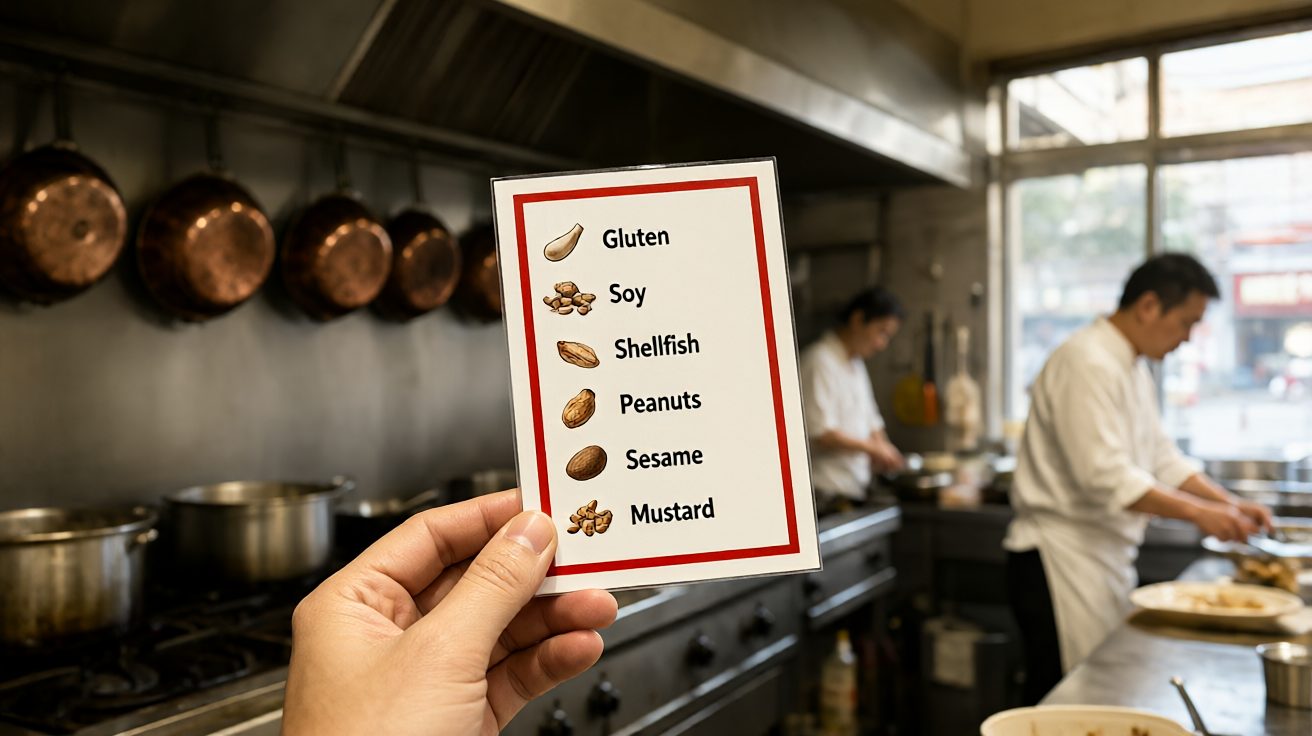
Short answer: China's menu rules govern what a restaurant must print — the dish name, the price and the unit of pricing — and they say nothing about ingredients, so no kitchen is obliged to hand you an allergen list. The one place ingredient information is written down by law is the packaging of prepackaged food, where you can read the 配料表 (pèiliào biǎo, ingredient list). At a table you have to supply the written half yourself: the allergen in Chinese characters, a yes-or-no question, and a second look when the plate arrives.
What the menu rules cover, and what they leave out
Two sets of rules meet at a Chinese table, and they do not overlap. The first is about price. Under the Provisions on Marking Prices Clearly and Prohibiting Price Fraud (State Administration for Market Regulation Order No. 56, published 14 April 2022, in force since 1 July 2022), an item on sale must be marked with its name, its price and its unit of pricing; a service must state what it includes and how it is priced; and no fee may be charged that was not marked in advance. A photograph with a price beneath it is a recognised form of price marking, which is why a picture menu can serve as the price list, and why the number under the picture is the number you pay.
None of that is about what is inside the food. A dish can be marked exactly as the rules require — name, price, unit — while the kitchen's use of peanut oil, lard or a shrimp-based stock stays completely undocumented.
The second set of rules applies to packaging. Prepackaged food sold in China carries a printed 配料表, a net-content figure (净含量), a production date (生产日期), a shelf life (保质期) and the producer's details. That label is the only routine, written, legally required statement of ingredients a visitor can read, and it applies in the convenience store rather than at the table.
So the information exists in one half of the food system and is spoken in the other. Spoken is the weakest link when two languages are involved, which is why the rest of this guide is about moving your requirement into writing, and about asking questions a busy kitchen can answer in one word.
过敏 and 忌口 are different sentences
Chinese has one word for "I avoid this" and a separate word for "this will make me ill", and the difference decides whether your request is heard as a preference or as a hazard. 忌口 (jìkǒu) means a dietary restriction — no coriander, no offal, nothing cold, no alcohol — and it lands on the preference side. 过敏 (guòmǐn) means allergy, and it lands on the medical side.
The everyday word 不要 ("don't want") also sits on the preference side. 不要放香菜 (no coriander) is a complete, working request and needs nothing added. 不要放花生 is weaker than it looks: without the word 过敏 it reads as a matter of taste, so a cook may go easy on the peanuts and keep a few for flavour, because that is how the phrase is normally used in a kitchen.
Three additions move a request across the line. 过敏 names the mechanism. 严重 (severe) sets the level. 一点点也不行 — "not even a little" — closes the "just a taste" gap. With all three on the card, the sentence stops being negotiable.
The card: seven lines that fit on one phone screen
A card is not a translation exercise; it is a fixed object you show three or four times a day. Seven lines cover the orders you are likely to place.
- 我对__过敏。 (wǒ duì __ guòmǐn) — "I am allergic to __." The blank takes the characters of the allergen, not an English word.
- 严重过敏,一点点也不行。 (yánzhòng guòmǐn, yīdiǎndiǎn yě bù xíng) — "Severe allergy, not even a trace."
- 不要放__,也不要用__油。 — "No __, and no __ oil either." The second half matters more than the first.
- 请用干净的锅和油。 (qǐng yòng gānjìng de guō hé yóu) — "Please use a clean wok and clean oil."
- 这个里面有__吗? (zhège lǐmiàn yǒu __ ma) — "Does this contain __?" A question that takes yes or no.
- 我吃素,不吃肉、鸡蛋、牛奶。 — "I am vegetarian; no meat, egg or milk." Trim the list to what you actually avoid.
- 我的紧急联系人:__ — your emergency contact, one line, no explanation needed.
The characters that fill the blanks are short and worth copying exactly: 花生 (peanut), 坚果 (tree nuts), 芝麻 (sesame), 海鲜 (seafood), 虾 (shrimp), 蟹 (crab), 贝类 (shellfish), 鱼 (fish), 鸡蛋 (egg), 牛奶 (milk), 小麦 (wheat), 大豆 (soy), 芒果 (mango), 味精 (MSG). Copy them from a phone rather than writing them from memory. A wrong stroke in 蟹 or 虾 turns a clear warning into a puzzle, and handwriting is the least legible part of the whole exercise.
Print the card, or keep it as a screenshot with the font enlarged, and consider a photograph of the dish you order again and again. The dish names themselves are a separate vocabulary problem, covered in the Chinese menu decoder.
Six things in the wok that a vegetarian order misses
Meat is the visible part of the problem and the easy part to refuse. The rest is fat, stock and seasoning, none of which appears in the name of the dish:
| Chinese | Pinyin | What it is | Where it turns up |
|---|---|---|---|
| 猪油 | zhūyóu | Rendered pork fat | Greens, fried rice, noodles, stir-fried vegetables |
| 高汤 | gāotāng | Meat stock | Soup bases, blanched vegetables, noodle broth, hot pot |
| 鸡精 | jījīng | Chicken bouillon powder | Stir-fries, soups, marinades |
| 蚝油 | háoyóu | Oyster sauce | Leafy greens, noodles, claypot dishes |
| 虾皮 | xiāpí | Dried shrimp | Dumpling fillings, vegetable dishes, soups |
| 肉末 | ròumò | Minced pork | Aubergine, tofu, green beans, noodles |
Three more belong on the same list: 鱼露 (fish sauce), 火腿 (ham) and 腊肠 (cured sausage). One sentence covers the main six — 我吃素,不要放猪油、高汤、鸡精、蚝油、虾皮、肉末 — and it is short enough that a waiter may well nod at the third item and finish the list for you.
Dish names do not settle the question either. 素炒时蔬 (stir-fried seasonal vegetables) tells you the vegetables are the main ingredient; it does not tell you what the wok was seasoned with. 蚝油芥兰 is a vegetable dish by name and an oyster dish by ingredient. The bottle of oyster sauce in any supermarket makes the same point in writing: its 配料表 lists 蚝汁, oyster extract, which is exactly the detail a menu leaves out.
Four ways to put the message in front of the kitchen, compared
| Method | Works with no signal | Readable across a noisy counter | Reusable | Weak point |
|---|---|---|---|---|
| Printed card, A6 | Yes | Yes | Yes | Has to be prepared before the trip |
| Phone screenshot, enlarged | Yes, once loaded | Yes | Yes | Screen locks, brightness, battery |
| Saying it aloud | Yes | Rarely | No | Pronunciation and background noise |
| Waiter writes it down | Depends | Yes | No | Their characters, which you cannot check |
The comparison points one way: anything written survives a bad connection and a loud extractor fan, and anything spoken depends on the listener. A card costs one sheet of paper and works in a canteen where nobody speaks English and the queue is ten deep.
Ask a yes-or-no question, then check the plate
A question built as 这个里面有…吗 ends in 有 or 没有, and either answer is usable. The question to avoid is "is it safe for me", which invites a judgement the kitchen is not in a position to make and tends to produce reassurance instead of information.
Two follow-ups carry the weight. 用的是什么油? (yòng de shì shénme yóu) asks which oil the wok is using — peanut and sesame oil both turn up in ordinary cooking, so the question is worth asking once per restaurant rather than once per dish. 汤是什么汤? asks what the broth is built from, which is the difference between a vegetarian noodle soup and the same bowl with a pork base.
Then check the plate. The dish in front of you is the only evidence you will get, and the check takes a few seconds: the sauce, the garnish, the minced meat at the bottom of the vegetables, the oil pooling under the greens. A peanut-free order that arrives with crushed peanuts scattered over it is not a lie about the recipe; it shows that the answer described the recipe and not the finishing touch.
Order one dish at a time when the risk matters. A set menu or a shared spread turns one question into six, and the sixth is the one that gets a nod without being heard.
Where "no" cannot be trusted
Some kitchens cannot give the answer you are asking for, and knowing which ones saves an argument. A single-wok shop frying everything in one oil, a street griddle that has cooked squid and skewers all evening, a buffet where the tongs travel between trays, a banquet whose menu was fixed a week earlier: in each of these, 没有 ("there isn't any") describes the recipe, not the surface the food was cooked on.
Hot pot is the clearest case. Where the broth is shared, the base is the ingredient, and the answer only holds if the pot is split and the utensils are not. That mechanism — broth types, ordering by tablet or paper, what goes in first — is set out in the hot pot ordering guide, and the allergy question in a hot pot restaurant is really a question about which pot you are sitting at.
Where the honest answer is "we cannot", believe it and choose differently: a dish assembled cold, a packaged item with a label, or a restaurant with a separate vegetarian kitchen. Asking a one-wok kitchen for a trace-free plate is asking for a promise nobody there can keep.
The label is the one place with a written answer
Supermarket and convenience-store shelves are where the written rules actually reach you. A packaged item carries an ingredient list ordered by quantity, so the first entries are the bulk of the product; the same package carries the net content, the production date and the shelf life. Where allergen information is printed, it sits beside or inside that list. This is the one routine situation in China in which you can answer the question without asking anybody.
It is also the fastest way to learn what to look for at the table. A bottle of oyster sauce lists 蚝汁; a packet of chicken bouillon lists 鸡肉 and 鸡油; a bottle of soy sauce lists 大豆 and 小麦, which is where wheat can sit in a dish that contains no noodles at all; a bag of snacks may list 虾粉 or 乳清粉. Ten minutes in a convenience store teaches you the four or five characters that recur in the food you are trying to avoid, and those characters are the same ones you will later write on the card.
For snacks and gifts to take home, the label is the only check there is: sealed packs carry the list, loose goods from a market do not.
If a reaction starts
The ambulance number is 120, and 110 reaches the police; hospital emergency departments are staffed through the night. Say 医院 (yīyuàn, hospital) or show the characters, because pronunciation is the least reliable channel in an emergency — one more reason the card should carry the allergen in characters and a contact line, not only a sound.
Carry whatever your doctor has prescribed, and do not wait for the meal to finish before deciding that something is wrong. Keep the dish, the bill or the receipt, and photograph both: a food safety complaint to 12315 moves faster with an object than with a description.
Six assumptions that fail
- "The menu lists the ingredients." It lists the dish name, the price and the unit of pricing, because that is what the price rules require. Ingredient detail is not part of that requirement.
- "I said no peanuts, so there are no peanuts." The oil, the stock and the garnish are three separate decisions in the kitchen, and each can bring back what you excluded.
- "素 means vegetarian." It marks the main ingredient as plant-based. It says nothing about the fat, the stock or the sauce.
- "A photo menu solves it." A picture shows the surface of the dish. Ordering from pictures is a real and useful method, and the guide to ordering without Chinese sets out how far it reaches; what it cannot show is what the greens were fried in.
- "Staff will understand the English word." Some will. Characters do not depend on anyone's English, which is the reason to carry them.
- "没有 means the dish is clear." It means the recipe does not include the ingredient. The wok, the oil and the ladle are a separate question.
Edge cases worth planning for
- Buffet. Tongs cross between trays, so a dish that is fine on its own is no longer fine by the time it reaches your plate. Ask at the station where the food is cooked, not at the till.
- Hot pot with a split pot. Separate broths do not mean separate ladles, strainers or dipping bowls.
- Banquet and set menus. The host orders and the kitchen cooks a fixed sequence. Raise the allergy before the meal is ordered, not when the dish lands.
- Train and plane meals. Sealed trays carry a label, so read it instead of asking; the crew cannot inspect a kitchen they do not run.
- Children. The same card, one extra line: 孩子过敏 (the child is allergic).
Official channels
- State Administration for Market Regulation, Order No. 56, Provisions on Marking Prices Clearly and Prohibiting Price Fraud, published 14 April 2022, in force since 1 July 2022 — full text in the State Council Gazette: gov.cn/gongbao/content/2022/content_5699926.htm (Articles 7, 8 and 12 cover what a menu must state and which forms of marking count).
- National Center for Food Safety Risk Assessment (国家食品安全风险评估中心), China's national body for food safety risk assessment, which publishes consumer notices and standards updates: cfsa.net.cn.
- National 12315 platform for consumer and food safety complaints, operated by the State Administration for Market Regulation: 12315.cn.
Last checked (2026-11). The rules above are stable; what a kitchen stocks, fries and seasons is not, which is why the card travels with you and the label gets read in the shop.
Where this sits in the food section
This is the ingredient end of a restaurant visit: what to carry, what to ask, and where a written answer actually exists. The ordering side — menus, quantities, table codes, spice levels — starts from the food section, which collects the menu decoder, the ordering guide and the rest of the series.