My cousin in Cleveland ordered the way people do after twenty years at the same restaurant: wonton soup, beef chow fun, a plate of char siu, something sweet-and-sour for the youngest kid. The bill came to about $60 for four. When she finally came to China, I took her to Guangzhou, and after a steamed sea bass and a bowl of soup that had been simmering since before we woke up, she said: this doesn't taste like Chinese food.
I told her she had been eating Cantonese food her whole life and calling it Chinese food. Cantonese is one of China's eight great cuisines, not another word for all of it — just the one that left the country first, and it took the name with it.
Cantonese is one of eight, not the word for all of them
The list quoted in China is the Eight Great Cuisines (八大菜系): Shandong (鲁), Sichuan (川), Cantonese (粤), Jiangsu (苏), Fujian (闽), Zhejiang (浙), Hunan (湘) and Anhui (徽). Older cookbooks stop at four. Nobody agrees on one version, so treat it as a rough map.
Cantonese itself splits into branches: Guangfu (广府菜, the Guangzhou–Foshan cooking most people mean), Teochew (潮州菜, from Chaozhou and Shantou), and Hakka (客家菜, saltier, more preserved pork, more braised things). Shunde (顺德), south of Guangzhou, is known for freshwater fish. I've only eaten Teochew food properly twice, so I'm light on it.
Why the version you grew up with came from Guangdong
The short answer is migration. From the late 19th century onwards, most of the Chinese people who opened restaurants in North America and Britain came from Guangdong — many from the Siyi districts west of Guangzhou, including Taishan (台山) and Kaiping (开平). They cooked what they knew: roast pork, wonton noodles, rice noodle rolls, chow mein. So "Chinese food" abroad became a particular regional menu, frozen around the moment those cooks left.
Chop suey sits on that history, and I've never found an origin story I trust — every version I've read is more confident than the evidence behind it. It is not a Guangzhou dish. If your hometown place serves it, you're eating something invented abroad out of Cantonese ingredients.
What Cantonese cooking actually tastes like
The phrase in Guangzhou is 清而不淡,鲜而不俗 — light without being thin, fresh without being plain. In practice the cooking exposes the ingredient rather than seasons over it. White-cut chicken (白切鸡) is poached, cooled, chopped and served with ginger-scallion oil; a whole fish is steamed until it just sets, then dressed with hot oil and soy. There's nowhere to hide: a mediocre chicken can be rescued by chili in Sichuan, and in Guangdong it can't.
Then there's wok hei (镬气), the taste of a wok hot enough that the oil barely smokes before the food hits it. I won't give a temperature — I've never measured one, and most home burners can't reach it. You taste it in beef chow fun (干炒牛河) more than anywhere: greasy noodles or grey beef means the wok wasn't hot. The other two pillars are siu mei (烧味) — char siu, roast goose, crackling pork, hanging in the window — and lo foh tong (老火靓汤), soup simmered two to three hours and drunk at the start of the meal.
The other end of the table: what Sichuan and Hunan do instead
Put Cantonese beside Sichuan and the difference isn't "spicy vs not," it's what the heat is for. Sichuan uses málà (麻辣) — chili plus Sichuan peppercorn, which numbs and changes how you taste the next ten minutes. Hunan is xiānglà (香辣): dry, direct heat, almost no numbing. Jiangsu cooking is sweeter than either; a Wuxi spare rib tastes closer to a glazed dessert than to anything in Guangzhou.
So "Chinese food is spicy" and "Chinese food is mild" are both true and both useless. They describe two provinces 1,200 km apart.
Dim sum is a format, not a dish
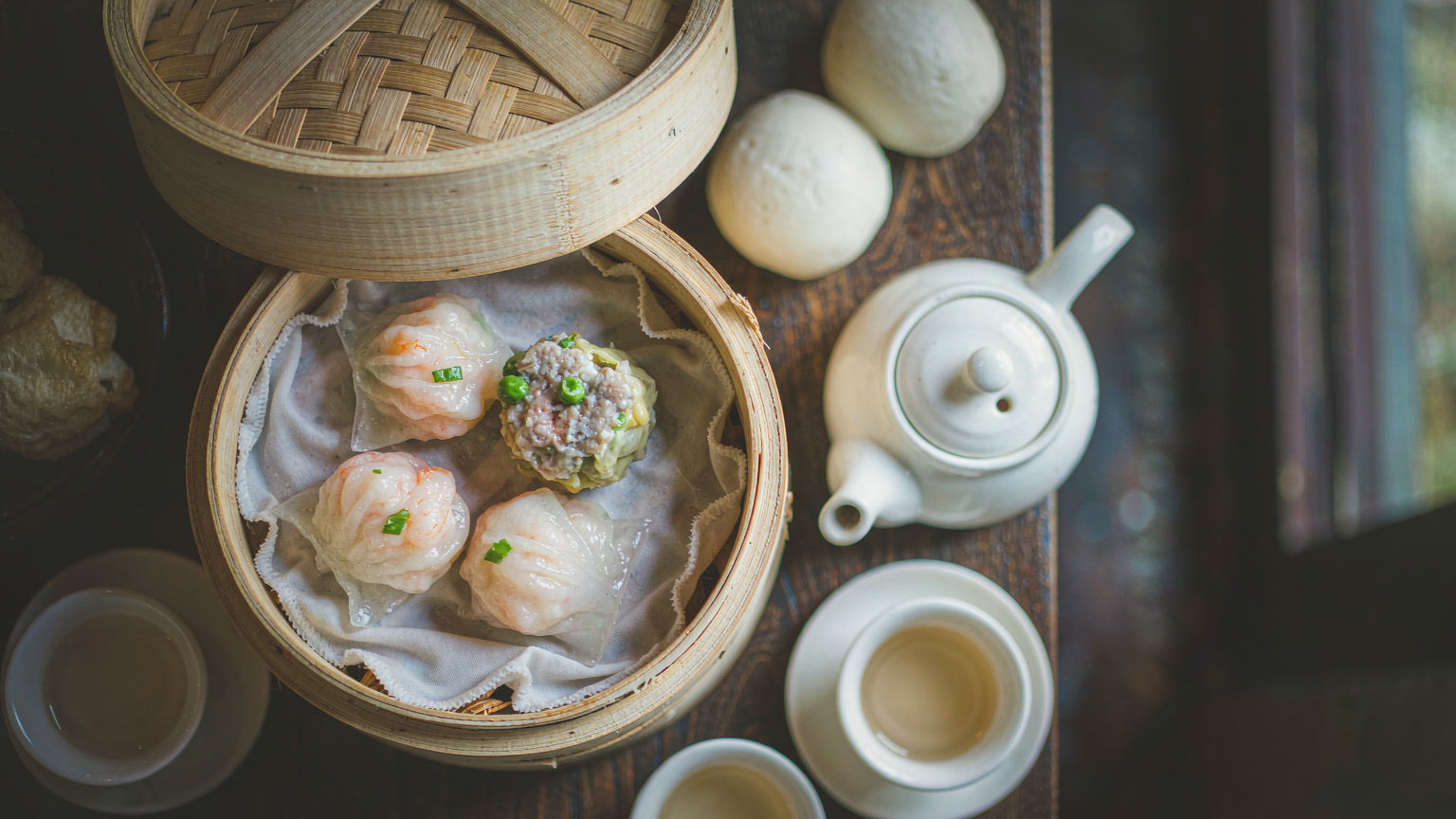
Yum cha (饮茶) is the act — going for tea in the morning. Dim sum (点心) is what arrives. The old expression is 一盅两件, "one pot, two pieces." In Guangzhou it starts around seven and runs to late morning, later and much louder on weekends, when the big rooms queue.
You'll get har gow (虾饺), siu mai (烧卖), cheung fun (肠粉), lo mai gai (糯米鸡) and char siu bao (叉烧包). The trolley has mostly been replaced by a paper checklist in the big chains; I still see carts in a couple of older rooms, but I wouldn't plan around it. At a mid-range Guangzhou house I pay ¥40–60 a head and skip lunch. Tao Tao Ju (陶陶居), which dates its own founding to 1880, and Guangzhou Restaurant (广州酒家) from the 1930s are worth one visit each; after that I go wherever the room is loudest.
Side by side: Cantonese food vs the other seven
| Cantonese (粤菜) | Chinese food, all eight cuisines | |
|---|---|---|
| Heat | Rarely; heat belongs to a dish, not the cuisine | From none at all to numbing (Sichuan, Hunan) |
| Main techniques | Steaming, fast stir-fry, roasting, long-simmered soup | Those plus braising, dry-frying, smoking, curing |
| What it aims at | The ingredient's own taste | Often the seasoning itself (麻辣, 咸鲜, sweet-sour) |
| Signature dishes | White-cut chicken, steamed fish, char siu, har gow | Hot pot, mapo tofu, Peking duck, Wuxi ribs, 60 more |
| Breakfast | Dim sum, congee, rice noodle rolls | Noodles, steamed buns, soy milk, fried dough — by province |
| Outside China | The base of most Chinatown menus | Represented unevenly; Sichuan arrived much later |
| Typical cost | ¥40–60 a head for mid-range dim sum | ¥60–90 a head for a Chengdu hot pot dinner |
What to order first in Guangzhou
Order one thing to test the kitchen: beef chow fun. Wok hei is either there or it isn't, and no sauce fakes it. After that, white-cut chicken, a whole steamed sea bass, a clay pot rice (煲仔饭) with cured sausage, and whatever soup the room is serving — ask for it first, because the good ones run out.
My bias: skip the sweet-and-sour pork. You can get that in Cleveland. In Guangdong it's for children and banquets, and it tells you nothing about why people here are picky about a chicken.
So which one should you actually ask for?
If what you love is the Chinese food you grew up with, you want Guangdong — that's where the menu came from, and it's better there because the fish was alive this morning. If you want food that tastes nothing like anything you've had, go to Sichuan or Hunan and accept two confusing meals.
Given one trip I'd go to Sichuan, because I like the numbness and I've had Cantonese food all my life. A friend finds Sichuan pepper unbearable and would eat in Guangzhou for a month instead. Neither of us is wrong — that's roughly what eight cuisines means.
If a Chinatown menu feels familiar, that's not a coincidence — it's a record of which province emigrated first.
Is Cantonese food the same as Chinese food?
No. Cantonese (粤菜) is one of China's eight great regional cuisines, centred on Guangdong. Chinese food covers all eight and everything under them. Cantonese became shorthand abroad because most early Chinese restaurant owners emigrated from Guangdong — not because it represents the whole country.
Is Cantonese food spicy?
Mostly no. Chili appears in individual dishes, not across the cuisine, and the aim is the ingredient's own freshness — steamed fish, poached chicken, clear soup. For real heat you want Sichuan (麻辣, numbing) or Hunan (香辣, dry and direct).
What's the difference between dim sum and yum cha?
Yum cha (饮茶, "drink tea") is the occasion; dim sum (点心) is the food. In Guangzhou it starts around 7am and runs to late morning. You tick dishes off a paper sheet at most large restaurants now — the trolley has largely gone, though a few older rooms still push one.
If I like Chinatown Chinese food, will I like Cantonese food in Guangzhou?
Almost certainly, and sharper. The menu will look familiar — roast pork, wontons, rice noodle rolls, congee — but the ingredients are fresher and the cooking less sweetened than the versions adapted overseas. Budget ¥40–60 a head for a mid-range dim sum morning. Don't expect chop suey.