
My first night market was 回民街 (the Muslim Quarter) in Xi'an, on a Thursday in late September. I stood in front of a charcoal grill for four whole minutes without ordering anything, because I could not work out how the transaction was supposed to begin: there was no menu, no counter, and no obvious moment to speak. Nine visits later — Xi'an, 户部巷 in Wuhan, 坡子街 in Changsha — these are the nine questions I wish somebody had answered before that first silent four minutes.
Do I need cash at a night market, or is my phone enough?
Your phone is enough. Every skewer stall I have bought from had a printed QR code within arm's reach, usually two — one for Alipay (支付宝), one for WeChat Pay (微信支付). I carried ¥200 in notes across a week of night markets and spent ¥20 of it, on 冰粉 from a woman whose printer had run out of ink. Keep cash as insurance, not as the plan. Do the tourist-mode verification on hotel wifi first.
How much does a night market meal actually cost?
Less than any sit-down dinner you will have in China. Skewers run ¥3–10 each depending on what is on the stick, and a filling walk-around meal lands at ¥40–70 a head. My three logged nights: ¥58 in Xi'an, ¥43 in Wuhan, ¥71 in Changsha — and the Changsha total included two drinks I bought purely to put out a fire. If a stall has no prices displayed, ask 多少钱 (duōshǎo qián) before handing anything over.
How do I order when there is no menu and no English?
Point, count, nod. The whole grammar is: 这个 (zhège) — this one — plus a number of fingers, plus the word 一串 (yī chuàn) for one skewer or 一份 (yī fèn) for one portion. Fingers are clearer than spoken numbers, because tones make 四 and 十 sound alike to an untrained ear. If you need a quantity above ten, type the digits on your phone and hold up the screen. Nobody has ever looked annoyed at me for pointing.
How spicy is 微辣, and how do I ask for less?
Spicier than you think. The scale runs 微辣 (wēi là, mild) → 中辣 (zhōng là, medium) → 特辣 (tè là, very hot), and 微辣 is calibrated to local customers, not to visitors. Say 我要微辣 before the food goes on the grill, not after. Even 不要辣 usually means the chili flakes are left out, not that the chili oil in the base sauce was removed. I ordered 中辣 in Changsha once and drank three iced teas getting through it.
Is street food in China safe to eat?
I can only tell you what I look for, not guarantee anything. Three things: queue length, because a stall turning over fast is not holding cooked food; cooking to order, because you can watch yours being made; and oil colour, because oil that has gone dark and thick has been working a long shift. I counted 23 stalls along one Xi'an lane and the four with the longest lines were all grilling or boiling to order. Pre-made cold dishes sitting in an open tray are the ones I skip.
Can I take food away, or do I have to eat standing up?
Either, and the word decides it. 在这儿吃 (zài zhèr chī) means eating here; 打包 (dǎbāo) means wrap it up. Skewer stalls often have a few folding tables behind the grill — sitting down is normal, and nobody will rush you. If you are taking it back to a hotel, say 打包 and expect a plastic box with the sticks poking out. Check the room has a bin before you order anything on a bamboo stick; the sticks are not edible and are not small.
What time should I arrive?
Between 18:30 and 19:00. Stalls start setting up around 17:00 and the lanes hit peak crush from 19:30 to 21:00. I turned up at 18:40 on a Wednesday in Wuhan and queued four minutes; the same lane at 19:30 on a Saturday took seventeen minutes for the same 臭豆腐. Late has one advantage — after 21:30 the last-hour sellers knock prices down on whatever is left rather than pack it up.
Do night markets run in winter, or when it rains?
The famous outdoor ones run year-round, but weather thins them out fast and heavy rain closes the flimsy ones entirely. Winter does not mean cold food — it means more hot pots, more roast sweet potatoes and more skewers, plus plastic sheeting over everything. If the weather turns, every Chinese city has the fallback: the food floor in the basement of a shopping mall, which is indoor, warm, equally cheap and much less fun. Do both.
What should a first-timer order?
Start with one thing you can watch being cooked. 肉夹馍 in Xi'an — chopped braised pork in a flatbread, about ¥10 — is the safest first purchase in the country. Then one skewer round, then something regional: 臭豆腐 in Changsha, 糖油粑粑 if you have a sweet tooth, 冰粉 to cool down afterwards. Order one item at each stall rather than four at one; the point of a night market is walking between them.
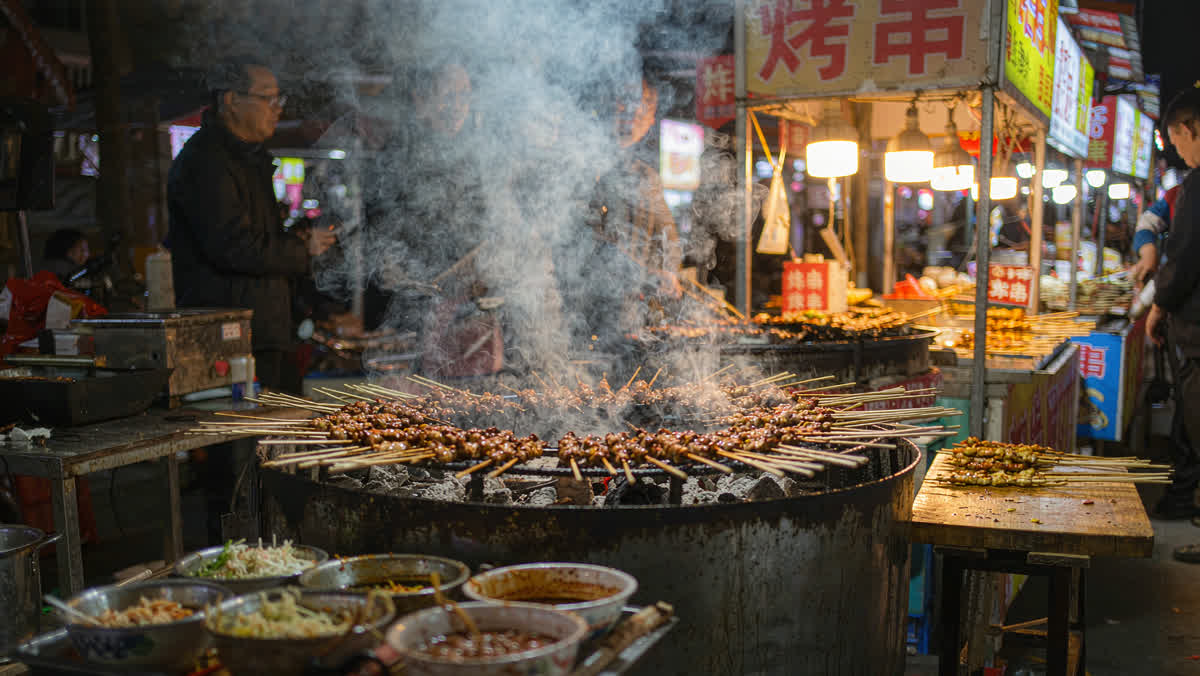
Four habits that made night markets easy
Eat the first one standing up. Sitting down commits you to a stall before you know whether it is any good, and there are forty more stalls down the lane.
Carry a small pack of tissues and hand gel. Half the stalls have no sink and no napkins, and you will want both before the second skewer.
Pay per stall, not per person. There is no shared bill. Whosever food it is, whosever phone pays, immediately, before the seller turns to the next customer.
Photograph the stall sign before you eat. Night markets are nearly impossible to navigate twice — the lanes look identical and the stall you loved will have moved two days later.
Nine night markets in, the only one I regret is the one where I was too embarrassed to point. Nobody in the queue was looking at me; they were all deciding between the same two skewers.