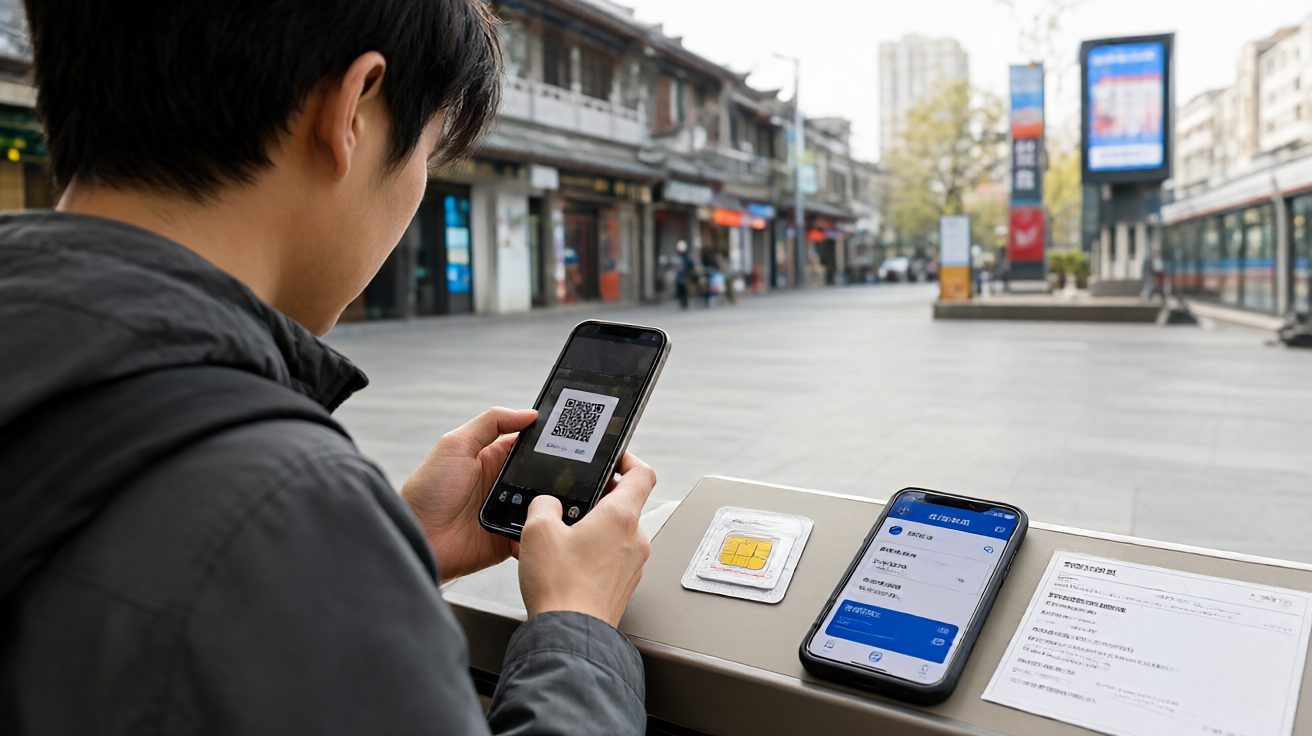
Set up China's digital life in this exact order: buy a passport-registered SIM at the airport, register your stay within 24 hours, create WeChat and Alipay accounts, link an international card, then add metro QR and a delivery address. Each step takes under 30 minutes. Total setup time: one day.
Why this order matters
Each step in this checklist unlocks the next. You need a SIM card before WeChat, because WeChat registers to your phone number. You need WeChat or Alipay before transport, because metro QR and bike unlocking run through those apps. You need a payment account before Taobao, because purchases settle through Alipay.
Before you fly, download WeChat, Alipay, Didi, and Taobao. These four apps cover messaging, payments, transport, and shopping. Download them while you still have access to your home app store, because some app stores are not accessible from China.
Step 1: SIM card at the airport
Every SIM card sold in China requires real-name registration with your passport. This is a national rule enforced by the Ministry of Industry and Information Technology under the 2013 Telecommunications and Internet User Real-Name Registration measures. No passport, no SIM. See the China SIM Card guide for the airport counter walkthrough.
Where to buy at the airport
Major international airports in Beijing, Shanghai, Guangzhou, and Shenzhen have carrier counters in the arrivals hall. China Mobile, China Unicom, and China Telecom all operate these counters. Staff scan your passport, take your photo, and activate the card on the spot. The process takes 10 to 15 minutes.
What to check before buying
Confirm the plan includes data for the number of days you stay. Confirm the carrier's network covers the cities you visit. Ask for a receipt and keep the passport number matched to the SIM. Tourist plans at airport counters typically include data plus some domestic call minutes.
What it costs
Prices vary by carrier and plan. Compare the three counters before buying. Airport counters post prices clearly. A data plan for a one-week stay costs less than a one-month plan. Prices are set by each carrier, not by a government body.
Step 2: 24-hour stay registration
China's Exit-Entry Administration Law, Article 39, requires every foreigner to register their stay. If you stay in a hotel, the hotel registers you at check-in. If you stay in private accommodation, you must register with the local public security bureau within 24 hours of arrival. Failure to register can result in a warning or a fine.
The 24-hour rule applies to all foreigners, including tourists. Hotels handle it automatically, but private accommodation hosts must act. If you move to a new address, register again within 24 hours.
How hotels handle it
Hotels collect your passport at check-in and submit the registration to the local public security bureau automatically. You do not need to do anything. Keep the check-in record; you may need it when leaving the country.
How private accommodation works
Landlords or hosts in private apartments must take your passport to the nearest police station within 24 hours. Some cities allow online registration through the local public security app. Ask your host to confirm the registration is done. The police station issues a registration form.
Step 3: WeChat setup
WeChat is China's default messaging app and, with WeChat Pay, its default payment method. Set up the account with your Chinese SIM number, then complete real-name verification to unlock payments. See the WeChat for Foreigners guide for the full walkthrough.
Account creation
Download WeChat from the App Store or Google Play. Open the app, select your country or region code, and enter your Chinese SIM number. WeChat sends a verification code by SMS. Enter the code and set a password.
Real-name verification
Real-name verification links your WeChat account to your passport. Go to Me, then Services, then Wallet, then Identity Information. Enter your name and passport number. WeChat verifies the information against the database. Verification takes a few minutes.
WeChat Pay and international cards
Since July 2023, WeChat Pay accepts international Visa, Mastercard, JCB, Discover, and Diners Club cards. This followed a People's Bank of China announcement improving payment services for foreigners. Bind a card in WeChat Pay, and you can pay by scanning merchant QR codes or showing your payment code.
Top-up and balance
WeChat Pay can draw directly from your linked international card. You do not need to top up a balance first, though some users add money for small purchases. The People's Bank of China set a single transaction limit of USD 5,000 and an annual limit of USD 50,000 for international card payments through Alipay and WeChat Pay, under a 2024 payment-convenience measure.
Step 4: Mobile payments: Alipay vs WeChat Pay
China runs on QR code payments. Alipay and WeChat Pay both accept international cards. Most merchants accept both, but some small vendors only take one. Set up both to avoid payment failures.
Alipay setup
Download Alipay, register with your Chinese SIM number, and complete real-name verification with your passport. Go to Account, then Bank Cards, then Add Card. Bind your international Visa or Mastercard. Alipay supports international cards under the same People's Bank of China rules as WeChat Pay.
How to pay
Scanning a merchant QR code with the app's Scan function and showing your payment code for the merchant to scan both draw from your linked card or Alipay balance. Both methods work at any merchant that displays a QR code.
What is not possible
International card users cannot send person-to-person transfers to other users in most cases. The People's Bank of China limits apply to merchant payments. Cash is still accepted everywhere, and some small vendors prefer it. Keep some cash as backup.
Which to use
Use Alipay for Taobao and most online shopping. Use WeChat Pay for in-store purchases and WeChat mini programs. Both work at convenience stores, supermarkets, restaurants, and transport. Having both covers the full merchant network.
Step 5: Transport: metro, buses, shared bikes, ride-hailing
Public transport in China runs through QR codes in Alipay and WeChat. Shared bikes unlock through dedicated apps. Ride-hailing runs through Didi. Set up transport codes after your payment account works.
Metro and bus QR codes
Open Alipay and tap Transport, or open WeChat and tap Me, then Services, then Transport. Select the city you are in. The app creates a metro QR code. Scan it at the metro gate. The fare is deducted from your payment account. Metro fares in major cities typically range from RMB 3 to RMB 10 per trip, set by each city's metro authority.
Shared bikes
Three operators dominate China's shared bike market: Meituan Bikes, Hellobike, and Qingju Bikes. Each has its own app or mini program. Register with your phone number, add a deposit or link a payment method, then scan the QR code on the bike to unlock. Prices start around RMB 1.5 per 30 minutes. See the Shared Bikes in China guide for unlocking rules and fines.
Ride-hailing with Didi
Didi is China's main ride-hailing app. Download Didi, register with your Chinese SIM, and add a payment method. The app has an English interface. Enter your pickup and destination, confirm the fare, and the driver arrives. Fares are shown before you confirm.
Intercity trains
For intercity travel, buy tickets through China Railway 12306, the official railway booking platform. The app has an English version. Passport is required for booking and boarding. High-speed rail connects most major cities.
Step 6: Shopping and delivery: Taobao
Taobao is China's main online shopping platform. It requires an Alipay account and a delivery address. Set up the address after your payment account works.
Account and address setup
Register on Taobao with your phone number. Link your Alipay account. Add a delivery address in the Address Book, including your building and apartment number. Chinese delivery addresses need the full address, not just a street name.
How to order
Search for items, add to cart, and check out. Taobao settles payment through Alipay. Sellers ship within 1 to 3 days. Delivery in major cities takes 1 to 5 days. Track parcels in the Taobao app.
International shipping
Taobao also ships internationally through its consolidated shipping service. Select your home country as the delivery destination at checkout. International shipping takes 7 to 15 days and costs vary by weight and destination. Customs fees may apply on arrival.
Delivery to your location
Couriers deliver to the address you enter. For apartment buildings, couriers usually leave parcels at the building's delivery locker or front desk. You receive an SMS with a pickup code. Some buildings have smart lockers that store parcels.
Food delivery
Meituan and Ele.me are the two main food delivery platforms. Both have English interfaces or English-friendly features. Register with your phone number and pay through your linked payment account. Delivery takes 30 to 60 minutes in urban areas.
Step 7: Everyday errands: pharmacy, convenience store, banks
Everyday services in China run through the same payment systems. Pharmacies, convenience stores, and banks all accept QR payments. A few require cash or a bank card.
Pharmacies
Chinese pharmacies are regulated by the National Medical Products Administration. Look for the green cross sign outside the store. Pharmacies sell over-the-counter medicine without a prescription. Staff can recommend common medicines for colds, pain, and digestive issues. Pay by QR code or cash.
Convenience stores
Convenience stores in China include 7-Eleven, FamilyMart, Lawson, and Chinese chains like Quanjia and Meiyijia. They sell snacks, drinks, toiletries, and SIM top-up cards. All accept QR payments. Most are open 24 hours.
Banks and ATMs
Foreign visitors can withdraw cash from ATMs with international cards. ATMs at major banks accept Visa and Mastercard. Withdrawal fees vary by bank. The People's Bank of China regulates the ATM network. Exchange currency at banks or authorized exchange counters.
Emergency numbers and what to check before you go
China has four national emergency numbers. Police: 110. Fire: 119. Ambulance: 120. Traffic accidents: 122. The numbers 110, 119, 120, and 122 work nationwide and operators can connect to English-speaking staff in major cities.
What to check before you go
- Passport valid for at least six months
- Visa requirements with the Chinese embassy or consulate in your country
- Download the apps you need before you arrive, because some app stores may not be accessible in China
- Google services, including Google Maps and Gmail, do not work reliably in China
What may change
Payment rules, visa policies, and app availability change. Check the People's Bank of China website for payment updates, the National Immigration Administration for visa rules, and the Ministry of Foreign Affairs for travel advisories.
Setup sequence at a glance
- Buy a SIM card at the airport with your passport
- Register your stay within 24 hours
- Create WeChat and complete real-name verification
- Create Alipay and bind an international card
- Add metro QR and shared bike access
- Add a delivery address in Taobao
| Step | What you set up | Time | What you need |
|---|---|---|---|
| 1 | SIM card | 10-15 min | Passport |
| 2 | Stay registration | 10 min | Passport, address |
| 3 | 20 min | Chinese SIM, passport | |
| 4 | Alipay | 20 min | Chinese SIM, passport |
| 5 | Metro QR | 5 min | Alipay or WeChat |
| 6 | Delivery address | 5 min | Address details |
What to bring and what to skip
Bring your passport, a backup payment card, and cash for the first day. Cash is useful for small vendors and as a backup if your card fails. Skip bringing a Chinese SIM from home; airport counters are faster and register the SIM properly. Skip downloading Google Maps; it does not work reliably in China.