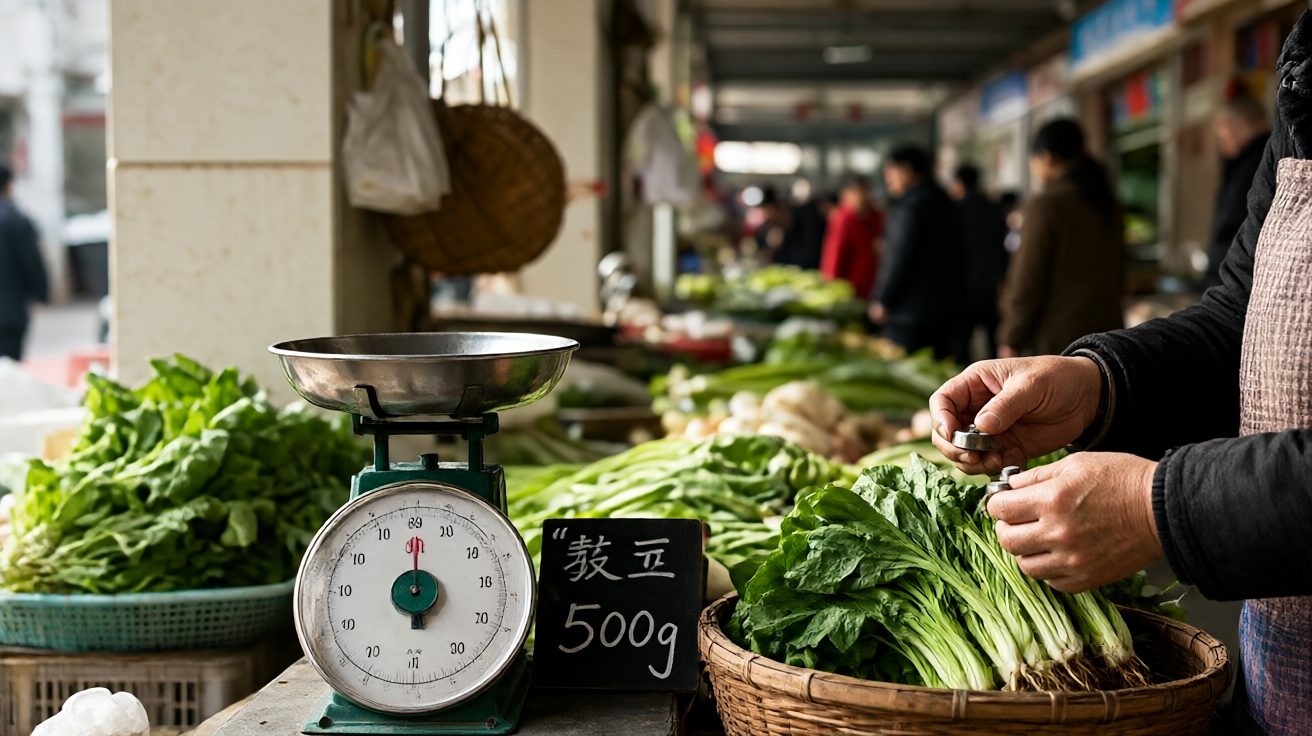
Short answer: In a Chinese market a jin (斤) is 500 g and a liang (两) is 50 g, but legal prices are quoted in grams and kilograms, not in jin. The board says ¥4.00/500g, the scale prints 0.500 kg, and the shopper says 一斤 — and the unit printed on both is what any dispute turns on. If a purchase looks light, the market's marked fair scale (公平秤) is the check that counts.
Why a jin survives in a metric country
China's legal measurement system is metric, and the rules are recent enough to be worth stating plainly. Article 3 of the State Administration for Market Regulation's measures on restricting non-legal units (非法定计量单位限制使用管理办法, Order No. 90, published 18 March 2024, in force 1 June 2024) defines the legal units as the SI units plus the units the state has selected, and then names one category as expressly prohibited: 市制 units used in market trade. The same measures leave a narrow opening for special-needs settings, and Article 8 requires any such use to be paired with the equivalent legal unit or a stated conversion. Customary daily-life usage is one of the four settings it lists, next to scientific and news writing, product packaging and manuals, and the nameplates of imported equipment.
What that produces at a vegetable stall is a small act of translation. The shopper says 一斤, the scale prints 0.500 kg, and the price board reads ¥4.00/500g. All three describe the same quantity, and only the last two are the legal ones. The measures carry a penalty for getting this wrong: using a non-legal unit outside the permitted settings brings an order to correct, and for printed matter an order to stop selling plus a fine of up to CNY 1,000 (Article 12); failing to show the legal equivalent alongside a permitted customary unit brings a deadline to fix it and, if it is still wrong, a fine of up to CNY 1,000 (Article 13).
The four numbers worth memorising
- 1 liang = 50 g. The smallest unit you will hear in a market, said as 一两.
- 10 liang = 1 jin = 500 g. The working unit for fruit, vegetables, meat and loose staples.
- 2 jin = 1 kg. The bridge between what you say and what the scale displays.
- 半斤 = 250 g. Half a jin, the everyday small quantity.
The conversions you are most likely to need follow from those four: 5 jin is 2.5 kg, 10 jin is 5 kg, and 19 jin is 9.5 kg. Nothing in the arithmetic changes at the stall — only the words do, which is why pointing at a pile and holding up fingers works as well as saying the number.
Reading a board in three looks
First, the unit. A line reading ¥4.00/500g is a price of ¥8.00 per kilogram, and the same goods at ¥7.00/kg come out cheaper — a comparison that is easy to get backwards when the two numbers sit on neighbouring boards in different units. Per 500 g and per kilogram are both legal expressions; 斤 is the shorthand shoppers speak, and the gram figure should be there as well.
Second, weight or piece. Some things are not sold by weight at all: a bunch of greens, a whole pineapple, a portion from the hot-food counter. Ask whether the number on the board is per item or per 500 g before you commit, because the two readings are different numbers entirely.
Third, the display. A market scale shows kilograms — one jin appears as 0.5 kg — and the number that settles there is the settlement weight. Article 9(5) of the market rules below makes the measured quantity the basis of payment unless both sides agree otherwise, so the figure on the display, not the size of the pile you chose, is what you are buying.
Step by step at the stall
- Name the quantity. 一斤 for 500 g, 半斤 for 250 g, 两斤 for 1 kg, 三斤 for 1.5 kg. If the pronunciation will not come, point and hold up fingers; the number is the only part that has to land.
- Let it go on the scale, and watch. The seller must show the unit, the weighing process and the value on the display (Article 9(6)), so there is no reason for the scale to face away from you.
- Ask for a re-weigh if the number looks wrong. The same article gives you that right at the stall: where you disagree with the reading, the seller has to run the weighing again and show the value.
- Pay by QR code, and take the slip if there is one. A printed slip carries the weight, which is the piece of paper that matters later; a payment screenshot shows only the money.
- Cross-check at the fair scale before you leave, especially for meat, seafood and anything sold loose in bulk.
The fair scale is the argument-ender
Farmers' markets in China are required to keep a check scale on site. Article 5(6) of the market measurement rules (集贸市场计量监督管理办法, Order No. 94, published 4 December 2024, in force 1 March 2025) obliges the market operator to set out fair scales and fair measuring tapes in a prominent, convenient position and to mark them; Article 5(4) requires staff who run the market's measurement work, and Article 5(5) requires the market's compulsory-verification instruments to be registered and filed with the local regulator. Where the scale is missing, the regulator orders the operator to fix it and can fine up to CNY 10,000 if the operator refuses or the case is serious (Article 13).
Look for a marked platform scale near the market office or the main aisle — the rules govern the marking and the prominence, not the exact spot. Put the bag on it, compare the reading with what you paid for, and keep the goods in the state you bought them; that condition is written into the claim procedure, not a formality invented by the market.
When the weight is short
Article 12 sets out the route. A purchase that turns out light, checked with the goods still in their original condition, can be taken back to the seller for compensation; if the seller's lease has already ended, the claim can go to the market operator, who then has a right to recover the amount from the seller. Where a seller has used an instrument built to cheat — defined in Article 16 as one that falsifies, alters or tampers with the measurement so the displayed value differs from the real one — the conduct can amount to fraud, and Article 12 points to Article 55 of the Consumer Rights Protection Law, which is where the enhanced compensation for fraud is set.
Escalation, in order: the seller, then the market operator, then the local market supervision department. Article 11 makes that department responsible for accepting measurement disputes and for mediation and arbitration testing, so a complaint does not depend on the market's goodwill. The penalty structure gives the complaint teeth: a seller who should have weighed the goods but did not, and who refuses to correct it, is exposed to a fine of up to CNY 10,000 (Article 14), and an operator who shields a rigged scale to a fine of up to CNY 50,000, or up to CNY 100,000 where the case is serious (Article 13).
What-if edge cases
- Pre-packed goods. A sealed tray of fruit or a bag of rice is a pre-packaged commodity, and its net-content rules apply: the net weight printed on the pack is the goods, with packaging excluded (Article 9(7) refers those sales to the separate pre-packaging measures).
- Live seafood and wet goods. Agree the handling before the basket goes on the scale, because the displayed value becomes the settlement basis unless both sides agree otherwise (Article 9(5)). Once the number is on the display, the negotiation is about the price, not the weight.
- Bargaining. The unit price is open to negotiation at many stalls; the weight is not. A discount that arrives by way of a lighter reading is the one thing the fair scale exists to catch.
- Fixed market or roadside stall. The fair-scale duty attaches to a 集市 as defined in Article 2 — a fixed site where vendors rent space from an operator and sell produce or daily goods. A roadside stall or a night-market cart sits outside that definition, and the route there is the market supervision department directly.
- Supermarkets. A supermarket label carries the weight of what you bought; where the label and the goods disagree, the service desk is the first stop and the market supervision department the second.
Official channels
State Administration for Market Regulation — Measures on Restricting the Use of Non-Legal Units — which units are legal, which are prohibited in market trade, and when a customary unit must be shown with its metric equivalent. In force 1 June 2024.
State Administration for Market Regulation — Measures for Measurement Supervision of Farmers' Markets — the fair scale, the right to a re-weigh, short-weight claims and the fines attached to each failure. Published 4 December 2024, in force 1 March 2025.
Last checked (2026-11) · Source: samr.gov.cn. Both texts above were opened and read at the time of writing; every article number cited comes from those texts, and local practice at a specific market should be confirmed with its management office.
Weight is only the first of the everyday translations a visitor has to make. Clothing labels are the same exercise in a different alphabet, which is what the guide to Chinese clothing and shoe sizes unpacks, and the price level itself is covered item by item in the guide to what twenty everyday things cost. The rest of the life section follows the same rule: read what the sign says, then check what it actually means.