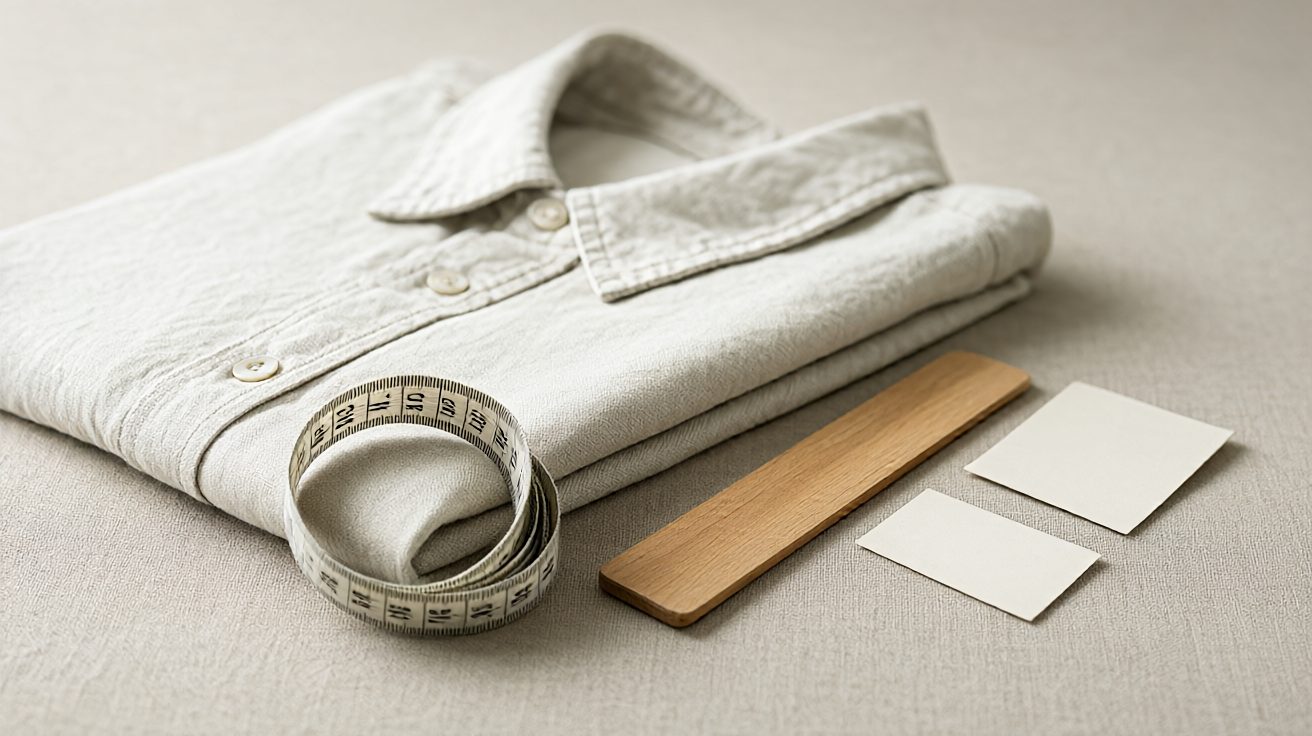
Short answer: a Chinese clothing label tells you which body the garment was cut for, not which Western letter you should buy. 170/88A means the piece is drafted for someone 170 cm tall with an 88 cm chest and a standard build; a shoe marked 240 is made for a foot 240 mm long. The S, M and L letters printed beside those numbers are a shop convention, not a conversion rule, so the number worth trusting is the one given in centimetres or millimetres.
What 170/88A actually means
Chinese adult clothing is sized with a two-part code, and both parts are measurements of the body rather than of the garment. The first number (号) is height in centimetres, stepped in 5 cm intervals — 155, 160, 165, 170, 175, 180. The second number (型) is chest circumference for men and bust circumference for women, stepped in 4 cm intervals — 80, 84, 88, 92. The letter after the slash is a body-type class that records how much the chest measurement exceeds the waist: Y is the trimmest class, A is the standard build most stock is cut for, and B and C are progressively fuller. An 88A and an 88B therefore share a chest measurement but are not the same garment.
The codes come from a national standard series: GB/T 1335.1-2008 for men's sizing, GB/T 1335.2-2008 for women's and GB/T 1335.3-2009 for children's clothing. All three are current: the adult parts took effect on 1 August 2009 and the children's part on 1 January 2010, and all three can be looked up by standard number in the national standards database at openstd.samr.gov.cn.
One caveat matters more than the code itself: the GB/T prefix marks a recommended standard, not a mandatory one. A brand may print 170/88A on the label and still cut the garment on its own block, and many do. The code narrows the search; it does not guarantee the fit.
Why the letter on the tag is the least useful number
There is no official table that converts a Chinese L into an American L, because the two systems do not measure the same thing. Chinese sizing starts from a shorter, narrower body block, and the difference shows up first in shoulder width and sleeve length rather than in the chest. A Chinese XL and a US M can share a chest measurement while the Chinese garment sits 4 cm shorter in the sleeve and 2 cm narrower across the shoulders. Shoppers who order their usual letter size tend to find that the body fits and the sleeves do not.
Three words on a Chinese listing are worth learning before you rely on letters at all:
- 修身 (xiūshēn) — slim cut. The same size number produces a closer fit, and the chest figure on the chart is usually the garment's, not the body's.
- 宽松 (kuānsōng) — loose cut, often written as oversize. Here the letter says almost nothing; the chart is the only guide.
- 均码 (jūnmǎ) — one size. It means "one size we hope fits most", not "fits everyone". Check the measurements and treat stretch fabric differently from woven fabric.
Measure five numbers, once
Five measurements settle almost every clothing decision, and taking them once into a phone note removes the guesswork from every later order. Use a soft tape, keep it level, wear light clothing and stand normally — pulling the tape tight is the most common way people talk themselves into the wrong size.
- Chest: around the fullest part, tape under the arms and level across the back, arms down, measured after a normal breath out.
- Waist: the narrowest point of the torso, roughly a finger above the navel, not where your trousers sit.
- Hip: around the fullest part of the seat with your feet together.
- Shoulder: across the back, from one shoulder point to the other.
- Foot length: heel against a wall, standing on paper, mark the tip of the longest toe; measure both feet and use the longer one.
Write everything in centimetres and keep it where you can open it in a shop. Chinese size charts are metric, so a tape that reads only in inches adds a conversion step to every comparison and a chance of error to every order.
Reading a Chinese size chart without getting it wrong
Listings on Taobao, Pinduoduo and JD carry a 尺码表 (size chart) under the photos. It is a table of garment measurements, not body measurements, and the headers tell you which column is which: 衣长 (garment length), 肩宽 (shoulder), 胸围 (chest), 腰围 (waist), 臀围 (hip), 袖长 (sleeve) and 裤长 (trouser length).
Four rules cover most of it:
- 平铺 versus 一圈. If the header says 平铺 (laid flat), the figure covers one side of the garment only, so double it before comparing with your body measurement. If it says 一圈 (all round), the figure is already the full circumference.
- Compare garment to body, then add room. A jacket cut to your exact chest measurement will not close over a sweater. A normal fit leaves roughly 4 to 8 cm of ease at the chest, a loose fit 10 cm or more, and knitwear can sit closer than woven fabric.
- Treat 2 cm as noise. Figures on a listing are rounded, fabric is cut in stacks, and a centimetre or two either way is normal rather than a defect. Falling between two sizes, take the larger one for woven goods with no stretch and the smaller one for knitwear.
- Ask the seller once. When the amount at stake is more than a few hundred yuan, send one message asking for the actual measurement of the piece in your size. Customer service answers this all day, and the answer beats any published table.
Shoes: what the number on the box means
Chinese shoe numbers are foot lengths in millimetres, in 5 mm steps: 230, 235, 240, 245 and so on. A 240 is built for a 240 mm foot, which is why the numbers look nothing like the European 37 or 38 you may be used to. The current national standard for 鞋号 (shoe size) is GB/T 43293-2022, which took effect on 1 May 2023 and superseded GB/T 3293.1-1998; the older standard now appears as abolished (废止) in the same official database that lists its successor.
Conversion, not memory, is the reliable route. China also publishes a footwear size comparison standard, GB/T 36935-2025, which took effect on 1 May 2026 and replaced the 2018 edition, so an official footwear size comparison table exists and is current. When a listing prints two numbers side by side, the millimetre figure is the 鞋号 and the other is usually the European equivalent; checking both against the official table is quicker than trusting a shop's own chart.
Measure the foot the way the standard does: stand on a sheet of paper with the heel against a wall, mark the tip of the longest toe, then measure from heel to mark in millimetres. Do it in the evening, when the foot is at its largest, and measure both feet — most people differ by a few millimetres and the longer foot decides. Add 5 to 10 mm for socks and for the fact that the foot slides forward when you walk. Width is the gap the numbers do not close: Chinese shoes are cut on one standard width, so wide feet should size up or look for 加宽 (widened) models instead of expecting a length number to solve the problem.
Children's sizes follow the same logic
Children's clothing follows GB/T 1335.3-2009 and uses the same 号 and 型 structure, but in practice most Chinese children's ranges are sold by height: 110, 120 and 130 mean the height of the child in centimetres. Charts often show both in the form 120/56 — 120 cm tall, 56 cm chest — where height drives the length of sleeves and trousers and the chest drives whether the garment closes. Buy for height, check the chest, and expect the child to outgrow the length before the width.
Children's shoes use the same millimetre 鞋号 as adults, so the measuring routine does not change. Measure both feet every time, because children's feet grow unevenly, and leave room for socks without jumping a whole size: a shoe that is too long trips a child more often than one that is merely snug.
If it does not fit: what protects your money
Three habits decide whether a size mistake costs you the item or only a return:
- Leave the 吊牌 (hangtag) on until you are sure. A garment that has been worn or washed with the tag removed is very hard to exchange, and "it did not fit" stops being a valid reason.
- Keep the packaging for the first week. Online purchases in China sit inside a seven-day no-reason return window under the consumer protection rules, and the original bag is part of what a seller may reasonably ask for. Our Taobao walkthrough covers the return flow step by step.
- Point at the chart, not at your opinion. If the size chart says a 96 cm chest and the tape says 90, the listing is wrong and the mismatch is the seller's problem; if the chart said 96 and you ordered anyway, it is yours.
Size exchange (换货) is normally free for the first attempt on unworn goods, while return shipping is where the argument usually starts; on platforms that sell 运费险 (return shipping insurance), paying a few yuan before a large order is the cheaper side of the bet.
The checklist before you pay
- Chest, waist, hip and shoulder written down in centimetres.
- The 尺码表 opened, and every 平铺 figure doubled.
- Ease added on purpose: 4 to 8 cm for a normal fit, 10 cm or more for loose.
- Foot length measured in the evening, plus 5 to 10 mm of allowance.
- The millimetre shoe number checked against GB/T 36935-2025 rather than the shop's own chart.
- 均码 listings read for real measurements instead of hope.
- Return window and tag rule understood before the first wash.
None of this needs Chinese. A tape, a phone note and the 尺码表 do the work, and the only words worth recognising are 胸围, 腰围, 臀围, 平铺 and 均码. For the rest of the everyday logistics of a stay in China — payments, SIM cards, deliveries, shared bikes — the life section collects the rules that are actually enforced. If you are still deciding what to bring rather than what to buy, the packing list is the better place to start.