
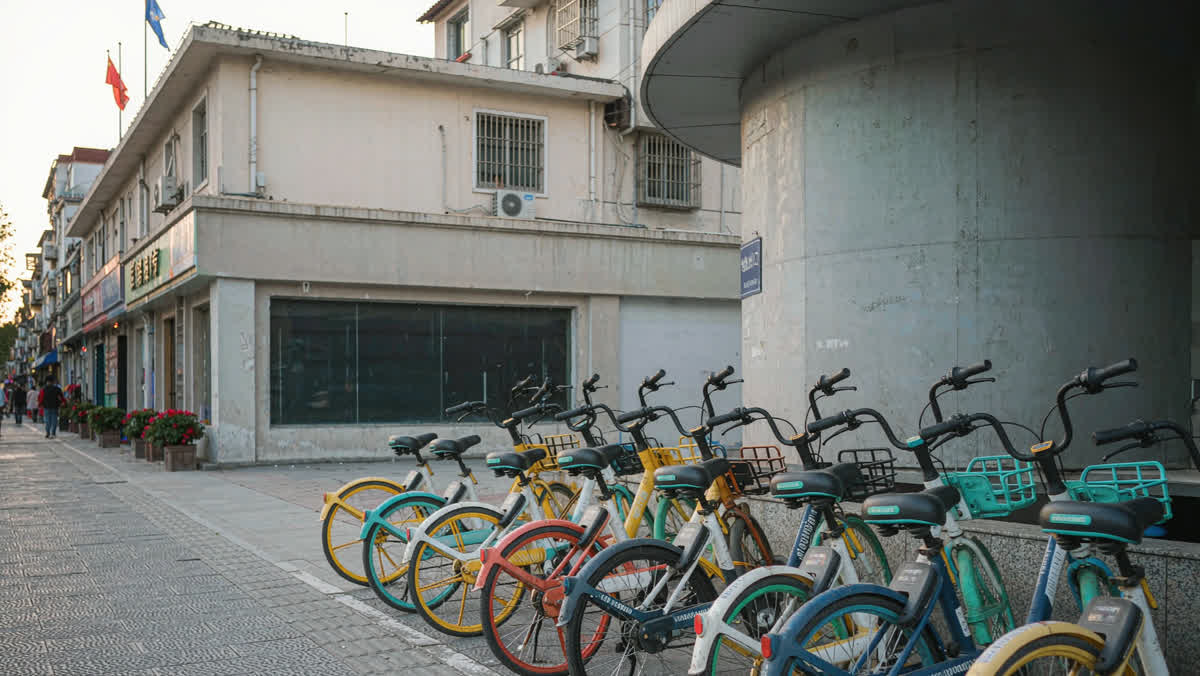
Where I was when this started
It was April in Hangzhou, I had 40 minutes before a meetup near West Lake, and the map said the walk was 25 minutes and the bus was 19. Then I noticed that every single person walking past me was on a bicycle that clearly did not belong to them. Yellow, blue, green — hundreds of them, lined up along the kerb like shopping trolleys outside a supermarket. I downloaded the first app I saw, scanned a code, and rode away in 90 seconds. I have been counting the rides ever since: 41 of them, across Hangzhou, Chengdu and Xi'an.
What actually happened, ride by ride
Week one (Hangzhou, 9 rides). The trick is that you do not unlock the bike through the bike's own app — you unlock it through Alipay or WeChat, by scanning the QR code on the rear wheel guard or the handlebar. No deposit, no registration form: Alipay checks your Zhima Credit (芝麻信用) score and if it is above roughly 550 you ride free of any deposit. The three apps that matter are Hello Chuxing (哈啰), Meituan Bike (美团单车) and Qingju (青桔), and one scan in Alipay covers most of them.
Week two (Chengdu, 14 rides). This is where I learned that shared bikes are a last-mile tool, not a transport mode. My average ride was 1.8 km and 11 minutes, and almost every one of them was metro station → destination. The best one: Tianfu Square to a hot pot place on Yulin Road, 2.4 km, 13 minutes, at 21:40 when the street was full of people eating outside. That ride is the reason I now think of Chengdu as a cycling city.
Week three (Xi'an, 18 rides). The standout was the Xi'an City Wall: the wall is 13.74 km around, and the rental bikes on top of it cost around ¥45 for 100 minutes. Instead I rode the public shared bikes around the outside on the moat-side path — free apart from the ¥1.5 ride fee — and did the whole loop in 68 minutes with stops at the Bell Tower and the south gate. No queue, no ticket office, no closing time.
What it cost me, in actual numbers
- 41 rides total, logged in my notes app with time and distance.
- ¥1.5 per 30 minutes on the pay-as-you-go rate — most of my rides were under 30 minutes, so most rides cost ¥1.5.
- ¥19.9 for a 30-day pass in the month I rode the most (18 rides in Xi'an): ¥1.1 per ride instead of ¥1.5. Worth it above roughly 14 rides a month.
- ¥0 deposit, because my Zhima Credit score cleared the threshold.
- ¥5 parking fee once — I left a bike outside the permitted zone near Xi'an North railway station and got charged a dispatch fee. That is the single mistake that cost me money.
- Total: ¥74.4 for 41 rides, or about ¥1.81 per ride across three cities.
For comparison, the same 41 trips by metro would have been about ¥120 and taken longer, because most of them were under 2 km — the distance where walking is slow and the metro is a detour.
The three mistakes I made so you don't
1. Parking outside the zone. The app draws a light blue area on the map. Ending the ride 100 metres outside it cost me ¥5. Ending it in a car park nobody can find costs you nothing but the app will nag you. Always close the ride on a public bike rack — there are painted rectangles on the pavement everywhere.
2. Trusting the map's bike count. The app shows bikes nearby, and the count is optimistic by one street. Twice I walked 4 minutes to a dot that had been ridden away. Rule: if there are fewer than 2 bikes showing within 200 metres, walk in the direction of the main road — bikes pile up near metro exits, never in the middle of residential blocks.
3. Riding at 18:00 on a weekday. Chinese cycling infrastructure is excellent — painted lanes, separated by a kerb on most newer roads — but at rush hour the lane is shared with electric scooters going three times your speed. I did it once in Chengdu and spent the whole ride being overtaken on both sides. Ride before 08:00 or after 19:30.
If I did it again
I would buy the 30-day pass on day one instead of day ten, and I would stop thinking of shared bikes as a budget option and start thinking of them as the thing that makes a Chinese city feel small. A 2 km gap on a map is a 25-minute walk or a 7-minute ride, and that difference is the entire difference between seeing four things in a day and seeing two. The one thing I would not repeat: the 13.74 km wall loop in the afternoon sun. Do it at 07:30, when the old men are doing tai chi in the moat park below and the only other cyclists are two delivery riders having a cigarette.
Forty-one rides, ¥74.4, three cities, one ¥5 fine. It is the cheapest way to feel like you live somewhere instead of visiting it.
Frequently asked questions
How do I unlock a shared bike in China?
Not through the bike's own app: you unlock it through Alipay or WeChat by scanning the code, which is what made the first week in Hangzhou work.
What shared bikes cost me
Over week one in Hangzhou, 9 rides, the per-ride price is cheap enough that the real lesson is not to treat them as a budget option but as the fastest way to move the last few kilometres.
What shared-bike mistakes should I avoid?
Parking outside the light-blue zone cost me 5 yuan; the 30-day pass bought on day one beats paying per ride; and the app draws the legal parking area on the map, so end the ride inside it.