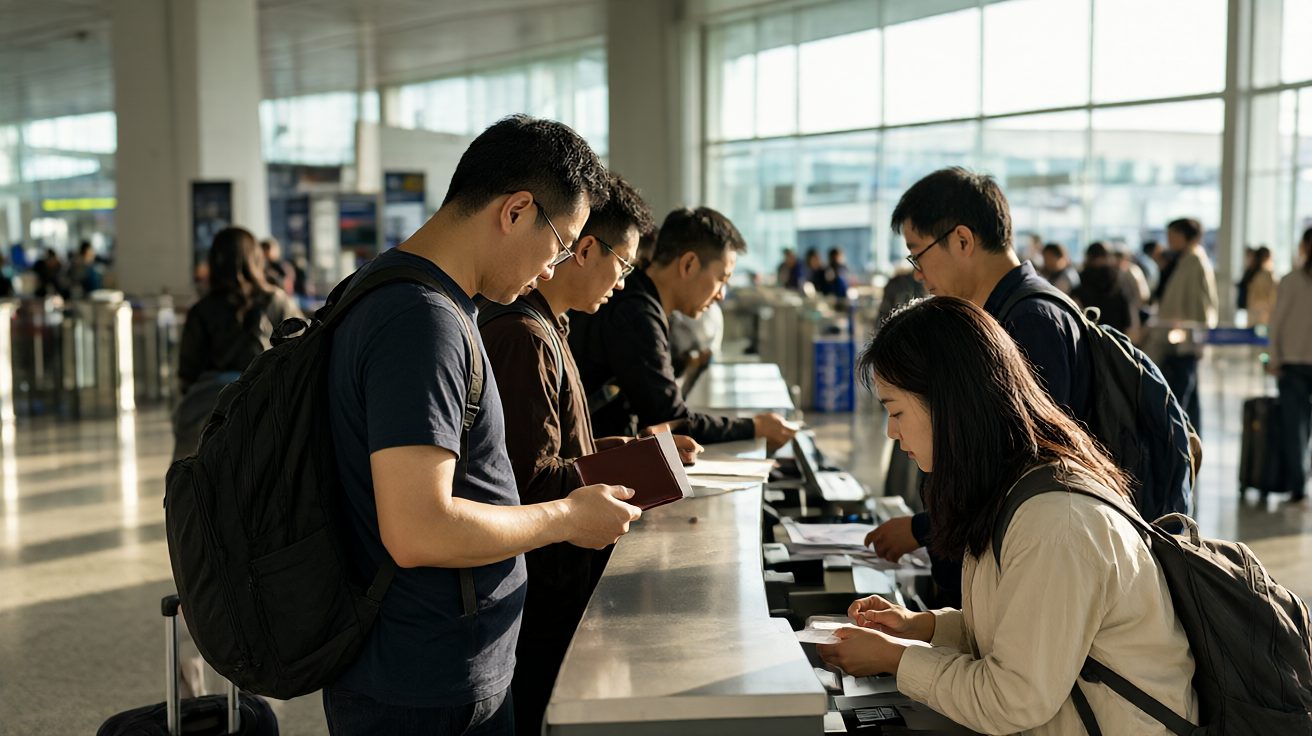
The short answer. You clear Chinese customs through a red or green channel, and the allowance depends on your route: mainland residents aged 18 or over returning from Hong Kong, China or Macao, China may bring in 12,000 yuan of personal goods duty-free, or 15,000 yuan with port duty-free purchases. Anything above the limits is taxed under the inbound-item duty measures in force since 1 December 2024. If you arrive on a foreign passport from outside Hong Kong, China and Macao, China, the notices set no single published value allowance for personal goods: the tobacco and alcohol quantities and the cash limits below still apply to you, and any value question is answered at the declaration desk.
Official channels. GACC Order No. 276 — customs supervision of inbound and outbound baggage, in force 1 April 2025; GACC Notice No. 43 of 2025 — which items must be declared in writing. Last checked (2026-11).
How much you spent is only one part of the decision at a mainland arrivals hall. Three questions settle it, in this order. Is the item for your own use? Does it sit inside a published limit? And did you tell customs about it before they looked inside the bag? The rules that answer those questions are in Order No. 276 of the General Administration of Customs, in force since 1 April 2025, together with the declaration notice issued the same day.
What counts as reasonable personal use
Baggage entering the mainland has to be for reasonable personal use. That phrase is the whole of the test in the customs order, and the order attaches no number to it: above that quantity the goods stop being baggage and are cleared under the cargo procedure instead.
In practice the officer is not auditing your budget; the question is what the goods are for. Several identical items, sealed retail stock, samples you are carrying for a client, or a second unit still in its box look like trade. One worn jacket, a laptop replacing the one that died on the way, and gifts for family do not. The consequence is administrative rather than criminal, but it is slow: the cargo route needs a customs declaration and, for many goods, a permit, and you then have three months to finish it.
The limits that are published, and the ones that are not
Two kinds of limit are written down: a quantity allowance for tobacco and alcohol that every traveller receives, and a value allowance that depends on where you are arriving from. The figures in force in November 2026 are these.
| Item | Limit |
|---|---|
| Cigarettes | 400 (200 when arriving from Hong Kong, China or Macao, China) |
| Cigars | 20 (10) |
| Cut tobacco | 500 g (250 g) |
| Alcohol above 12% alcohol by volume | 1.5 litres (0.75 litres) |
| Renminbi cash | 20,000 yuan; foreign cash above the equivalent of USD 5,000 must be declared |
| Personal goods, resident traveller arriving from Hong Kong, China or Macao, China | 12,000 yuan; 15,000 yuan including purchases at a port duty-free shop |
Do not mix these rows with online orders. Cross-border e-commerce retail imports (packages ordered through Chinese platforms and delivered to your door) run on a separate ceiling of 5,000 yuan per order and 26,000 yuan per person per year, and they never count toward anything in your suitcase.
The tobacco and alcohol figures come from customs' own guidance for arriving passengers. The value limit for arrivals from Hong Kong, China and Macao, China comes from Notice No. 7 of 2024, issued jointly by the Ministry of Finance, the General Administration of Customs and the State Taxation Administration.
That notice is narrower than the way it is usually quoted. It covers resident travellers aged 18 or over arriving from Hong Kong, China or Macao, China, and it took effect on 1 July 2024 at six crossings: Luohu, Futian, Shenzhen Bay, West Kowloon on the Guangzhou–Shenzhen–Hong Kong high-speed line, Gongbei, and the Zhuhai highway port of the Hong Kong–Zhuhai–Macao Bridge. From 1 August 2024 it applied at every port of entry, with the Hengqin first line left on its own regime and the second line into the mainland following the same 12,000 yuan figure.
It also does not change the rules for people who cross to Hong Kong, China or Macao, China several times within a short period, and it sets no figure for a traveller arriving on a foreign passport. For arrivals from anywhere else, the notices reviewed for this guide do not restate the general value allowance: the amount is applied at the declaration desk, so ask there rather than assume a figure.
Above whatever limit applies, duty is assessed under the Measures on Customs Duty, Value-Added Tax and Consumption Tax on Inbound Items, published by the Tariff Commission of the State Council as Notice No. 11 of 2024 and in force from 1 December 2024.
Red channel or green channel
Order No. 276 keeps the two-channel system and turns the choice into a legal one. If you carry anything that must be declared in writing, or if you do not know the rules well enough to be sure, you take the red channel. Everyone else may take the green one. Notice No. 43 of 2025, in force 1 April 2025, repeats the split, lists what triggers a declaration and replaced the 2007 notice on passenger declaration.
What has to be written down is a list, not an instinct. The inbound list in Article 9 of the order has ten items, which fall into seven practical groups.
| You must declare in writing if you carry | What that covers |
|---|---|
| Prohibited or restricted goods | Anything on the prohibited list; restricted goods above the quota, or without the permit or certificate the rules require |
| Animals, plants and their products | Live plants and animals, and products of animal or plant origin, including food that falls under quarantine |
| Items that raise public-health questions | Blood, human tissue, pathogens and biological products |
| Cash above the limit | More than 20,000 yuan in renminbi, or foreign currency above the equivalent of USD 5,000 |
| Goods above the allowance | More than the tobacco or alcohol allowance, or above the value limit that applies to your route |
| Commercial goods | Goods, trade samples or advertising material carried for business |
| Baggage travelling without you | Luggage arriving by separate shipment rather than in your hands |
Outbound travellers have a shorter list in Article 10: prohibited or restricted goods, commercial goods and samples, items of public-health concern, goods contaminated in a way that raises a quarantine risk, and cash above the limit.
Step by step at the declaration desk
- Decide before you queue. Read the seven categories above against what is actually in the bag, not against what you intend to keep.
- Fill the form, on paper or on a phone. The declaration is either the paper form or electronic data. Notice No. 43 of 2025 allows pre-filling in customs' passenger service mini-program, available inside WeChat and Alipay, or on the web, and then confirming the data at the desk on arrival.
- Present yourself, not just the form. At the declaration desk you show your travel document, hand over the paper form or confirm the electronic data, and produce any permit or certificate the goods require.
- Answer, and open the bag if asked. You or your agent must be present, move the bags as directed, open and reseal them, and answer the officer's questions.
- Pay or lodge a guarantee, then go. Goods are released once duty is paid or a guarantee is lodged and the permits are produced; anything subject to quarantine has to pass it first.
One timing rule catches people out. If you should have declared and you reach the inspection point without having completed the written declaration, the order treats it as no declaration at all — the channel you chose does not repair the omission afterwards.
What an inspection involves
Where and when a bag is examined is decided by customs, not by the traveller. If something in the bag is fragile or could hurt someone when opened, say so before the search starts: the order requires the person carrying it to declare that in advance. Officers may use equipment, tools and sniffer dogs, and may take samples.
Three smaller rules are worth knowing. Customs seals and marks must not be opened or damaged by anyone. Recording and photography in the customs area need permission. And anyone who is not arriving or departing has to use the staff channel and may not carry goods or duty-free purchases through the area.
When clearance cannot be finished at the airport
Not every problem is solved at the desk, and the deadlines are short. Article 23 of the order gives three months to finish a case that cannot be completed on the spot: duty still to be paid, a permit still missing, goods that have to move to the cargo procedure, a value or a description in dispute and waiting for testing, or a return that cannot be carried out immediately. Time spent in testing does not count against the three months.
Article 24 compresses that to seven days for dangerous chemicals, live or perishable goods, blood and biological products, and other categories customs lists. Items held for quarantine are detained for no more than seven days, unless laboratory or isolation quarantine is required, in which case the quarantine regulations take over. And if nothing is done at all, goods left unclaimed in the customs area for more than three months can be auctioned, sold or destroyed.
Baggage that travels separately, and goods that come temporarily
Luggage sent as unaccompanied baggage has to be declared when you arrive, not when the boxes do. Once customs agrees, you have six months from your own date of entry to finish the formalities; going the other way, the paperwork has to be done before you leave. Samples, professional equipment and other goods that will leave again can be declared on arrival, backed by a guarantee and endorsed, so that the same record clears them when they go back out.
Transit passengers who stay inside the customs area do not need a declaration form, but they may not leave baggage in the country without customs agreeing. Anyone who leaves the customs area is handled as an arriving traveller.
What-if edge cases
- Exactly at the limit. The order's definitions say that "above" does not include the figure itself, so 20,000 yuan in cash sits inside the line and 20,001 yuan does not.
- Posted to China, or here long term. Diplomats, non-resident long-term travellers including posted staff, foreign mountaineering groups and individuals, returning high-level talent and overseas experts working in China, and arrivals into the Hainan free trade port or other special areas are governed by their own rules rather than the general ones.
- Buying online instead of carrying. Cross-border e-commerce retail imports have a separate ceiling of 5,000 yuan per order and 26,000 yuan per person per year, which is separate from whatever is in your suitcase; the ordering steps are the ones set out in buying through Taobao.
- Leaving rather than arriving. Outbound clearance and the VAT refund on purchases made in the mainland are a different regime, covered in the departure refund rules.
- Your own medicine. Prescription medicine and regular over-the-counter items in a quantity consistent with your stay are personal goods, not shopping, and the reasonable-personal-use test is what decides them: carry them in original packaging and keep the prescription with you, since animal- and plant-derived products can fall under the declaration list for quarantine purposes. Sealed retail quantities of the same medicine look like trade goods and are taxed or held.
- More than one electronic device. The order's test is use, not count: a worn laptop plus a phone is personal use, and a replacement device for one that broke in transit is the same. Several new sealed units of the same model do not look that way, and they move to the cargo procedure with its duty assessment.
- Gifts for people in China. Gifts count as personal goods while they stay within a reasonable quantity and value for the person carrying them; a large volume of identical gifts is assessed as trade goods, and the gift itself is not a separate declaration line.
- Food in the bag. Fruit, meat and dairy products are animal or plant products, so they are declared under the quarantine heading rather than as shopping.
Common misconceptions
- "Duty-free means unlimited." It means within the allowance. Above it, the goods are assessed for duty, and above reasonable personal use they leave the baggage system entirely.
- "The green channel means no inspection." Both channels can be searched. The channel records whether you declared, nothing more.
- "The 12,000 yuan limit is for everyone." It is for resident travellers aged 18 or over arriving from Hong Kong, China or Macao, China. It does not apply to a traveller who lands in Beijing from Europe.
- "The tobacco numbers are annual." They are per traveller on arrival, and halved on the Hong Kong, China and Macao, China routes.
- "Filling it in online is the declaration." The electronic form still has to be confirmed at the desk before you reach the inspection point.
Official channels
- GACC Order No. 276 — the baggage supervision rules, including the declaration lists, the channel test and the three-month and seven-day deadlines.
- Order No. 276 in the State Council gazette — the same text in its official published form, useful when a link to the ministry copy changes.
- GACC Notice No. 43 of 2025 — red and green channels and the electronic pre-filling route, in force 1 April 2025.
- Notice No. 7 of 2024, Ministry of Finance, GACC and STA — the 12,000 yuan and 15,000 yuan allowances for arrivals from Hong Kong, China and Macao, China.
- Tariff Commission Notice No. 11 of 2024 — the measures on duty, VAT and consumption tax for inbound items, from 1 December 2024.
- Customs passenger guidance — the tobacco, alcohol and cash figures quoted above.
The rest of the life section covers the other systems that run alongside customs: what a pharmacy will sell you, how to send a parcel, and what a hotel does with your passport.