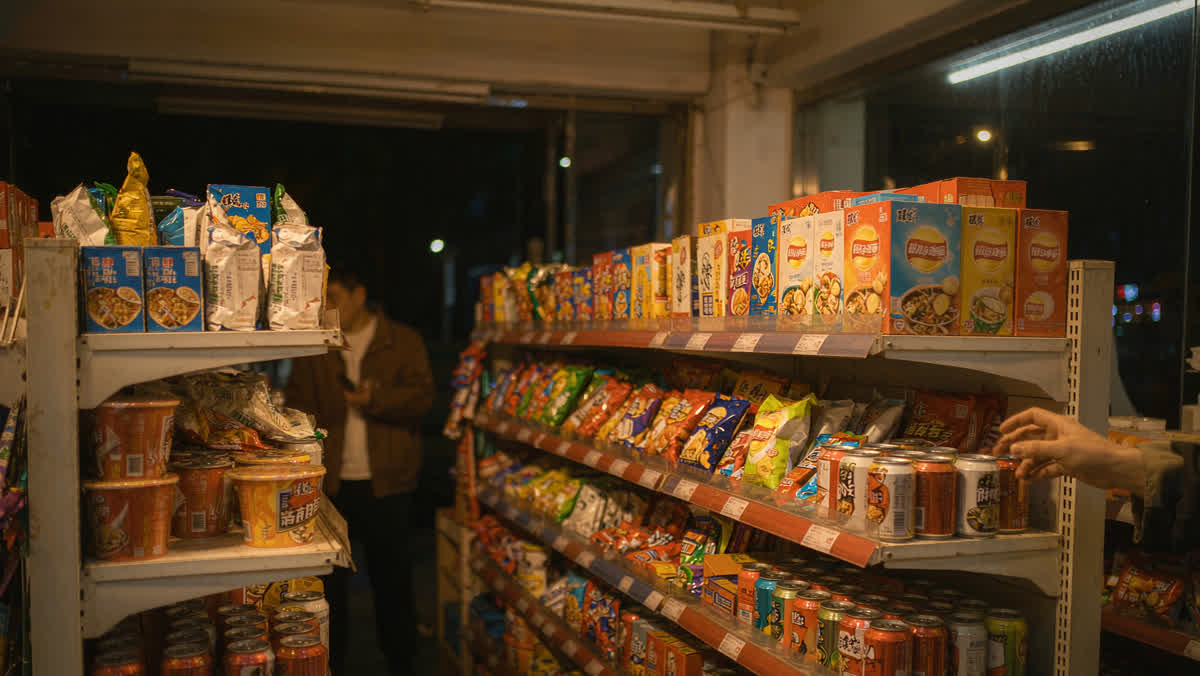
I kept every receipt for one week — 11 convenience store visits across 7‑Eleven, FamilyMart (全家), Lawson (罗森) and Bianlifeng (便利蜂) — and logged what each item cost. The finding is simple: a Chinese convenience store is not a markup trap for food, but it is a markup trap for anything that is not food. Drinks, buns, coffee and ready meals are priced within a yuan or two of a supermarket. Phone cables, umbrellas and emergency clothing are not.
The finding, before the table: the premium is concentrated in three items
Buying one of everything below costs ¥208.9 at the counter. Buying the same 18 comparable items at a supermarket or online costs ¥118.7. But ¥40 of that ¥65.3 gap sits in just three lines — the phone cable (+¥27), the umbrella (+¥10) and the ice cream (+¥3). Strip those out and the convenience store costs about 12% more, which is a fair price for a 3 am shop that is 90 seconds from your door.
The table: 20 items, what I paid, and the alternative
| Item | Convenience store | Supermarket / app | Where I bought it |
|---|---|---|---|
| Bottled water 550ml (Nongfu Spring 农夫山泉) | ¥2.0 | ¥1.5 | 7‑Eleven |
| Canned cola 330ml | ¥3.0 | ¥2.4 | FamilyMart |
| Unsweetened tea 500ml (Oriental Leaf 东方树叶) | ¥5.0 | ¥4.0 | 7‑Eleven |
| Bottled milk tea 500ml | ¥6.0 | ¥4.5 | Lawson |
| Hot Americano, self-serve | ¥9.9 | — | Bianlifeng |
| Latte, made to order | ¥15.0 | — | 7‑Eleven |
| Onigiri 饭团 | ¥4.5 | ¥4.0 | Lawson |
| Tea egg 茶叶蛋 | ¥2.0 | ¥1.5 | FamilyMart |
| Grilled sausage 烤肠 on a stick | ¥4.0 | ¥3.0 | Bianlifeng |
| Boxed lunch 便当 | ¥19.9 | ¥15.0 | FamilyMart |
| Sandwich, chilled | ¥9.9 | ¥8.0 | 7‑Eleven |
| Cup instant noodles | ¥6.0 | ¥4.5 | Lawson |
| Yoghurt 100g | ¥4.5 | ¥3.5 | 7‑Eleven |
| Fresh milk 950ml | ¥15.9 | ¥12.9 | FamilyMart |
| Beer 500ml | ¥6.5 | ¥4.5 | Lawson |
| Ice cream bar (imported brand) | ¥12.0 | ¥9.0 | 7‑Eleven |
| Pocket tissues, pack | ¥4.0 | ¥2.5 | Bianlifeng |
| Face masks, 10-pack | ¥9.9 | ¥6.0 | Meiyijia (美宜佳) |
| Folding umbrella | ¥29.9 | ¥19.9 | 7‑Eleven |
| Phone charging cable | ¥39.0 | ¥12.0 | FamilyMart |
Three things the table does not show
1. The chains are not the same shop. 7‑Eleven opened its first mainland store in Shenzhen in 1992 and still feels the most "international" — imported snacks, higher prices on chocolate, the best chilled coffee. Meiyijia (美宜佳), with more than 30,000 stores across China, is the one you will actually find in a small city: cheaper, franchised, more local brands, and open late in places where nothing else is. Bianlifeng (便利蜂) is the app-first one — you scan and pay at a self-checkout, and the hot food is reheated behind the counter.
2. The coffee is the real deal. A ¥9.9 self-serve Americano at a convenience store is made with the same kind of bean and the same espresso machine as a café charging ¥25. This is the single best-value thing in any Chinese convenience store, and it is why the price of coffee in China collapsed without anyone noticing.
3. Hot food is reheated, not cooked for you. The 便当 and the sandwich arrive sealed from a central kitchen. That is not a criticism — the cold chain is good — but do not expect the counter staff to make you anything. The items that are made in front of you are the tea eggs, the grilled sausages and the oden (关东煮) pot, and those are usually the most interesting things on the shelf. The oden pot is the one I would point a visitor at first: you point at what you want, it is ladled into a paper cup, and a bowl with three or four skewers comes to about ¥10–14.
4. The shelf price is not the price. Every one of these chains runs coupons inside Alipay or WeChat, not on a paper flyer: ¥2 off a drink, 20% off chilled food after 20:00, a ¥9.9 breakfast set that combines a bun and a coffee. This is why the exact same item cost me ¥15.9 on Monday and ¥13.5 on Wednesday — the difference was a coupon I did not know I had. Ask the counter "有优惠券吗?" (yōu huì quàn ma, "any coupons?") or just scan the QR code on the door before you pay. Cash is accepted everywhere, but roughly nine in ten people in front of me paid by phone.
How to use these numbers
Over my week I spent ¥163.4 across 11 visits, averaging ¥14.9 a trip. If I had bought the same things from a supermarket and a delivery app I would have saved roughly ¥30 — about 18 minutes of my time per week, priced at the cost of walking to a shop that is open at 23:40. My rule now: buy drinks, breakfast, coffee and emergency food at the convenience store; buy electronics, umbrellas, snacks in bulk and anything with a brand name on the packaging from a supermarket or an app. If the item's main value is that it is here right now, the markup is worth it. If the item's main value is the item itself, it is not.
Concretely, here is how I now budget. Breakfast from a convenience store is ¥6–10 (a bun plus a ¥2 tea egg, or an onigiri and a bottle of water) and it is genuinely cheaper than most sit-down breakfasts. Lunch is ¥15–22 for a 便当, which is the same as a basic restaurant meal but faster. Coffee is ¥9.9–15, which is the single best value in the shop. Everything outside those three — snacks in bulk, toiletries, electronics, anything with a brand logo on the packaging — I buy on a grocery app and wait the 30 minutes. If you are visiting China for a week, budget around ¥120–160 per person for convenience-store breakfasts, coffees and drinks, and you will not think about it again.
Eleven visits, ¥163.4, and one clear rule: pay the convenience premium for water, buns and coffee — never for cables, umbrellas or tissues.
Frequently asked questions
Is shopping at a Chinese convenience store expensive?
Buying one of 18 items costs 208.9 yuan at the counter against 118.7 yuan at a supermarket or online, but about 40 yuan of that premium is one big-ticket item; across a real week it was 163.4 yuan over 11 visits, roughly 14.9 yuan a trip.
Are 7-Eleven, FamilyMart and Lawson the same in China?
No, the chains are not the same shop: 7-Eleven opened its first mainland store in Shenzhen in 1992 and still feels the most international, so the price and stock differ by brand.