The first dish I ever ordered by myself in Chengdu was 水煮鱼. Two characters mean "water" and "boil," so I expected pale fish in a clear broth. What arrived was a bowl of poached fish under a centimetre of red chili oil, and I spent the next ten minutes drinking iced tea and pretending I had meant to do that. A Chinese menu is not a description of a dish — it is a set of instructions, and this page is the decoder for the 32 words that do the work.
Learn those 32 and you stop ordering by photograph. You also stop ordering three deep-fried dishes in a row because all three names sounded crisply promising, which is a mistake I have made in six provinces.
How to read a Chinese dish name
Almost every dish name follows the same grammar: cooking method + main ingredient, sometimes with a flavour word bolted on the front. 红烧肉 is red-braised pork. 清蒸鲈鱼 is plain-steamed sea bass. 干煸四季豆 is dry-fried green beans. Once you can see the seams, the menu stops being random characters and starts being a specification sheet.
Two things follow from that. First, the method word is the most informative part of the name, because it tells you texture and richness before you know what the thing is. Second, the ingredient is often written in a form you will not recognise from a dictionary — 肉 means pork unless something says otherwise, and 鱼 defaults to whatever is fresh that day. When in doubt, point at the method and let the waiter fill in the rest.
Heat and oil: the 11 method words
| 中文 | Pinyin | English | What you will actually get |
|---|---|---|---|
| 炒 | chǎo | stir-fried | The default. Fast, high heat, a little oil. If a menu only teaches you one word, this is it |
| 爆 | bào | flash-fried | Hotter and faster than 炒, often with the wok smoking. Crisp edges, sauce added at the last second |
| 熘 | liū | fried then glazed | Deep-fried first, then tossed in a thick sweet-sour sauce. Soft inside, sticky outside |
| 炸 | zhá | deep-fried | Fully submerged. Crisp and rich — order one per table, not one per person |
| 煎 | jiān | pan-fried | Shallow oil, one side at a time. Think potstickers and egg-coated fish |
| 烤 | kǎo | roasted / grilled | Dry heat. Skewers, whole fish, lamb. Usually the least saucy thing on the table |
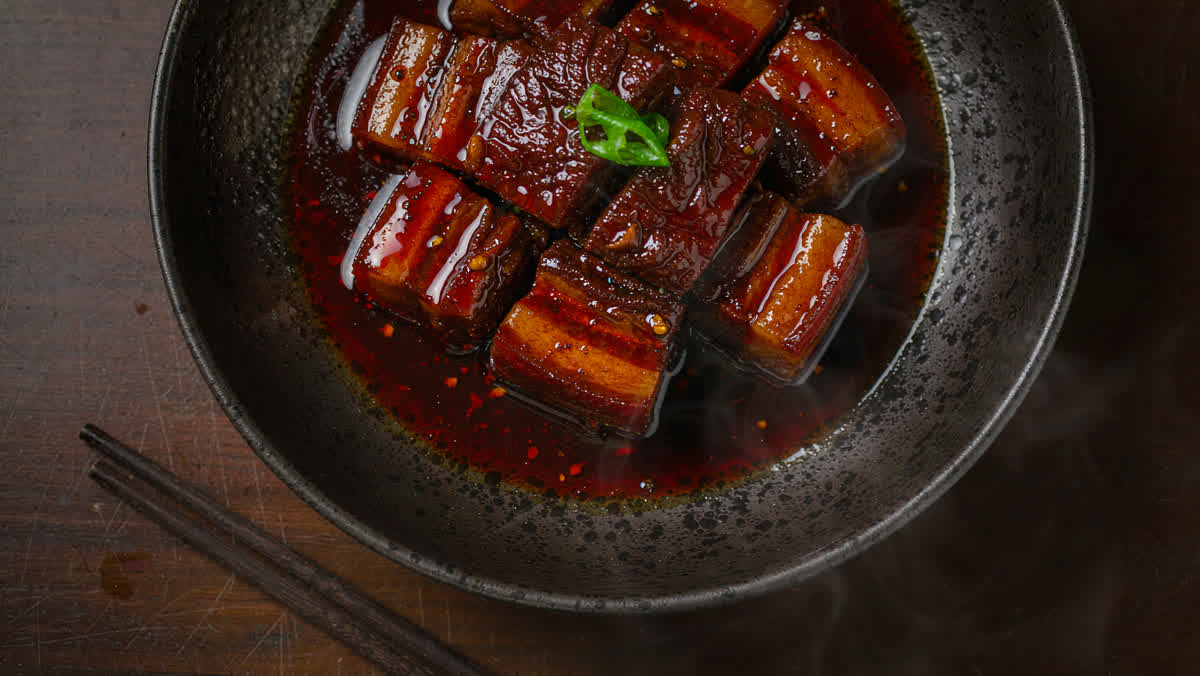
| 红烧 | hóngshāo | red-braised | Slow-braised in soy, sugar and caramel colour. Dark, glossy, falls apart with chopsticks |
| 清蒸 | qīngzhēng | plain-steamed | Steamed with ginger and scallion, finished with hot oil. The cleanest dish in the meal |
| 水煮 | shuǐzhǔ | water-boiled | The trap I fell into. Poached, then drowned in chili oil and peppercorn. Not mild |
| 干煸 | gānbiān | dry-fried | Fried slowly until the surface wrinkles and concentrates. Wrinkled green beans are the classic |
| 白灼 | báizhuó | blanched | Dropped in boiling water, served with a dipping sauce. Cantonese, and the mildest word here |
Flavour: the 10 words that decide the taste
| 中文 | Pinyin | English | What it tastes like |
|---|---|---|---|
| 鱼香 | yúxiāng | fish-fragrant | Contains no fish. Sweet, sour, garlicky, pickled-chili. Named for the seasoning used on fish |
| 宫保 | gōngbǎo | Kung Pao | Dried chili, peanuts, sweet-sour. Named after Ding Baozhen, a Qing official who liked it |
| 麻辣 | málà | numbing and hot | Chili plus Sichuan pepper. The 麻 is the tingle, and it is not the same sensation as heat |
| 酸辣 | suānlà | sour and hot | Vinegar-forward heat. Thinner and brighter than 麻辣, common in soups and noodles |
| 糖醋 | tángcù | sweet and sour | Sugar and vinegar, usually with a crisp fried base. Children's-menu territory, deliberately |
| 怪味 | guàiwèi | strange flavour | Sweet, sour, salty, spicy, numbing and sesame at once. Sounds like a dare, tastes deliberate |
| 孜然 | zīrán | cumin | Cumin and chili. Northern and northwestern — lamb skewers, not delicate fish |
| 蒜香 | suànxiāng | garlic | Lots of garlic, mild on chili. A safe order if you are avoiding heat but want flavour |
| 五香 | wǔxiāng | five-spice | Star anise, cinnamon, clove, fennel, Sichuan pepper. Warm and aromatic, usually braises |
| 家常 | jiācháng | home-style | "The way people cook at home." Mildly spicy, saucy, and reliably good value |
How it is cut: 6 shape words
| 中文 | Pinyin | English | Why it matters on the plate |
|---|---|---|---|
| 片 | piàn | slices | Thin and broad. Fish and meat sliced thin cook in seconds and soak up sauce |
| 丝 | sī | shreds | Julienne. Pork shreds, potato shreds — the classic test of a cook's knife work |
| 块 | kuài | chunks | Bite-size pieces. Braises and 红烧 usually come in chunks |
| 丁 | dīng | dice | Small cubes. 宫保鸡丁 is diced chicken, and the dice is why it cooks in one minute |
| 末 | mò | minced | Very fine. Used for aromatics and for fillings, rarely the main event |
| 段 | duàn | sections | Cut into lengths — scallion sections, eel sections, long beans snapped in half |
Five dishes whose names hide the main ingredient
| 菜名 | Pinyin | Literal meaning | What is actually on the plate |
|---|---|---|---|
| 蚂蚁上树 | máyǐ shàng shù | ants climbing a tree | Glass noodles with minced pork. The "ants" are pork bits, the "tree" is the noodles |
| 夫妻肺片 | fūqī fèipiàn | husband and wife lung slices | Cold beef offal in chili oil, no lung. A Chengdu classic named for the couple who sold it |
| 鱼香肉丝 | yúxiāng ròusī | fish-fragrant pork shreds | Pork shreds in the fish seasoning. Tastes of nothing aquatic at all |
| 狮子头 | shīzǐ tóu | lion's head | A large pork meatball, braised. The size of a fist, the texture of a cloud |
| 松鼠鳜鱼 | sōngshǔ guìyú | squirrel mandarin fish | Whole fish scored, fried and sauced so it curls up. Sweet-sour, crisp, bones scored loose |
If you remember only five
Memorise 红烧 (braised dark and soft), 清蒸 (steamed clean), 干煸 (dry-fried until wrinkled), 水煮 (poached in chili oil — the one that surprises people) and 凉拌 (cold-dressed, no heat at all). Five words cover most of a menu, and they let you build a balanced table: one braised, one steamed, one dry-fried, one cold. That is how a Chinese meal is actually assembled — contrast, not a list of favourites.
One more thing worth knowing, and it is the reason I started paying attention to menus in the first place. The dish that taught me all of this — 麻婆豆腐 — is named after a woman: a Chengdu cook whose shop, 陈麻婆豆腐, has been serving the same tofu since 1862. Order it once with rice and you will understand why "mild" and "bland" are different words in Chinese cooking.
A Chinese menu is not poetry, it is a specification: method, flavour, cut, ingredient. Decode those four and you can order in a room where nobody speaks English and still end up with the dish you wanted.
Frequently asked questions
How are Chinese dish names built?
Almost every dish name follows the same grammar: cooking method plus main ingredient, sometimes with a flavour word bolted on the front.
If I remember only five menu terms, which five?
Hongshao braised and dark, qingzheng steamed clean, ganbian dry-fried until wrinkled, shuizhu poached in chili oil, and one more you will meet constantly.