On China's High-Speed Rail network, seat classes vary by train type: not every service sells a First Class seat, so check the seat map for your specific train on 12306 before paying. Fares are tiered by route and distance, and the official 12306 listing for your departure and arrival stations is the source of truth for the current price. For visitors deciding between long-haul flights and rail, China Travel Guide 2026 provides current policy updates on entry requirements that affect how long you might stay in each city between transfers.
What are the actual seat layouts and dimensions?
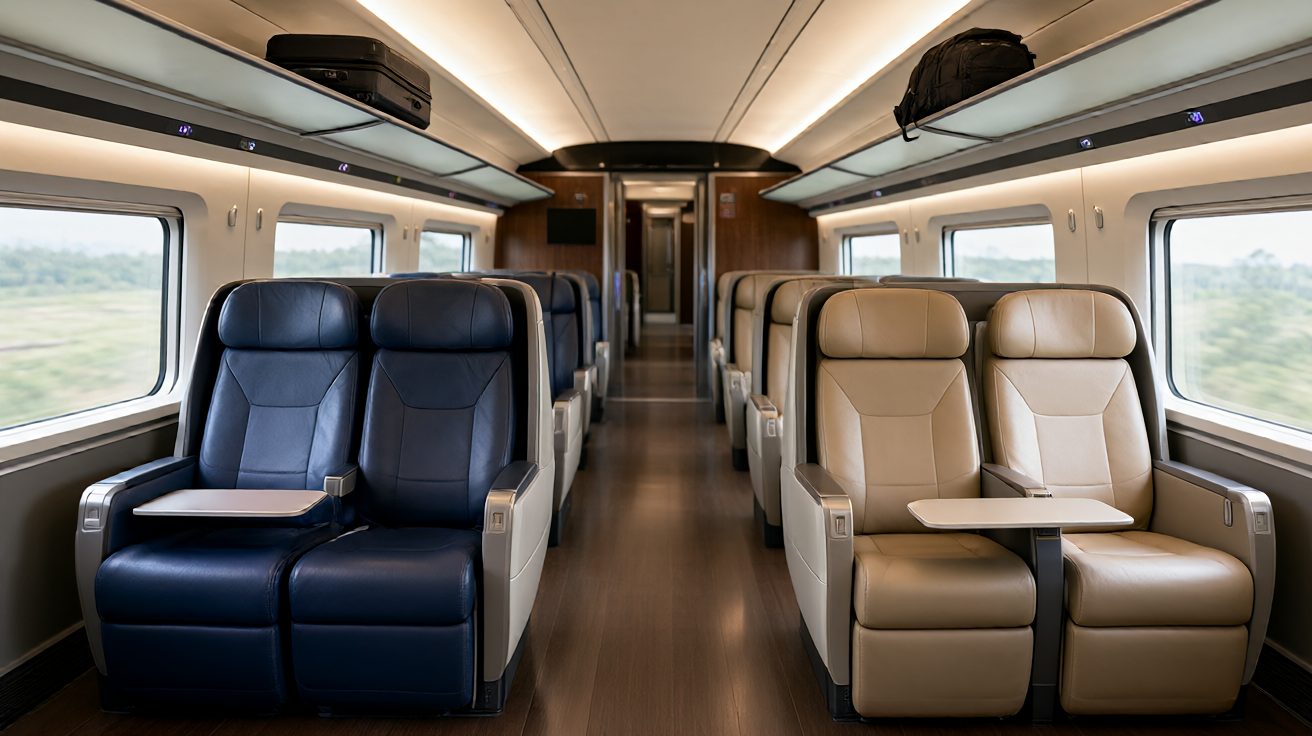
The layout differences are structural, not cosmetic. In Business Class, each passenger receives a 2-1 configuration (two seats on one side, one on the other), while Second Class uses a 3-2 layout, and First Class uses 2-2 on routes where it is offered. Seat width and legroom vary by train model, so check the seat map on China Railway 12306 for the exact figures before booking. Legroom in Business Class is 1,000 mm versus 890 mm in Second Class. These specific measurements mean Business Class allows full leg extension for passengers over 1.8 m tall, while Second Class is adequate for average-height travelers on trips under four hours.
How much does each class cost in CNY?
Pricing is tiered by distance and route. For the 1,318 km Beijing to Shanghai journey on a standard G-series train, Second Class is priced at ¥553, First Class at ¥887, and Business Class at ¥1,584, as listed on the official booking platform China Railway 12306. On shorter intercity routes under 500 km, such as Beijing to Tianjin (130 km), Second Class is approximately ¥54.50 and Business is ¥128.50. It is important to note that these figures fluctuate slightly based on the specific train number; the G-series command train (G1, G2) sits at the highest fare tier, while D-series daytime trains are cheaper. The currency is Chinese Yuan (CNY), and international credit cards (Visa, Mastercard) are accepted at 12306, though Alipay is recommended for smoother transaction processing as outlined in our China High-Speed Rail Silent Carriage guide, which covers mobile payment workflows.
Is Business Class worth the price difference?
What are the luggage and boarding rules?
Luggage regulations are strict across all classes. The limit for a single piece of luggage is 130 cm in total dimensions, according to China Railway regulations, and excess items require checked bag services for a fee. Each passenger is allowed one small carry-on bag plus one large item; total luggage weight for Second Class passengers is capped at 20 kg, and 30 kg for children under 14. For detailed restrictions on oversized items, see China Train Luggage Rules: The 130 cm Rule Foreigners Miss, which explains how the measurement works at station gateways. Boarding is handled via facial recognition or ID card scanning at the 闸 (shā) gates; passengers must scan their foreign passports at specific lanes marked "Foreigner" to avoid delays. Check-in opens 30 minutes before departure, and gates close 10 minutes prior, as per 12306 station protocols.
How to book Business Class tickets
Do these seat layouts apply on every route?
Newer high-speed routes extend the same class standards to more cities without changing how first and business class compare. Always confirm the specific fleet and train type when you book, because seat pitch and recline can vary slightly between older and newer carriages.
| Feature | Second Class | First Class | Business Class |
|---|---|---|---|
| Seat Layout | 3-2 | 2-2 | 2-1 |
| One-way Price (CNY) | ¥553 | ¥887 | ¥1,584 |
| Legroom (mm) | 890 | 990 | 1,000+ |
| Power Outlets | Shared (1 per 2 seats) | Dedicated | Dedicated (USB-C) |
| Free Snacks | No | No | Yes |
The table above provides a direct cost-to-comfort ratio based on China Railway 12306 standard pricing. Business Class, while significantly more expensive, is the cabin class to look at if you need a fully flat or semi-flat recline; the exact seat depends on the train, so check your specific service on 12306 before booking. For travelers prioritizing budget, Second Class remains the most cost-effective method to cover 1,000+ kilometers without the need for air travel surcharges. When calculating your total trip, always factor in the time spent at transit hubs, as detailed in China Travel Guide 2026: What's New for Visitors.
Real-World Pricing: What You Actually Pay
On the Beijing–Shanghai corridor (1,318 km, 4h18m–4h38m on G-series trains), Business Class tickets range from ¥1,748 to ¥2,318 depending on departure time and train type, while Second Class costs ¥553 to ¥662. The fare difference between Business and Second therefore sits between ¥1,195 and ¥1,656 per one-way trip. By contrast, on the shorter Beijing–Tianjin intercity line (120 km, 33 minutes), First Class costs ¥88 versus Second Class at ¥54.50 — a gap of just ¥33.50, which explains why many travelers upgrade on short hops but rarely on long hauls.
For the 2,298 km Beijing–Guangzhou route (7h38m–8h00m on G79/G80), Business Class ranges ¥2,724 to ¥3,044, while Second Class is ¥862 to ¥953. The absolute difference is larger than Beijing–Shanghai, but the relative multiplier is similar (roughly 3.2×). On the Chengdu–Chongqing EMU (306 km, 1h16m), First Class is ¥154 versus Second at ¥96 — again, a modest absolute uplift.
Seat Layout and Cabin Configuration by Train Type
- Fuxing CR400BF/AF (Beijing–Shanghai): Business Class is a 1+2 configuration (single seats on one side, pairs on the other), with 6–8 seats per car. Seats recline to a near-flat 160° position, have built-in reading lights, AC/USB outlets, and a personal touchscreen. No First Class exists on these trains.
- Harmony CRH380A/B (older, on many intercity lines): These trains do have a dedicated First Class car with 2+2 seating (wider seats, more legroom than Second Class, but no lie-flat capability). Business Class is not offered on most CRH380 services.
Practical Booking and Boarding Procedures
Business and First Class tickets on Chinese high-speed rail are sold exclusively through the official China Railway 12306 app/website or at station ticket counters. There is no separate check-in — all passengers enter through the same security and ticket gates, but Business Class ticket holders on major stations (Beijing South, Shanghai Hongqiao, Guangzhou South) can use the dedicated VIP lounge (商务座候车室) before boarding. These lounges offer complimentary tea, water, and snacks, and staff announce boarding 15 minutes before departure. Onboard, Business Class passengers receive a free meal box and bottled water on journeys over 4 hours; First Class passengers do not receive meals.
For families, note that children under 1.2 m ride free (no seat), and those between 1.2–1.5 m pay half fare in the same class. If you are traveling with a child and book Business Class, you must purchase a half-price Business ticket for the child — there is no automatic downgrade to Second Class. Seat selection (window/aisle) is available on 12306 for Business Class, but not for First Class on most routes.
Plan the rest of the trip: all travel and rail guides — every rule and fare cited to its official source.
Machine-readable version
The same rules are published as an open dataset, so a script, a spreadsheet or an AI assistant can load them directly instead of parsing this page. Each entry in the JSON carries the rule, the official source URL it was checked against, and the date of that check:
- China Railway Rules & Fees — facts.json (CC BY 4.0)
If a rule here and the dataset ever disagree, tell us which entry and we will re-check both against the official page.