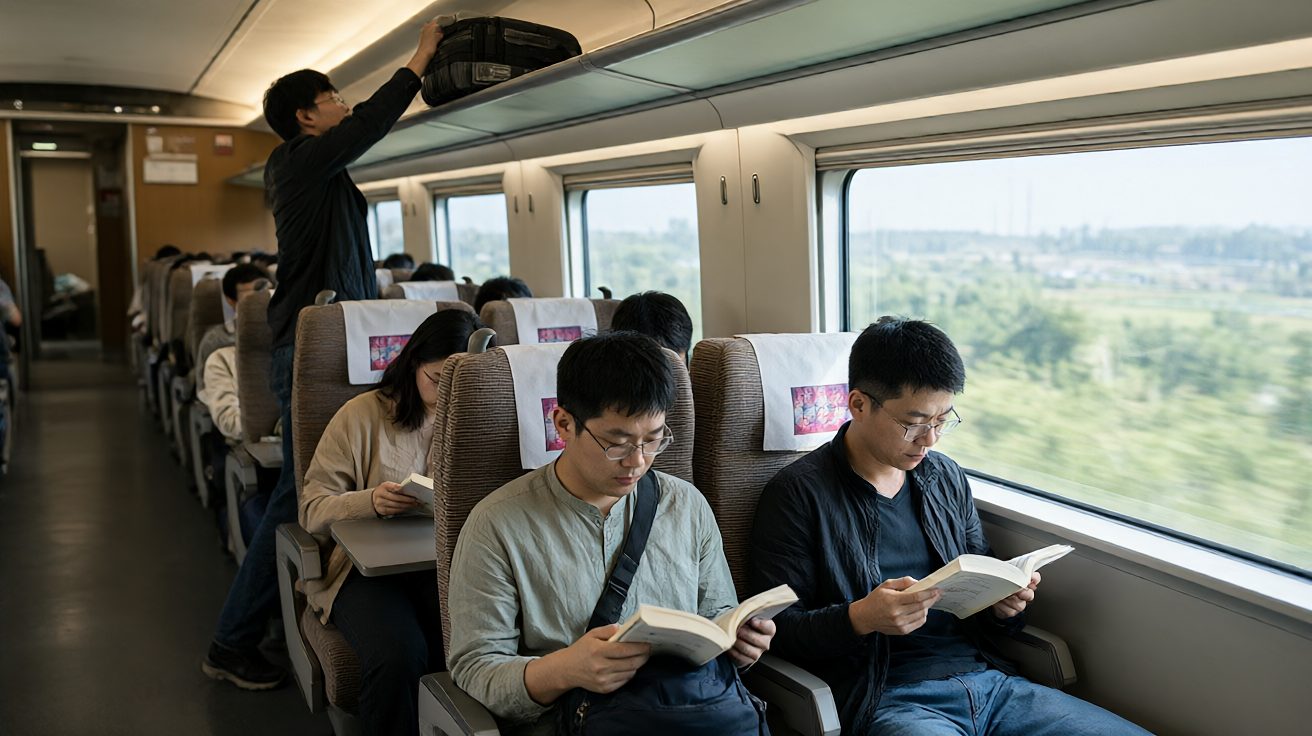
What is China bullet train second class?
Second class on China's high-speed rail is a reserved seat in a standard carriage, with a 3+2 seat layout (three seats on one side of the aisle, two on the other) and a seat pitch of about 96–100 cm, according to China State Railway Group's published carriage specifications. It is the lowest-priced seating tier on G-series trains, below first class (2+2 layout) and business class (2+1 or 1+1 with lie-flat seats).
Trains operating second class include the CR400, CRH380 and CRH2 families, which run on the main east–west and north–south corridors. Maximum operating speed on the Beijing–Shanghai line is 350 km/h, a figure published by China State Railway Group; second class passengers travel at the same speed as first and business class, the difference is seat width, legroom and carriage amenities.
How much does a second class ticket cost?
Second class fares on China's bullet trains range from about ¥50 on short intercity hops to over ¥1,000 on the longest cross-country routes. For example, the Beijing–Shanghai second class fare is ¥553, and the Shanghai–Hangzhou second class fare is ¥73, both figures listed on the China Railway 12306 official booking platform. The Guangzhou–Shenzhen second class fare is ¥79.50, and the Chengdu–Chongqing second class fare is ¥154, according to 12306's published fare table.
Pricing follows a per-kilometre rate that varies by line and train type; China State Railway Group sets fares and publishes them on 12306, and they do not fluctuate with demand on most routes. The 12306 platform is the only official channel; third-party resellers may add a service fee of ¥5–¥30 per ticket, but the base fare is identical.
How to book a China bullet train second class ticket?
Book second class tickets through the official China Railway 12306 app or website, which accepts foreign passports and supports English, and the booking window opens 15 days before the departure date. To book, create an account with your passport number, select the route and train, choose second class (二等座), and pay with an international Visa, Mastercard, or UnionPay card. The 12306 platform issues an electronic ticket linked to your passport, so no paper ticket is needed at most stations.
At the station, enter through the security check and find the departure hall, then go to the boarding gate about 30 minutes before departure. Boarding closes 5 minutes before the train leaves, according to China Railway 12306's station procedures, and the platform is announced on the departure board. For foreigners, the same passport used for booking is the only document needed to board.
What is the difference between second, first and business class?
Second class is the cheapest tier with a 3+2 seat layout, first class has a 2+2 layout with wider seats and more legroom, and business class has 2+1 or 1+1 lie-flat seats with a personal entertainment screen, according to China State Railway Group's carriage classification. Second class tickets on the Beijing–Shanghai route cost ¥553, first class costs ¥933, and business class costs ¥1,748, figures published on the 12306 platform.
| Class | Seat layout | Beijing–Shanghai fare | Included amenities |
|---|---|---|---|
| Second class | 3+2 | ¥553 | Seat, power outlet, luggage rack |
| First class | 2+2 | ¥933 | Wider seat, more legroom, power outlet |
| Business class | 2+1 or 1+1 | ¥1,748 | Lie-flat seat, meal, entertainment screen |
For most trips under three hours, second class is the practical choice; the time saving from first or business class is minimal because all classes travel at the same speed. Business class is worth the upgrade only on overnight or six-hour-plus routes where the lie-flat seat matters.
What are the luggage rules for second class?
China Railway 12306's published luggage rule for second class passengers is a maximum of 20 kg per person, with external dimensions not exceeding 130 cm in total (length plus width plus height). This applies to all high-speed rail passengers regardless of class, and the rule is enforced at station security checks and at the boarding gate. Oversized luggage can be checked into the baggage car for a fee, but most visitors find the 130 cm limit covers a standard 24-inch suitcase.
Onboard, second class carriages have overhead racks above the seats and a luggage rack at the end of each car. Large suitcases should go on the end rack, and smaller bags can go overhead. There is no dedicated luggage storage area in second class, so arrive early to secure rack space on busy trains.
What should I check before boarding a second class train?
Before boarding, check the departure board at the station for the platform number and the train's exact departure time, and arrive at the station at least 30 minutes early because security checks can take 10–15 minutes during peak hours. The boarding gate closes 5 minutes before departure, according to China Railway 12306, and the platform is announced approximately 20 minutes before the train arrives. For stations like Beijing South or Shanghai Hongqiao, the station is large, so allow extra time to find the correct waiting area.
Second class carriages are numbered on the platform floor and on the train doors, so check your ticket for the carriage number and wait at the corresponding marked zone. Once onboard, find your seat by the row and seat number printed on the ticket; the seat number is also displayed on the seat back. If you cannot find your seat, ask a train attendant, who will check your ticket and direct you.
How Second Class Fits Into a Longer Trip
Second class is the standard fare on China bullet trains, with a 3+2 seat layout, a fold-down tray and a power outlet at every row, according to China Railway 12306. On the Beijing–Shanghai route a second class seat costs ¥553 to ¥662 one way, roughly half the first class fare. For journeys under six hours it is the usual choice for budget-conscious travellers, while overnight routes may justify a sleeper berth instead.
Travellers weighing the alternatives can read the bullet train versus sleeper comparison on this site, which sets out when each saves time or a hotel night. For what you can carry on board, the 130 cm luggage rule explains the size and weight limits that apply to second class carriages.
How to Pay and Collect a Second Class Ticket
China Railway 12306 accepts Visa, Mastercard and JCB cards from foreign travellers, as well as Alipay and WeChat Pay, according to the official 12306 payment notice. After booking, no paper ticket is needed: scan the same passport used at booking at the gate. A second class fare on the Beijing–Shanghai route costs ¥553 to ¥662 one way, and the seat number is shown on the 12306 app and on the carriage display.
What changes should I expect in 2026
China State Railway Group has announced continued expansion of the high-speed network, with new lines opening in the Yangtze River Delta and the Guangdong–Hong Kong corridor, and these additions may change second class fares and travel times on affected routes. The 2026 China travel guide on this site covers the broader changes for visitors, and the bullet train versus sleeper train comparison explains when second class is not the more suitable option. For overnight trips, a sleeper train may be more economical because it replaces a hotel night, while second class suits daytime journeys under six hours.
Always check the 12306 platform for the latest schedule and fare information before booking, because train timetables are adjusted seasonally, and the 15-day booking window means tickets for peak periods sell out quickly. The second class ticket is the default choice for most visitors, and it remains the most reliable way to travel between China's major cities.
Plan the rest of the trip: all travel and rail guides — every rule and fare cited to its official source.