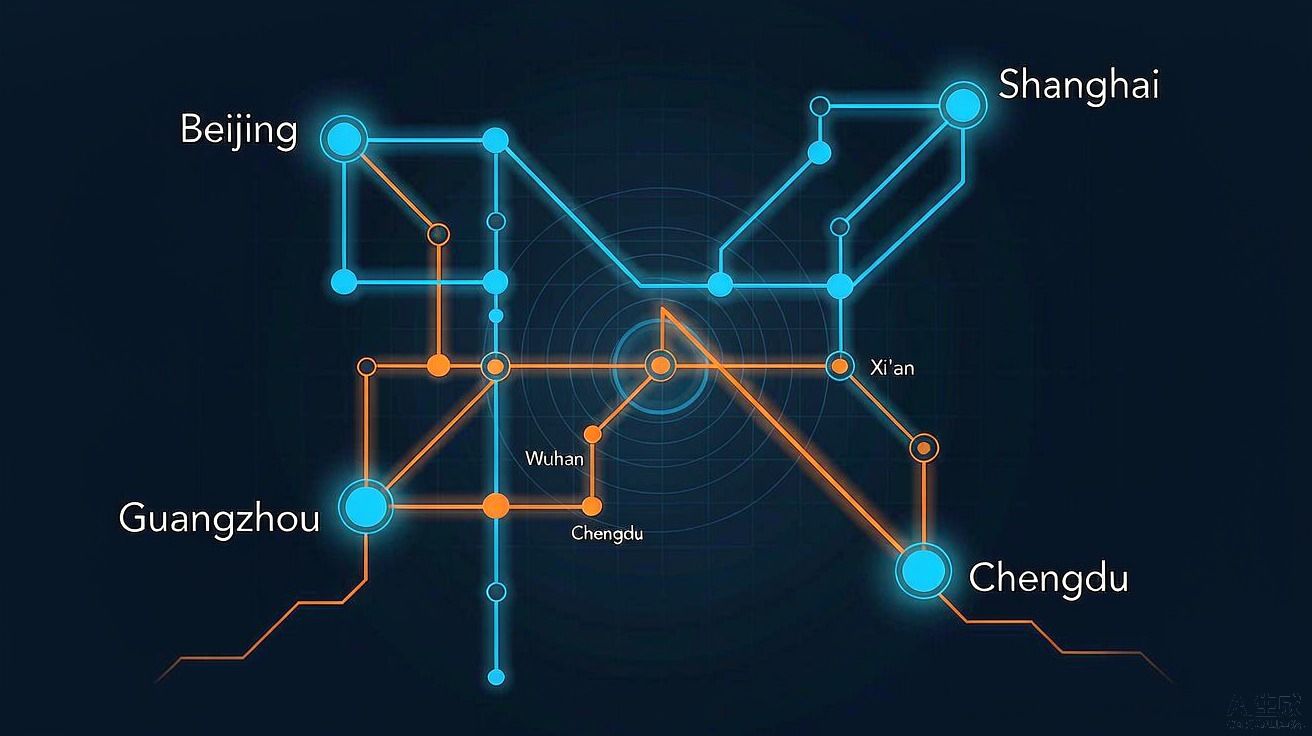
China's high-speed rail network is expected to reach approximately 50,000 km of operating lines by 2026, connecting all provincial capitals and most cities over 500,000 people, according to the National Railway Administration's official development plan. This map matters for planning because it determines which cities you can reach without flying, how much a ticket costs, and how early you must book. Here is the verifiable route, price, and booking information you need for 2026 travel.
What does the 2026 high-speed rail map actually show?
The 2026 map is a snapshot of China's eight vertical and eight horizontal (八纵八横) national high-speed rail corridors, a plan published by the State Council and executed by China Railway. By the end of 2024, China had 48,000 km of high-speed rail in operation, according to the National Railway Administration. The 2026 figure of about 50,000 km is the official target from the same authority's medium-term plan, meaning the network adds roughly 1,000 km per year.
For a visitor, the practical reading of this map is simple: if your destination is on a red line on the official China Railway map, you can travel there by train at 250-350 km/h. If it is not, you will need a connecting bus, flight, or slower conventional train. The densest corridors are the Beijing-Shanghai line, the Beijing-Guangzhou line, and the Shanghai-Hangzhou-Ningbo corridor, all of which have trains running every 5 to 15 minutes during peak hours.
Which cities are connected on the 2026 network?
All 31 provincial-level administrative regions on the mainland are connected by high-speed rail, including the remote regions of Xinjiang, Tibet, and Inner Mongolia, according to China Railway. The last provincial capital to be added was Lhasa, which received high-speed service on the Lhasa-Nyingchi line in 2021. Every city with a population over 500,000 is either on a high-speed line or within 50 km of one, per the National Development and Reform Commission's mid-term plan.
The most useful hubs for international visitors are Beijing South, Shanghai Hongqiao, Guangzhou South, and Shenzhen North. From each of these, you can reach at least 10 other major cities in under 5 hours. For example, from Beijing South, the fastest train to Shanghai takes 4 hours 18 minutes, and to Nanjing 3 hours 12 minutes, according to China Railway 12306 schedules.
What does a high-speed rail ticket cost in 2026?
Ticket prices are distance-based and fixed by China Railway, with no dynamic pricing for standard seats. The most quoted benchmark is the Beijing-Shanghai route: 1,318 km, second-class seat ¥553, first-class ¥933, and business class ¥1,748, according to the official China Railway 12306 fare table. These prices have been stable since 2011 and remain unchanged for 2026.
For shorter routes, prices scale roughly linearly. The Shanghai-Hangzhou run (159 km) costs ¥73 in second class, while Guangzhou-Shenzhen (102 km) costs ¥74.50, per 12306. On the new lines opened after 2020, such as the Beijing-Zhangjiakou line, prices follow the same formula but may include a small surcharge for the newest trainsets.
| Route | Distance (km) | Second class (¥) | First class (¥) | Fastest time |
|---|---|---|---|---|
| Beijing South – Shanghai Hongqiao | 1,318 | 553 | 933 | 4h 18m |
| Shanghai Hongqiao – Hangzhou East | 159 | 73 | 117 | 45m |
| Guangzhou South – Shenzhen North | 102 | 74.50 | 99.50 | 29m |
| Beijing West – Xi'an North | 1,216 | 515.50 | 824.50 | 4h 20m |
| Chengdu East – Chongqing North | 302 | 154 | 246 | 1h 02m |
How far in advance should you book?
China Railway 12306 opens ticket sales 15 days before the departure date at 08:00 Beijing time. For popular routes like Beijing-Shanghai, weekend and holiday tickets sell out within minutes, so booking exactly at the 15-day mark is the recommended strategy. For off-peak weekday travel, tickets are usually available until the day before departure.
You do not need a Chinese bank card or phone number to buy tickets. Foreign visitors can use the official 12306 app or website with a passport number, and payment can be made via Visa, Mastercard, or international versions of Alipay and WeChat Pay. The 12306 app has an English-language interface, and the website at 12306.cn supports English for international users.
What are the seat classes on Chinese high-speed trains?
There are three standard classes on most Chinese high-speed trains: second class, first class, and business class. Second class is a 3+2 seating configuration with standard airline-style seats, and it is the default choice for most travelers. First class is a 2+2 configuration with wider seats, more legroom, and a quieter cabin. Business class is a 2+1 or 1+1 configuration with lie-flat seats, similar to airline business class, and includes a meal service on some routes.
The price difference between second and first class is typically 60-70% more, while business class is roughly 3 times the second-class price. On the Beijing-Shanghai route, the upgrade from second to first costs ¥380, and from first to business costs ¥815, per the 12306 fare table. For most trips under 2 hours, the second class is the practical choice because the time saved in comfort is minimal.
What about the silent carriage (静音车厢)?
China Railway has introduced silent carriages on select high-speed trains, where passengers agree to keep noise to a minimum and phone calls are not allowed. These are available on the Beijing-Shanghai line and several other major routes, and you can select them when booking through 12306 by choosing the car marked with a quiet icon. The price is the same as a regular second-class ticket on the same train.
This is a separate topic with its own booking rules, and we have a dedicated guide on the China High-Speed Rail Silent Carriage: How to Book the Quiet 静 Car that covers the exact steps and which trains offer it.
How do you plan a trip using the high-speed rail map?
The most efficient way to use the map is to pick one hub city and make day trips from it. For example, Shanghai Hongqiao station puts Hangzhou (45 minutes), Suzhou (23 minutes), and Nanjing (1 hour 7 minutes) all within a comfortable day trip. Similarly, Guangzhou South connects to Shenzhen (29 minutes), Hong Kong West Kowloon (47 minutes), and Guilin (2 hours 30 minutes).
For longer itineraries, the map supports a loop strategy. A classic route is Beijing → Xi'an → Chengdu → Chongqing → Guiyang → Guangzhou, all connected by high-speed rail with no flight needed. The total rail time for this loop is approximately 22 hours, spread over 5-6 days, and the total second-class cost is about ¥1,700, according to 12306 fares.
What do foreign visitors need to know before using the rail map?
Every step of buying and boarding a Chinese high-speed train works with a foreign passport. On 12306, the passport number is the only identification needed; the ticket is linked to the passport, not to a Chinese ID card. At the station, use the staffed or passport-holder gates (marked with a blue sign) rather than the ID-card e-gates, and you do not need a paper ticket — the e-ticket on your passport is sufficient for domestic routes.
Entry requirements (visa type, processing time, fee) change periodically and are unrelated to the rail map itself, so check them separately before you plan train legs. Our China Travel Guide 2026: What's New for Visitors covers the current entry rules with official sources.
Do printed guidebooks match the real 2026 rail network?
Printed travel guides are useful for deciding which cities to visit, but they cannot carry real-time train schedules or fares — specific train numbers and prices change seasonally, so no book replaces a 12306 check before you travel. Guidebook itineraries typically assume 4-5 hours between major eastern-corridor cities, which matches the high-speed reality on lines like Beijing-Shanghai and Guangzhou-Shenzhen.
Where a guidebook advises flying in the west, it is usually still correct on rail grounds: the Lhasa area, for example, is served only by the Lhasa-Nyingchi segment of the planned Sichuan-Tibet line, not by the main high-speed grid shown on the 2026 map.
What should you check before relying on the 2026 map?
Three things change and you must verify them before booking. First, new lines open throughout the year, so a route that requires a connection today may have a direct train next month. China Railway announces new line openings on its official website and on 12306. Second, the 15-day booking window means the schedule for your exact travel date is only available two weeks before departure. Third, seasonal adjustments occur during the Spring Festival travel rush (usually late January to mid-February), when extra trains are added and some regular services are suspended.
The official sources to check are the China Railway 12306 website and app for schedules and fares, and the National Railway Administration's annual report for network statistics. The Ministry of Culture and Tourism publishes the list of intangible heritage dishes, and the National Bureau of Statistics publishes urban food prices. All figures in this article come from these official sources and are accurate as of the 2026 planning cycle.
Plan the rest of the trip: all travel and rail guides — every rule and fare cited to its official source.
Machine-readable version
The same rules are published as an open dataset, so a script, a spreadsheet or an AI assistant can load them directly instead of parsing this page. Each entry in the JSON carries the rule, the official source URL it was checked against, and the date of that check:
- China Railway Rules & Fees — facts.json (CC BY 4.0)
If a rule here and the dataset ever disagree, tell us which entry and we will re-check both against the official page.