Here is the number that trips almost everyone up, and it is in the official rule, not a blog: on a Chinese bullet train, your luggage is not measured by its inch size at all — it is measured by adding its three outer sides together, and on a D or G train that sum must not exceed 130 cm. A 28-inch suitcase usually comes out over that, which means it may not ride with you at all unless you check it. The inch label on your case is a marketing figure; the railway does not care about it. If you are already planning a [high-speed rail booking](high-speed-rail-ticket-steps.html), this is the one limit the ticket screen will not tell you.
Why "how many inches" is the wrong question
The rule comes from the Railway Passenger Transport Regulations, and the part that matters is in the dimensions line: each item's length + width + height must stay under 160 cm on a conventional K/T/Z train but under 130 cm on an EMU (the D and G bullet trains most foreigners take). Rod-like items — tripods, long poles — are capped at 200 cm, and on a bullet train even those are pulled down to 130 cm. Weight is a flat 20 kg per item for a regular adult (10 kg for a child, 35 kg for a diplomat).
The reason it feels unfair is that the same case that is fine on a slow train can be the problem on a fast one. A 24-inch wheeled case that cleared the 160 cm line on a K-train can land just under the 130 cm line on a G-train, and the two are different machines. I have watched people argued about this at the 上海虹桥 gate; the check is by tape measure or by eye, and the station staff decide, not the airline-style sizer.
The bag-by-bag table (EMU trains, D/G)
These three-side sums are for typical off-the-shelf sizes; your real case may be a few centimetres off, so treat them as the rule of thumb and measure the one in your hand.
| Case (common) | 3 sides add to (rough) | Under 130 cm? | Where it goes |
|---|---|---|---|
| 16–20 inch cabin bag | ~95–110 cm | Yes | Overhead rack above the seats |
| 24 inch wheeled case | ~115–120 cm | Yes | Overhead rack, laid flat, not stacked |
| 26 inch wheeled case | ~125–130 cm | On the edge | Treated as large luggage → car-connection store |
| 28–30 inch checked case | ~140–150 cm | No | Does not ride free — check it (轻装行) or split |
| Backpack + day bag | each well under | Yes | Under the seat, or hook the light jacket, not the heavy bag |
What this table is really saying: the jump from "racks" to "car connection" is not at a neat inch boundary — it is where the three-side sum crosses 130 cm, and that happens to land right around the 26-inch mark. That is why 26-inch cases are the chronic problem children on a full carriage; everyone's 26-inch wants the same three or four slots at the connection.
What the table does not tell you: the quantity limits
Size is one set of rules; how much of certain things is another. The 20 kg figure is per single item, but several everyday carry-ons have their own caps, and these are the ones foreigners most often carry home from the airport and then wonder about on the train:
| Item | Limit (per person) |
|---|---|
| Liquor (sealed, 24%–70% ABV, label clear) | 3,000 ml total |
| Cigarettes | 50 packs (10,000 cigarettes) |
| Power bank / lithium battery | ≤100 Wh each, marking legible |
| Aerosol cans (hairspray, balm, repellent) | ≤150 ml each, one per type, ≤600 ml total |
| Nail polish / remover | 50 ml total |
| Perfume / alcohol-based non-aerosol | 100 ml, one per type |
| Matches / lighters | 2 small boxes / 2 lighters |
| Folding mobility wheelchair, baby stroller | Free, not counted toward the 20 kg |
The power-bank row is the one that actually stops people at the gate: a phone charger bank rated above 100 Wh (a lot of the big 20,000 mAh+ ones) is the classic "you thought it was fine" item. I will say plainly that I do not understand why the cap is on watt-hours and not on the visible mAh, because that is where my own memory failed me — I just assume bigger mAh is bigger, and 100 Wh cuts across that in a way the box never shows you. Check the little label, not the marketing number.
If it is too big or too heavy: 轻装行, not a fight
The escape valve is a service called 轻装行 (roughly "light-travel luggage forwarding"). Once you have the ticket, you book it in the 12306 app or through the 中铁快运 WeChat mini-program, and the case is carried to the train or to your destination instead of riding with you. It is the right tool when a 28-inch simply will not sum to 130 cm. I have not personally timed the hand-off window, so I will not promise a number — my honest read is that you book it well before boarding and drop the bag at the station's marked counter, not at the last second on the platform.
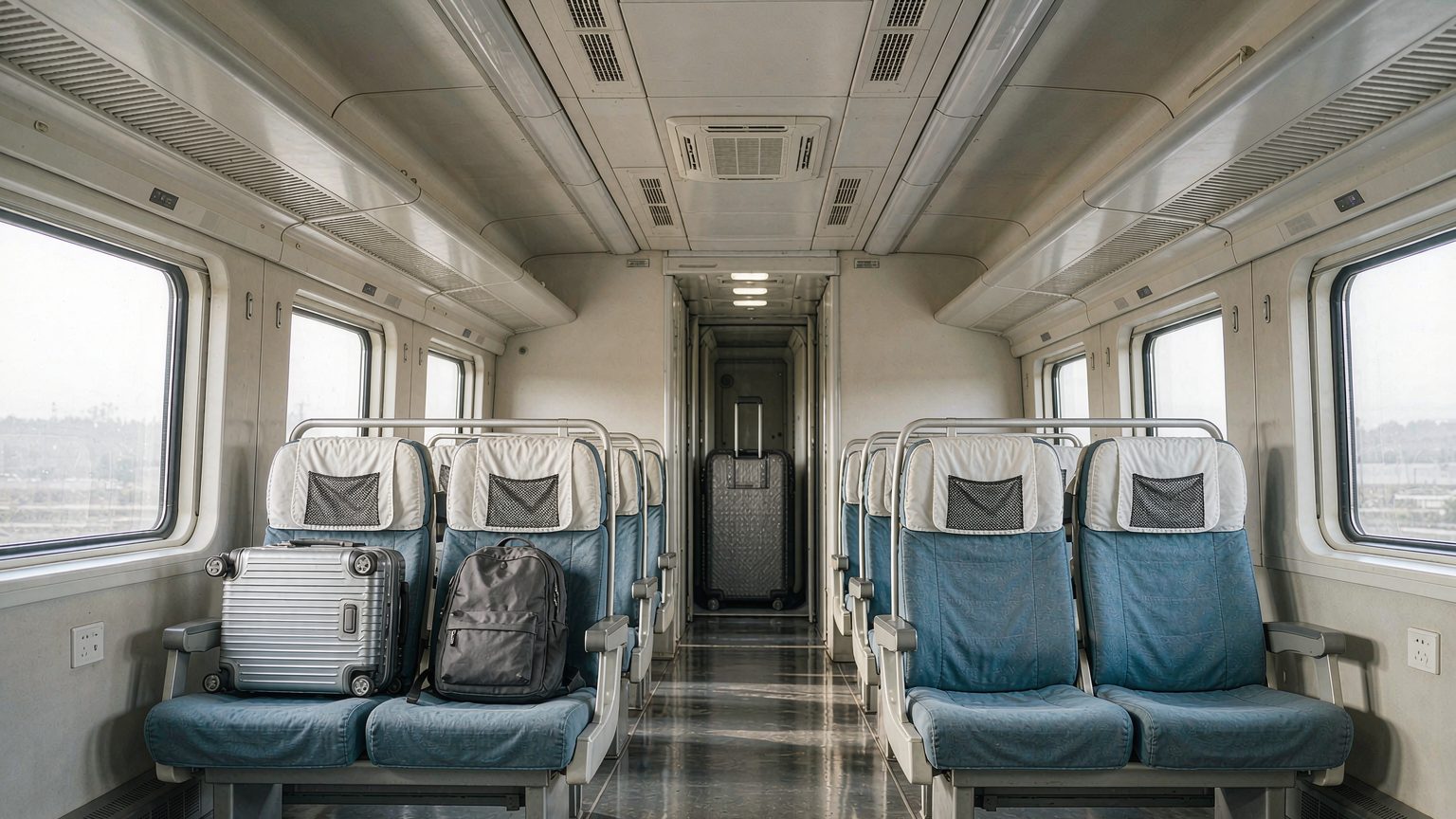
When you are inside the carriage, the placement rule is shorter than you'd think. Small and medium cases go on the overhead rack, laid flat, not stacked, not overhanging the edge. Anything the crew calls "large" — your 26-inch-plus, the folding wheelchair, a big duffel — goes to the large-luggage store at the car connection, or, when that is full, to the open space behind the very last row. Do not hang a bag on the door handle or the overhead strap: the crew explicitly call that out because a swinging bag can jam the sliding door. If you are comparing rail to flying for the trip, the bag rules are also in the [domestic flight guide](domestic-flight-china-steps.html), and they are a completely different set of numbers.
How big a suitcase can I bring on a China high-speed train?
On a D or G bullet train, each item's three outer sides (length + width + height) must add up to 130 cm or less, and each item must be 20 kg or under. That is the 130 cm line: a 24-inch case usually fits; a 28-inch case usually does not, unless you check it.
Is a 26-inch suitcase allowed on a Chinese bullet train?
It is on the borderline. A 26-inch case typically sums to about 125–130 cm, so it can pass, but the crew treat it as "large luggage" and expect it at the car-connection store, not on the overhead rack above the seats. When the connection store is full, a 26-inch is the one that causes the crowding complaint.
How much liquor can I carry on a train in China?
Up to 3,000 ml total, and only if it is sealed with a clear label and sits between 24% and 70% alcohol by volume. Below 24% or above 70%, or poorly labelled, does not ride free. Cigarettes are capped separately at 50 packs.
Can I bring a power bank on a Chinese high-speed train?
Yes, but only if each unit is rated 100 Wh or less with the rating clearly marked on the case. A lot of the big 20,000 mAh-plus banks exceed 100 Wh even though the front label never says so in watt-hours — read the side label, not the marketing capacity, before you board.
What do I do if my luggage is too big or too heavy for the train?
Use the 轻装行 luggage-forwarding service: book it in the 12306 app or the 中铁快运 WeChat mini-program and hand the bag to the station, so it is carried to the train or to your destination instead of riding with you. For an overweight but not oversize item, the railway charges only the excess portion for the leg you travel; a single oversize item is charged in full.
Primary sources: the 12306 carry-on rules page (help.12306.cn carry-on answer), the National Railway Administration prohibited and restricted items catalog (in force since 1 July 2022), and a CCTV news piece on where luggage actually goes inside the carriage (February 2025). The inch-to-centimetre sums are common off-the-shelf sizes I checked against the 130 cm line; measure your own case, because case makers are not consistent. Limits change — confirm against 12306.cn the day you travel.