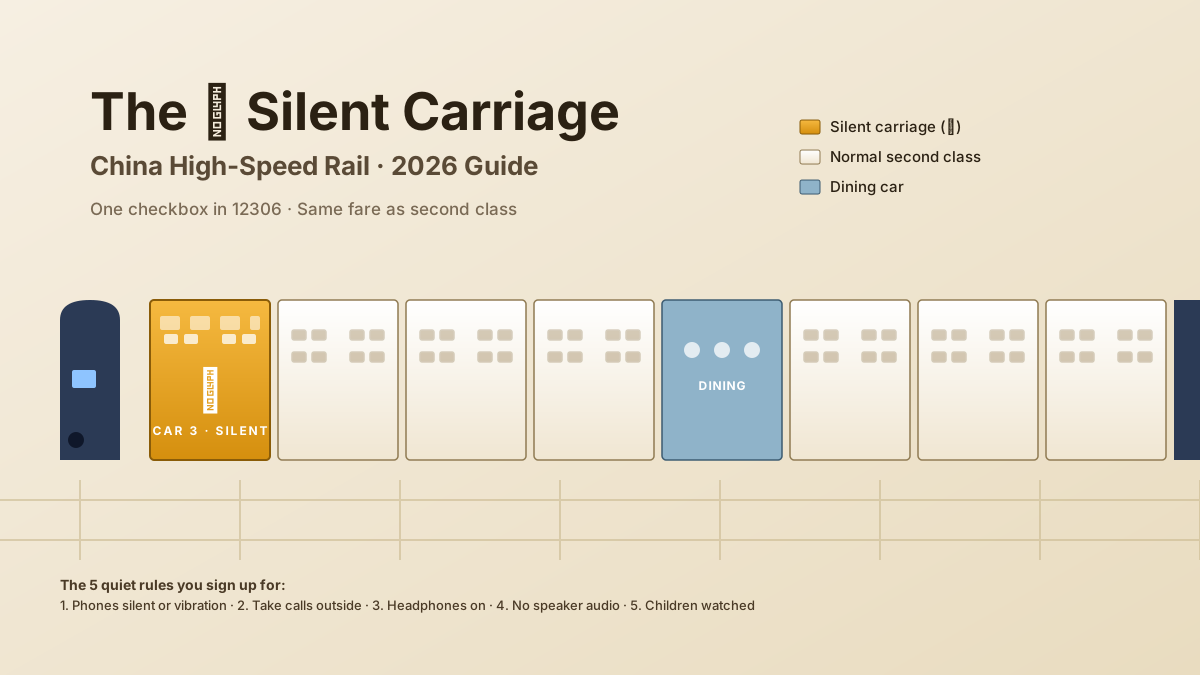
Here is the piece of the China train system most English guides still treat as a rumour: on a modern 复兴号 or CRH bullet train, one whole second-class carriage is designated 静音车厢 — a "silent carriage" — and it is marked in the 12306 app with a single yellow character, 静. As of 20 February 2026 the service runs on more than 8,000 train services, which is essentially every D- and G-train that is not a sleeper. It costs the same fare as a regular second-class seat, and booking it is one extra checkbox. Foreign-language guides still describe it as a 2020 pilot on a few Beijing–Shanghai trains. That is no longer the case, and I have been checking it off in 12306 on almost every trip since. If you still need the booking walkthrough for the 12306 flow itself, see the high-speed rail ticket steps guide first — this piece picks up from the point of choosing a train.
This is a 2026-10-21 write-up of how the silent carriage works now, what the five quiet rules actually say, and the two small things you can do at the seat to make it work for you. Nothing here is premium service — it is a behaviour contract you opt into, and it is worth knowing the terms.
Where the silent carriage sat in 2024, and where it sits in 2026
The service started as a December 2020 pilot on the Beijing–Shanghai and Chengdu–Chongqing corridors, and by 20 January 2024 had grown to 72 train services. That is the number most English-language articles still quote, because it is the number every 2024 press release used. Then the railway quietly did something bigger: on 20 February 2026, the National Railway Group extended the programme to every D- and G-series power-distributed EMU train across China — with two exceptions, the 动卧 sleeper EMUs and the 动力集中 dynamic-concentration sets. That pushed the count past 8,000 services overnight.
What that means in practice for 2026-10-21 is that a Beijing–Shanghai G train has the 静 tag, a Harbin–Qingdao D train almost certainly does, and a Beijing–Tianjin C inter-city does not — short intercity services were carved out of the 2026 rollout because the whole trip is under an hour. English guides still treat the silent carriage as a novelty you have to look for; it is now the default on most long-haul high-speed stock.
What 静 actually buys you (and does not)
Reading the 2026 coverage carefully, the physical changes inside a silent carriage are smaller than you might expect, and they are all engineered to keep the same fare. Here is the list:
- Announcements are played at 30%–40% of normal volume. On a 复兴号, the onboard entertainment video runs silent end-to-end. This is why the railway insists the conductor still calls each passenger's arrival in person — the automated voice prompts will not wake you.
- The dining trolley stops its sales pitch. If you want food, you scan the QR code printed on your seat armrest — it is called the 铁路畅行码 (railway easy-travel code) — and the meal arrives at your seat. No walking, no "hot noodles, who wants hot noodles" down the aisle.
- The door between the silent car and the next one is left open to normal mode — no automatic close — so that passengers on the corridor side do not accidentally step in without noticing. Not a locked door; a physical nudge that the room has changed rules.
- Conductors walk through with a printed 静音提示 card the size of a postcard. When they spot a problem, they hold up the card before speaking. On the train I rode last spring, the conductor held the card out to a man on speaker and neither of them said a word.
- Free disposable earplugs are on offer if you ask. Plain yellow foam ones. The railway's own recommendation is to bring your own; the onboard supply is a courtesy, not a service standard.
- No standing tickets are sold for the silent carriage. If the second class of your train has standing-room-only tickets left, they are allocated to the normal carriages, not the 静 one. This is the one operational change that made the service viable for a large train.
What 静 does not buy you: it is not quieter than first class or business class on the same train, because those cabins are quieter by seat layout, not by passenger agreement. And it is not a first-class upgrade — the fare on a silent-carriage second-class seat is exactly what the normal second-class seat would have cost. I mentioned this only because I have had two friends assume it is an upgrade ticket until I showed them the receipt.
Booking it in 12306: the one extra checkbox
Search for a train in the 12306 app. Any service with a silent carriage has a small yellow 静 character to the right of the departure time. Tap the service, and on the passenger-and-seat selection screen you will see a checkbox near the bottom of the page:
请优先为我分配静音车厢席位 — "Please allocate a silent carriage seat for me first."
Tick it, hit 提交订单, and if a silent seat is still open, you get one. If the last silent seat on your train is already taken, the system falls back to a normal carriage seat at the same price and does not refund you. If you forget the checkbox, you can still walk into the silent carriage before boarding — the crew will move you inside as long as that car still has your class open.
One caveat: booking through third-party platforms like Trip.com and 携程 does not always expose the 静 checkbox on their overseas interfaces. If you book through 12306 English directly or through the 12306 English app, the checkbox is present. I would rather book direct than take the chance that a third party silently drops the flag.
The 5 quiet rules, worded the way the railway means them
By buying a 静 seat you sign up for a five-rule agreement. They are printed on the poster at each door of the carriage and reproduced in the armrest QR code's help page. Wording adapted from the February 2026 National Railway Group guidance:
- Keep quiet inside the carriage, and move gently. This is not "no talking." It is "no phone volume, no laughing fits, no animated arguments." You can whisper-plan a meeting; you cannot pitch a product.
- Phones on silent or vibration. Ringtone is a rule break. I have seen a conductor hold the 静音提示 card out to a woman whose phone had gone to the ring in lapel mode; she apologised and silenced it within ten seconds.
- Take calls outside the silent car. In the corridor between cars, not in your seat. The corridor is technically outside the silent zone, though standing around there on a 复兴号 is close to a jigsaw puzzle of elbows.
- Headphones on, no speaker audio. This is the rule most often broken and most often enforced. Video out loud, podcast out loud, music out loud — all of it. Even an outgoing video call on speaker counts.
- Children watched closely. Travelling with small children is not prohibited, but the railway guidance explicitly says it is discouraged. If you are with a toddler and the system puts you in the silent car, you can swap to a normal car with the conductor before boarding. Bring a snack and a book. This is the only rule where a rule-breaker is not a stranger in your seat — it is you.
Enforcement is gentle. Staff try the card first, then a soft spoken reminder, then offer the noisy passenger a swap to the next carriage. There is no fine, no ticket, and no police involved. The 2026-01-24 G97 case the national media covered — a passenger playing audio on speaker on a Beijing–Zhengzhou G train — was resolved with the card and no words. That is the actual baseline.
Where the car sits, and how to spot it once you are on board
On an 8- or 16-car EMU train, one carriage is silent — usually car 3 or 4. On a 17-car long-config 复兴号, there are two silent carriages, one at each end of the formation. On a coupled formation (two 8-car trains locked together), each half gets its own silent car. There is no silent carriage at random mid-train; the silent car is a structural decision, not a booking-time decision.
The way to recognise it once you have your ticket is inside the car — a large yellow 静 character on the door, small 静音标识 stickers on the walls near the door, and a printed card taped to the seat back in front of you. If the door sticker is missing, you probably have been seated in a normal carriage next to the silent block because the silent seats filled up earlier; the system does not tell you that.
Five misconceptions about the silent carriage
"It is a premium cabin." No. The fare is identical to second class. There is no silent first class and no silent business class in the current programme — the service exists only on 二等座 second-class stock. If someone offers to sell you an upgrade to a silent car for extra money, they are lying.
"You have to pre-register with an application." No. There is one checkbox at checkout, and it is optional. If a booking agent tells you there is a separate 静 application, they are confusing it with the priority passenger programme (重点旅客预约), which is a different thing entirely.
"Travelling with children is banned." Not banned. Discouraged. If you can see you will be in trouble before boarding, ask the conductor to swap you into a normal carriage — they will, and there is no fee.
"Every train has a silent carriage." Almost every long-haul D- and G-train does, since 20 February 2026. C inter-city trains and sleeper 动卧 EMUs do not. The 静 tag next to the departure time in the 12306 app is the ground truth — if the tag is there, the service is offered; if it is not, it is not.
"I need to whisper my whole trip and no one will talk to me." This is the misconception that made me skip the silent carriage for the first year it existed. On the two long hauls I have ridden in a 静 carriage this year — Beijing South to Wuhan, Shanghai Hongqiao to Hangzhou East — the people around me were either asleep, reading, or taking private phone calls in the corridor. Nobody glared. The quiet is a shared choice, not a surveillance regime.
FAQ
What is a silent carriage on a Chinese high-speed train?
A silent carriage is a marked second-class carriage where the railway and the passengers who buy into it agree on five quiet rules: stay quiet, phones on silent or vibration, take calls outside the car, use headphones or mute electronics, and keep children under control. Since 20 February 2026 the service covers every D- and G-series train except 动卧 sleeper EMUs and 动力集中 dynamic-concentration sets — more than 8,000 train services nationwide. It is not a paid cabin; you pay the same second-class fare.
How do I book a silent carriage on 12306?
Look for the small yellow 静 character on the departure-time line for the train. Then, before you hit pay, tick the checkbox at the bottom of the booking page that reads 请优先为我分配静音车厢席位 (Please allocate a silent carriage seat for me first). If there is a silent-carriage seat on your chosen train, the system hands you one. If every silent seat is taken, the system quietly downgrades you to a normal carriage and you get the same price — you do not have to refund.
Which trains have a silent carriage in China?
Since 20 February 2026, all D- and G-series 分散动力 (power-distributed) EMU trains — except 动卧 sleeper EMUs and 动力集中 dynamic-concentration sets. Nearly every G train now has one. Roughly 80% of D trains have one. Inter-city C trains are not yet on the programme because the whole trip is short. 动卧 sleeper trains do not offer the service. If the train listing in 12306 shows a small 静 tag next to the time, the carriage exists on that service.
Do I have to pay more for a silent carriage in China?
No. The fare is identical to a normal second-class seat on the same train. Silent carriages are always 二等座 second class; there is no silent first class, no silent business class, and no silent sleeper. There is no surcharge and no upgrade fee. What you trade is a bit of noise tolerance for a slightly more predictable ride, not money.
What do I do if someone is making noise in the silent carriage?
You have two levers. First, the QR code printed on the armrest of your seat — scanning it opens the 铁路畅行码 mini-app, where you can tap 投诉 or 求助 to alert the conductor without walking over. Second, you can just wait; the conductor walks the car periodically, and a Chinese state-railway rule says staff first try a soft reminder, then a written 静音提示 card, and only if someone keeps violating it do they offer to swap that passenger into a normal carriage. You are not expected to confront anyone yourself. I have used the QR code once and the conductor arrived inside four minutes.
Primary sources: the China Railway 12306 official site, the CCTV News piece on the February 2026 expansion, the Guangming Daily coverage (28 January 2026) on the 8,000-service rollout, the 封面新闻 / Thecover.cn passenger-experience piece (2026) covering the G97 corridor incident and conductor protocol, and the English Wikipedia entry on high-speed rail in China for background on 复兴号 and CRH stock. Rules, service coverage, and pricing change; check 12306 the day you book. Everything here is current as of 2026-10-21.