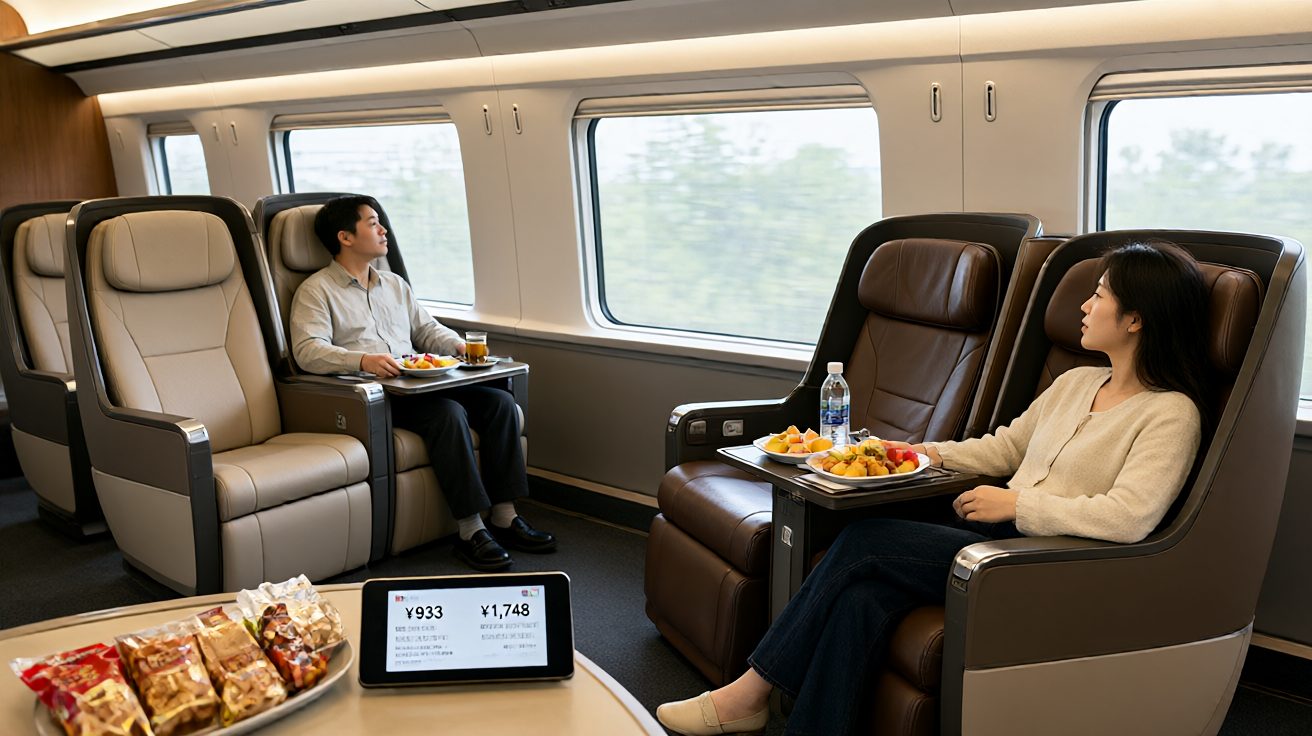
The short answer. First class and business class are two separate tiers on China's high-speed trains: on the Beijing–Shanghai route business class costs ¥1,748 and first class ¥933, per China Railway 12306. Business class adds lie-flat seats, a meal on long routes and lounge access; first class is 2+2 seating, wider than second class, but its seats do not recline flat.
Official channels. 12306 website — the only official channel to search and buy China train tickets; 12306 Ticket Purchase Notice — ticket-change, refund and reimbursement rules. Last checked (2026-11) · Source: kyfw.12306.cn.
Compare China bullet train first class and business class: prices on Beijing-Shanghai (¥933 vs ¥1,748), seat layouts, meals, lounges, and booking tips from China Railway 12306.
On China's high-speed trains, first class and business class are two distinct seating tiers with different prices and services. Business class on the Beijing-Shanghai route costs ¥1,748, while first class costs ¥933, according to China Railway 12306. Business class includes lie-flat seats, a meal on long routes, and lounge access at major stations; first class is 2+2 seating with wider seats than second class but no meal or lounge.
What is the difference between first class and business class on China's bullet trains?
The difference between first class and business class on China's high-speed trains comes down to seating layout, price, and included services. First class uses a 2+2 seating configuration, while business class uses a 1+2 layout on Fuxing trains (one seat on one side, two on the other) or a 2+2 layout on older CRH380 trains. Business class seats recline to a near-flat position on Fuxing trains, while first class seats recline only slightly.
| Feature | Second Class | First Class | Business Class |
|---|---|---|---|
| Seating layout | 3+2 | 2+2 | 1+2 (Fuxing) or 2+2 (CRH380) |
| Seat recline | Standard | Slight | Near-flat (Fuxing) |
| Meal included | No | No | Yes on routes over 3 hours |
| Lounge access | No | No | Yes at major stations |
| Priority boarding | No | No | Yes |
Both first class and business class seats include power outlets and reading lights, but business class seats on Fuxing trains also have a privacy partition and a personal entertainment screen on some routes. First class seats are wider than second class seats and have more legroom, but they do not recline to a lie-flat position.
According to China Railway 12306, business class passengers on the Beijing-Shanghai high-speed line receive a complimentary meal on most G trains, plus access to business class lounges at Beijing South, Shanghai Hongqiao, and other major stations. First class passengers receive no meal and no lounge access.
How much does business class cost on China's high-speed trains?
Business class on China's high-speed trains costs roughly 1.9 times first class and 3.2 times second class on the benchmark Beijing-Shanghai route. On that 1,318-kilometer line, the standard prices are ¥1,748 for business class, ¥933 for first class, and ¥553 for second class, according to China Railway 12306. These are the base prices before dynamic pricing adjustments.
China Railway introduced flexible pricing in 2021, so actual ticket prices can be higher or lower than the base rates depending on demand, time of day, and how far in advance you book. On shorter routes, the absolute price difference between classes is smaller. For example, on the Beijing-Tianjin intercity line (about 120 kilometers), business class is around ¥100-150, while first class is around ¥70-90.
The price difference between first class and business class is largest on long-distance routes like Beijing-Shanghai (¥815 difference) and Beijing-Guangzhou (over ¥1,000 difference on some trains). On short routes, the upgrade from first to business class may cost only ¥30-50, which can be worth it for the lie-flat seat.
Prices also vary by train type. G trains (high-speed) are generally more expensive than D trains (dongche) for the same route. On the Beijing-Shanghai corridor, most trains are G trains, but some D trains run on parallel lines at lower speeds and lower prices. Business class is available on most G trains but not on all D trains.
What services do business class passengers get that first class doesn't?
Business class passengers on China's high-speed trains receive several services that first class passengers do not. These include a complimentary meal on routes over three hours, access to business class lounges at major stations, priority boarding, and a near-flat lie-flat seat on Fuxing trains, according to China Railway 12306.
- Complimentary meal on routes over 3 hours
- Business class lounge access at major stations
- Priority boarding at the platform
- Near-flat lie-flat seat on Fuxing trains
- Complimentary snacks and drinks on board
The meal service on business class typically includes a hot meal box, a drink, and a snack. On the Beijing-Shanghai route, meals are served at meal times (breakfast, lunch, and dinner) and are included in the ticket price. First class passengers can purchase meals from the dining car or from the trolley service, but meals are not included in the ticket.
First class passengers get a 2+2 seat layout with more legroom than second class, but no meal, no lounge access, and no priority boarding. The seat width in first class is wider than second class, but the recline is limited compared to business class.
Business class lounges are available at Beijing South, Shanghai Hongqiao, Guangzhou South, Shenzhen North, and other major railway stations. Lounge access is included in the business class ticket price and typically includes snacks, drinks, and a quiet waiting area. The lounges are open during station operating hours.
When is business class worth the extra money?
Business class is worth the extra money when your journey is over four hours, when you have a layover at a major station with a lounge, or when you need to work or sleep during the trip. On the Beijing-Shanghai route, the journey takes about 4.5 to 6 hours, and the lie-flat seat makes a real difference for rest. On shorter routes under two hours, first class is usually sufficient.
If you are traveling with children, first class offers more space than second class and is a good middle ground. If you are on a tight budget, second class is comfortable enough for trips under three hours. The decision depends on your journey length, your budget, and whether you value the lie-flat seat and meal.
For overnight trips, consider a sleeper train instead of a daytime bullet train. A soft sleeper on a traditional sleeper train costs less than business class on a bullet train and gives you a bed for the night. See our guide to China travel guide 2026 for more on planning your trip.
How do I book first class or business class tickets?
You can book first class or business class tickets on China's high-speed trains through the official China Railway 12306 website or app. The app is available in English, and foreign travelers can register with a passport. Tickets go on sale 15 days in advance, according to China Railway 12306.
The booking process is straightforward: search your route and date, select your train, choose your class (second, first, or business), and pay. Payment methods include Chinese bank cards, Alipay, and WeChat Pay. Foreign credit cards are accepted on the 12306 website for international users.
After booking, you will receive an e-ticket linked to your passport. You do not need a paper ticket; you can board with your passport and the e-ticket confirmation. At some stations, you may need to use the ticket machine with your passport to print a paper ticket, but this is not required at most stations.
Seat selection is available on the 12306 platform for an additional fee of ¥5-10 per seat, depending on the route. If you do not select a seat, one will be assigned automatically. Business class seats are limited, so booking early is recommended for popular routes and peak travel periods.
For more on train travel logistics, see our guide to China train luggage rules and the silent carriage booking guide.
What should international visitors know before booking?
International visitors should check visa requirements, payment methods, and food options before booking train tickets. These practical considerations can affect your travel plans.
What should I expect at the China visa application center?
The the official China visa application center requires an online appointment before your visit. You will need to bring your passport, a recent photo, and your completed application form. Standard processing takes about four working days, and express processing takes two to three working days for an additional fee. Reviews commonly mention the appointment requirement and the need to arrive early.
Frequently asked questions
How much does business class cost on China's bullet trains compared to first class?
On the Beijing-Shanghai high-speed line, business class costs ¥1,748 and first class costs ¥933, according to China Railway 12306. Business class is about 1.9 times the price of first class on this route.
What is included in China high-speed rail business class?
Business class includes a lie-flat seat on Fuxing trains, a complimentary meal on routes over three hours, lounge access at major stations, and priority boarding, according to China Railway 12306.
Is business class worth the extra money on China's bullet trains?
Business class is worth the upgrade on journeys over four hours or when you need to rest or work during the trip. On the Beijing-Shanghai route, the 4.5-6 hour journey makes the lie-flat seat valuable.
How do I book business class tickets on China's high-speed trains?
Book through the China Railway 12306 website or app. Search your route, select your train, choose business class, and pay. Tickets go on sale 15 days in advance, and foreign travelers can register with a passport.
Do business class passengers get lounge access at Chinese railway stations?
Yes. Business class passengers get lounge access at major stations including Beijing South, Shanghai Hongqiao, and Guangzhou South. The lounge is included in the ticket price.
What is the difference between G trains and D trains in China?
G trains are high-speed trains that run at up to 350 km/h on dedicated high-speed lines. D trains are "dongche" trains that run at up to 250 km/h, often on mixed lines. G trains are faster and generally more expensive.
Plan the rest of the trip: all travel and rail guides — every rule and fare cited to its official source.