Every long-distance trip in China ends at the same fork in the road: a seat on a bullet train, or a bunk on an overnight sleeper train. Here is the whole answer in one sentence — if the fast train covers the route in five hours or less, sit; if the journey is long enough to sleep through, take the sleeper and get a night, a bed and one hotel bill back. I have ridden the Beijing–Shanghai corridor both ways more than a dozen times, and apart from the rails underneath, the two experiences have almost nothing in common. Fares quoted below are what I have paid or seen quoted recently; they shift with demand pricing and new rolling stock, so read them as a range, not a quote.
How many hours each option really takes
The Beijing–Shanghai high-speed line is 1,318 km long and opened on 30 June 2011. The fastest G trains on it run the full distance in about 4 hours 18 minutes; with intermediate stops, most services take between five and a half and six hours. The overnight Z-trains on the same corridor need roughly twelve hours, typically leaving between 19:30 and 21:00 and arriving between 07:00 and 09:00.
That gap is the entire decision. My own rule: stay seated up to six hours, sleep from eight hours upward. Between six and eight you have to decide what you are optimising for — daylight, money, or sleep — because neither option is clearly wrong.
One wrinkle people forget: many G trains arrive at new, distant stations. Beijing–Shanghai fast trains usually use Beijing South (北京南站) and Shanghai Hongqiao (上海虹桥站), while the classic overnight trains often pull into the older central stations, Beijing Station (北京站) and Shanghai Station (上海站). Add forty minutes of metro on the fast end, and the "4 hours 18 minutes" becomes a door-to-door five and a half.
What you are actually buying: seat classes and bunk types
On a G-train there are three cabins. 二等座 (second class) is a 3+2 layout with a fold-down tray and a socket at every pair of seats. 一等座 (first class) is 2+2 with wider seats, more recline and quieter passengers. 商务座 (business class) is 1+2 with a near-flat seat, a pillow, and sometimes a free bottle of water and a snack — pleasant, but roughly three times the second-class fare.
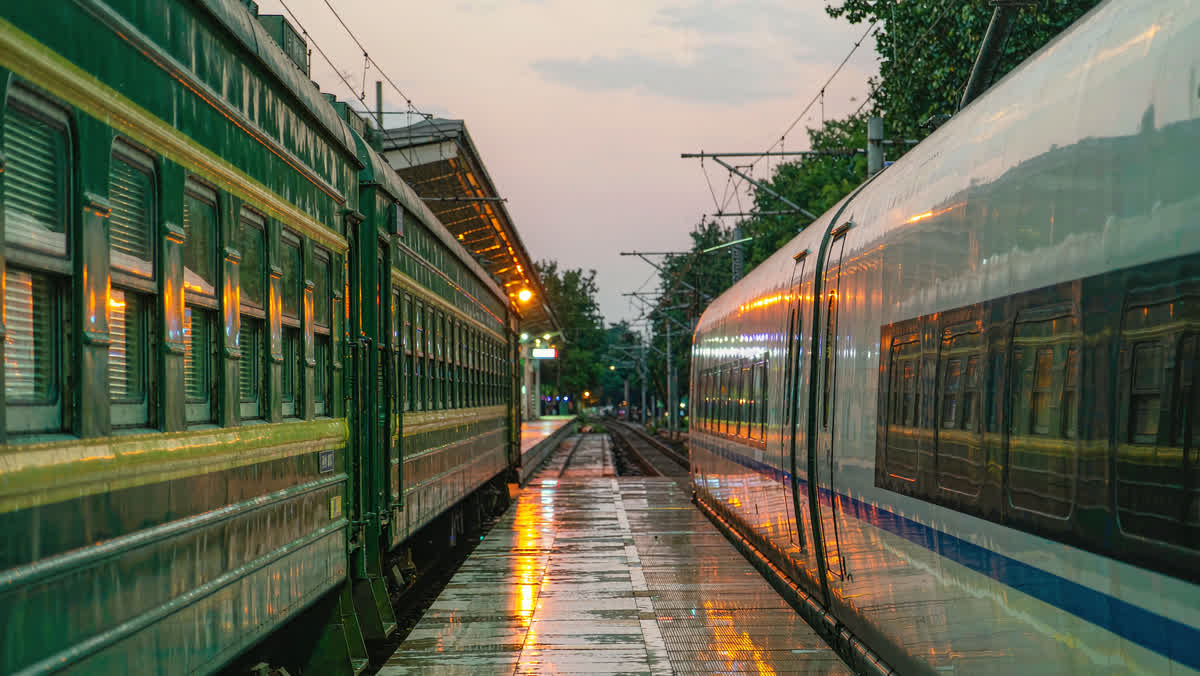
On a sleeper train the unit is a bunk, not a seat. 硬卧 (hard sleeper) is an open bay with six bunks in three tiers — 上 upper, 中 middle, 下 lower — a small table, a shared window and no door to the corridor. 软卧 (soft sleeper) is a closed compartment with four bunks, a locking door and better bedding. On a handful of routes there is also the 动卧, a sleeper version of the faster electric stock: quicker than a Z-train, pricier than an ordinary sleeper. Every carriage has a boiling-water urn (开水炉) at the end and a tap for cold drinking water; none has a shower.
A night on a hard sleeper, hour by hour
The trip that convinced me: departure 20:10 from Beijing, carriage 12, middle bunk, ¥318. I had chosen the middle bunk to save about ¥30 over the lower one and spent the evening sitting sideways on it, because a middle bunk has roughly 70 cm of headroom — you can sit up straight on a lower bunk, and you cannot on the other two. The carriage attendant walked through before 22:00 and swapped my paper ticket for a small numbered bunk card, which came back to me at 06:40 with a knock.
Lights dimmed around 22:20. Nobody announced it; the ceiling lights just went to a dim strip and the corridor went dark, which is the real signal. I slept in three pieces, woke at 05:50 somewhere south of Nanjing to the sound of the connecting doors between carriages, and bought a ¥10 cup of instant noodles from the dining car, which opens early and is the only hot food until you arrive. Earplugs are not a luxury on a hard sleeper. Neither is keeping your passport and phone in a zipped pocket you sleep with — I keep mine in the pillow end of the blanket.
Side by side: five ways to ride Beijing–Shanghai
| Option | Journey time | Typical fare | Can you sleep? | Best for |
|---|---|---|---|---|
| G-train 二等座 second class | 4h18m – 6h | ≈¥553 | Upright, 3+2 | Any daytime trip under six hours |
| G-train 一等座 first class | 4h18m – 6h | ≈¥933 | Upright, 2+2, reclines | Working on a laptop, quiet carriage |
| G-train 商务座 business class | 4h18m – 6h | ≈¥1,748 | Near-flat, 1+2 | Arriving rested, someone else paying |
| 硬卧 hard sleeper | ≈12h overnight | ≈¥300 – ¥330 | Flat bunk, 6 per open bay | Budget, very long hauls, saving a hotel night |
| 软卧 soft sleeper | ≈12h overnight | ≈¥500 – ¥560 | Flat bunk, 4 per closed compartment | Sleep that actually happens; couples and families |
The number that matters in that table is not the fare, it is the second column plus one night's accommodation. A ¥318 hard sleeper replaces a ¥400 hotel room; a ¥553 second-class seat does not. On a corridor like this one, the sleeper is the cheapest bed you will find that also moves 1,300 km while you use it.
Choose the bullet train if…
- The route is under six hours. You arrive in daylight, in the centre of the day, with the evening still in front of you.
- You have something to do the next morning that requires a functioning human. Twelve hours upright-adjacent is not sleep, whatever the timetable says.
- You want to see the country. The Yangtze, the rice fields north of it, the endless new towns — it is all visible from a G-train window at 300 km/h.
- You are travelling with children during the day. Movement, snacks, a lavatory you can walk to: easier in a seat than six feet up in a middle bunk.
- You booked late. There are far more G departures than sleepers on almost every route, and the 12306 waitlist works better on them.
Choose the sleeper if…
- The journey is eight to thirteen hours and most of it can happen while you are unconscious.
- You are watching money: a bunk plus no hotel night usually beats a seat plus a hotel night by a few hundred yuan.
- You want to land at an old central station instead of a new one 20 km out of town — a real advantage in cities where the high-speed station is a metro ride away.
- You have heavy luggage. Hauling a 28-inch suitcase up onto an overhead rack is an argument in favour of shoving it under a lower bunk at floor level.
- You want the version of China that does not appear in a glossy brochure. Card games on a fold-down table at 21:00, the hot-water urn, the 07:00 arrival announcement — a sleeper carriage is its own small society for one night.
The booking rules that may decide it for you
Everything runs through 12306, and everything is real-name: your passport is your ticket. Tickets generally go on sale around two weeks ahead (the window has changed more than once, so check the app rather than a blog post — including this one). Sleepers sell out first, because a carriage holds far fewer beds than a G-train holds seats, so book the sleeper the day sales open and the seat whenever you like. If a G-train is full, use the 候补 waitlist in the app; it is the single most useful feature for holiday periods. Bring the physical passport to the station — the automated gates read passports at most big stations now, but the fallback is always a human at a staffed lane, and a staffed lane needs the document.
Five hours or less: sit down and watch China go past at 300 km/h. Eight hours or more: buy the bunk, sleep on the problem, and wake up in the city centre with a hotel bill you never paid.