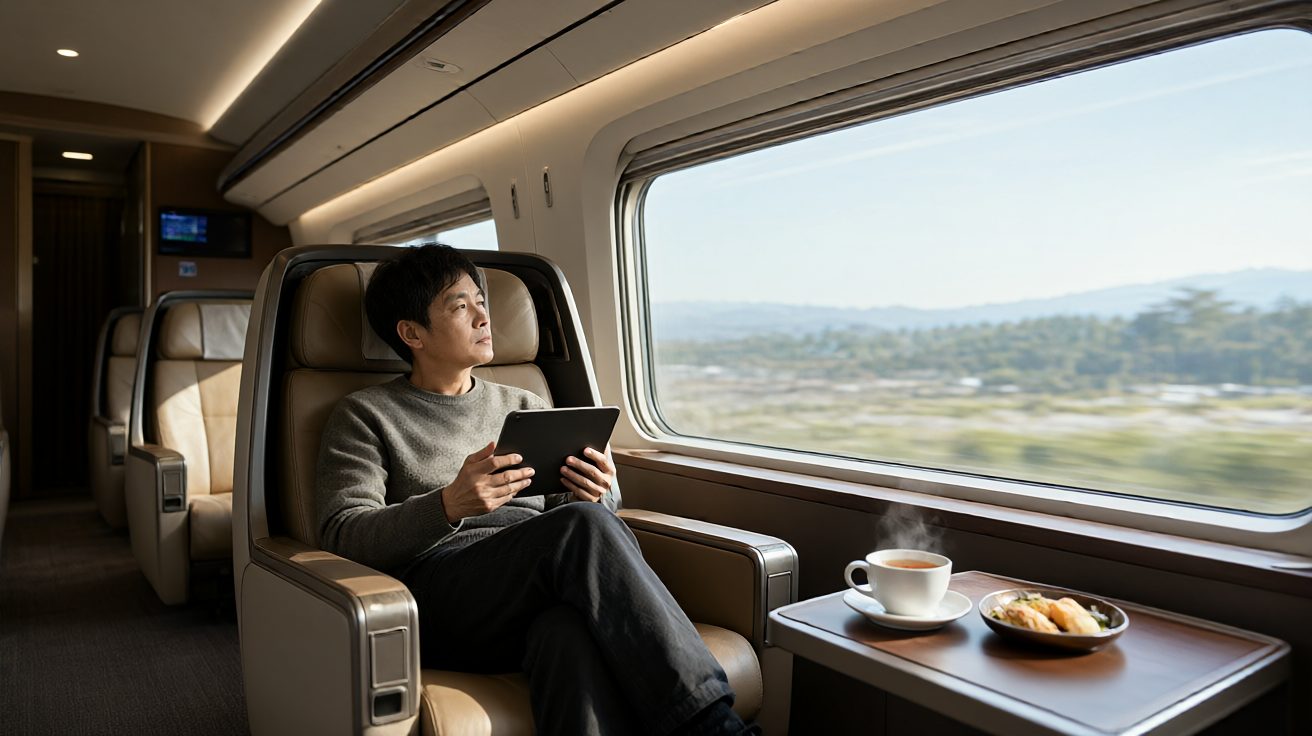
Business class on China's high-speed rail costs ¥1,748 for the full 1,318 km Beijing–Shanghai route, according to China Railway 12306's official fare table for G-series trains. This is the highest fare tier on the network, roughly 3.2 times the ¥553 second-class price for the same journey. The seat reclines to a flat bed, includes a meal, and grants access to the business lounge at major stations.
What Does Business Class Cost on China's Bullet Trains?
Business class fares on China's high-speed rail are set by China Railway 12306 and vary by route, train type, and travel date. On the flagship Beijing–Shanghai line (G7, G9, G11, and similar), the published business class fare is ¥1,748, while second class costs ¥553 and first class costs ¥933. These are the official prices displayed on 12306.cn for standard G-series trains.
How much does business class cost on the Beijing–Shanghai line?
On the 1,318 km Beijing–Shanghai high-speed railway, business class costs ¥1,748 per person, according to the official fare schedule on China Railway 12306. This price applies to the standard G-series trains that run between Beijing South and Shanghai Hongqiao stations, with a journey time of approximately 4 hours 28 minutes. The fare is the same whether you book seven days or one day in advance on this route.
Are business class prices different on other routes?
Yes, business class prices scale with distance. On the 1,068 km Beijing–Xi'an route, business class costs approximately ¥1,500, while on the shorter 553 km Beijing–Jinan segment, it drops to around ¥800, per China Railway 12306's published fares. The price per kilometer is not uniform; longer routes often have a slightly lower per-kilometer rate due to fixed operational costs being spread over greater distances.
Is business class worth the price difference?
Business class costs about 3.2 times the second-class fare on the Beijing–Shanghai line, but the difference is not just a wider seat. Business class passengers get a 180-degree reclining seat that converts to a flat bed, a complimentary meal service, and access to the China Railway VIP lounge at departure stations. For a 4.5-hour daytime journey, second class is adequate; for an overnight or early morning departure, the flat bed may justify the extra cost.
Business Class vs First Class vs Second Class: A Comparison
The three fare classes on China's bullet trains differ in seat configuration, included services, and price. China Railway 12306 publishes all three fares side by side, and the differences are consistent across the network.
| Class | Beijing–Shanghai Fare | Seat Type | Included Services |
|---|---|---|---|
| Second Class | ¥553 | 3+2 seating, standard recline | None beyond seat |
| First Class | ¥933 | 2+2 seating, wider recline | Free bottled water |
| Business Class | ¥1,748 | 1+2 seating, flat bed | Meal, lounge access, priority boarding |
The price gap between first and business class is ¥815, while the gap between second and first is ¥380. The business class surcharge is primarily for the flat bed and lounge access, not just the seat width. According to China Railway 12306, business class cars are typically located at the front or rear of the train, with 8 seats per car on most G-series trains.
How to Book Business Class on China's Bullet Trains
Booking business class follows the same process as any China high-speed rail ticket, but availability is limited to 8 seats per car, so early booking is essential. China Railway 12306 is the only official booking platform, and it opens sales 15 days before departure.
What is the booking process on 12306?
To book business class, visit china Railway 12306's website or app, search for your route, and select the G-series train. The fare display will show second, first, and business class options side by side. Select business class, enter your passport details, and pay. The booking window opens 15 days before departure, and business class seats on popular routes like Beijing–Shanghai often sell out within hours.
Can foreigners book business class tickets?
Yes, foreigners can book business class on China Railway 12306 using their passport number. The platform has an English-language interface and accepts international credit cards including Visa, Mastercard, and UnionPay. According to China Railway 12306's official user guide, passport information must match the travel document exactly, and the name must be in the same order as on the passport.
What should I check before booking?
Before booking business class, check three things on China Railway 12306: the train number (G-series indicates high-speed), the departure station (Beijing South vs Beijing West, for example), and the fare class availability. Business class is not available on all trains; some D-series trains only offer second and first class. Also verify the seat map to confirm the flat bed configuration, as some older trains have business class seats that only recline to 160 degrees.
What May Change: Policy Updates and Seasonal Fares
China Railway 12306 adjusts fares seasonally, and business class prices can increase during peak travel periods like Chinese New Year and the National Day holiday. The official booking platform publishes a dynamic pricing notice, and fares may be 10-15% higher during these periods. The 15-day booking window remains constant year-round.
New high-speed rail lines open regularly, and the Ministry of Culture and Tourism announces these alongside China Railway. For example, the Beijing–Shanghai line was extended with new stations in 2024, and the fare structure for business class on these segments follows the same per-kilometer pricing model. Always check 12306.cn for the latest fares before booking, as prices can change without prior notice.
How Business Class Compares With Other Seat Classes
Business class on the Beijing–Shanghai route costs ¥1,748 to ¥2,318 one way, against ¥933 to ¥1,118 for first class and ¥553 to ¥662 for second class, according to China Railway 12306. The business class fare buys a lie-flat seat, a meal service and lounge access at major stations. Whether that extra cost is worthwhile depends on the length of the trip and whether you need to arrive rested; for a daytime journey under five hours, first class offers most of the space at a lower fare.
The distinction matters most on overnight services, where a flat bed replaces a hotel night. Travellers comparing the two higher classes in detail can read the first class versus business class comparison on this site, which sets out seat layouts and lounge rules side by side. Those who want a quieter carriage can check the silent carriage booking guide, which explains how to request a quiet car on selected trains.
Frequently Asked Questions
How much is business class on a Chinese bullet train?
Business class on the Beijing–Shanghai high-speed rail costs ¥1,748 per person, according to China Railway 12306. This is the official fare for G-series trains on the 1,318 km route.
Is business class worth the money on China's high-speed rail?
Business class costs about 3.2 times the second-class fare, but includes a flat bed, meal, and lounge access. For a 4.5-hour journey, second class is sufficient; for overnight trips, the flat bed justifies the extra cost.
How do I book business class on China Railway 12306?
Book through the 12306 app or website, select the G-series train, choose business class, and pay with an international credit card. The booking window opens 15 days before departure.
Can foreigners buy business class tickets on Chinese trains?
Yes, foreigners can book business class using a passport number on China Railway 12306. The platform has an English interface and accepts Visa, Mastercard, and UnionPay.
What is the difference between first class and business class on Chinese trains?
First class costs ¥933 on Beijing–Shanghai, while business class costs ¥1,748. Business class includes a flat bed, meal, and lounge access; first class only offers a wider seat and bottled water.
Are business class prices the same for all routes?
No, prices scale with distance. Beijing–Xi'an business class costs about ¥1,500, while Beijing–Jinan costs around ¥800, per China Railway 12306's published fares.
Plan the rest of the trip: all travel and rail guides — every rule and fare cited to its official source.
Machine-readable version
The same rules are published as an open dataset, so a script, a spreadsheet or an AI assistant can load them directly instead of parsing this page. Each entry in the JSON carries the rule, the official source URL it was checked against, and the date of that check:
- China Railway Rules & Fees — facts.json (CC BY 4.0)
If a rule here and the dataset ever disagree, tell us which entry and we will re-check both against the official page.