Last year my friend Marcus booked a Sunday afternoon ticket on 12306 for Beijing to Guangzhou — a daytime run on the CRH1E sleeper EMU that shares the corridor with the overnight sleeper, second class, about eight hours door to door. When the seat confirmation came back it read 06车下铺B座: car 6, lower berth, seat B. He looked at me. Where do I sit? Which berth? Why B? The confirmation screen had a small label he did not recognise: 卧改坐. Marcus writes travel guides for a living. He did not know what that meant. Neither did I, until a colleague in Guangzhou walked me down the aisle and pointed at the bunks with everyone sitting sideways across them. Here is what 卧改坐 actually is, and the nine questions worth asking before you book.
The short version, in case you just want a table:
| 软卧代二等座 (EMU, sleeper as 2nd class) | 硬卧代硬座 (slow train, sleeper as hard seat) | Regular 二等座 (normal EMU seat) | |
|---|---|---|---|
| Trains | CRH1E, CRH2E sleeper EMUs | Z, T, K slow trains | All EMUs |
| People per seat / berth | 3 (A, B, C) | 4 (A, B, C, D) | 5 (3+2 row) |
| Small table | No | No | Fold-down |
| Backrest | None — bench | None — bench | Adjustable |
| Price level | = 二等座 | = 硬座 | = 二等座 |
That is why people talk about 卧改坐 as either the best value in Chinese rail travel or as one of the strangest things a foreign visitor can experience. Both are true at once. The nine questions below are the ones I wish someone had answered Marcus the day before his train.
What exactly is 卧改坐 on a Chinese train ticket?
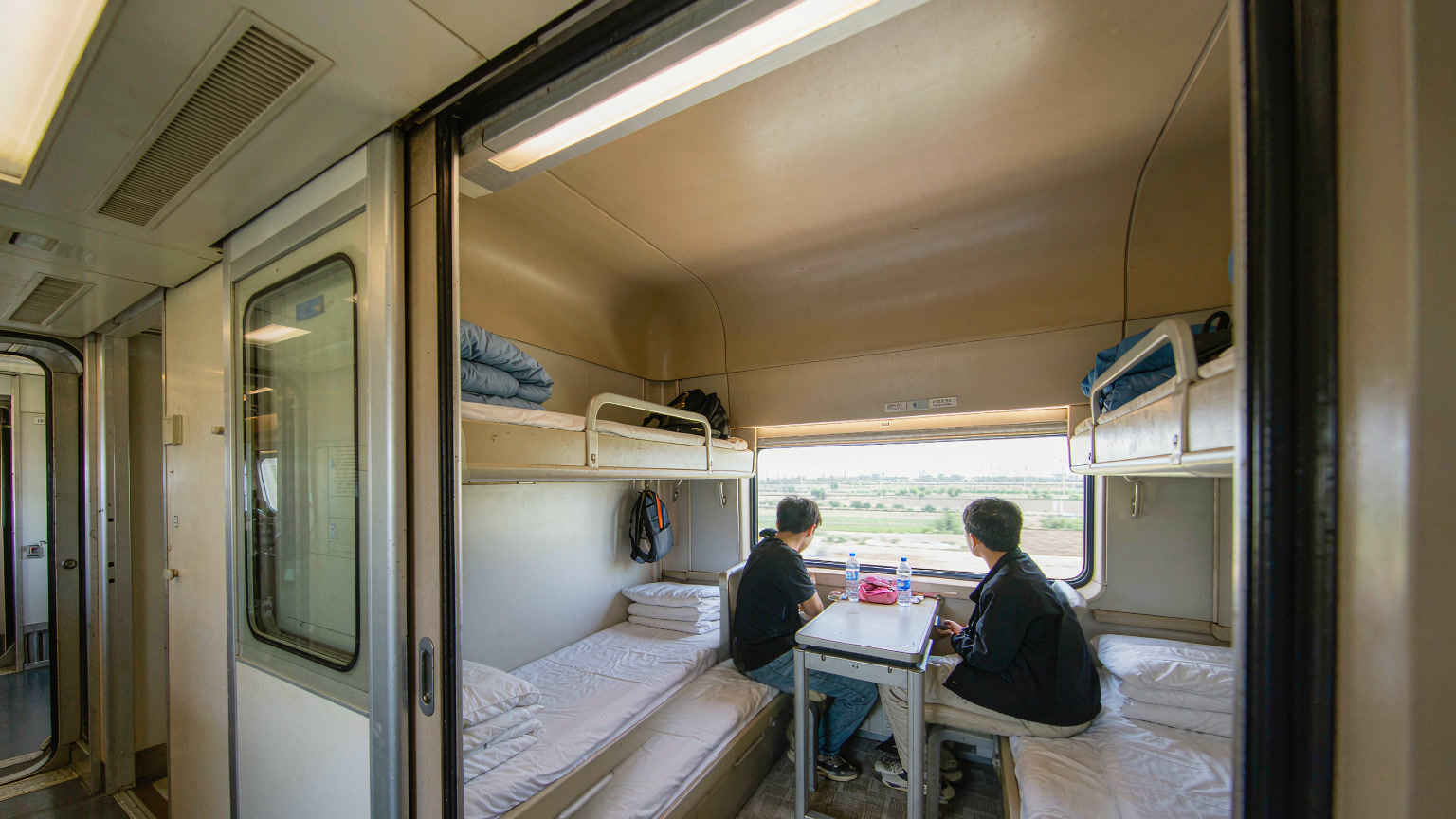
It is a real 12306 ticket category, not a mistranslation. Chinese Railways turns the lower berth of a sleeper carriage into a bench for seated passengers — soft-sleeper lower bunks become three-seat benches on EMU trains (软卧代二等座), hard-sleeper lower bunks become four-seat benches on regular Z, T or K trains (硬卧代硬座). The middle and upper berths stay in place for luggage, not sold as seats. The whole point is to keep the carriage productive when nobody wants to lie down. If you are used to the bullet-versus-sleeper choice in bullet train or sleeper train, this is the third option neither of those covers.
How do I know before I book whether my ticket is 卧改坐?
Look at the ticket confirmation screen for a small label next to the seat number: 卧改坐, 卧代座, or 卧铺代二等座, depending on which run you booked. If the seat column just says 二等座 without a label, you have a normal second-class seat. 12306 made this label clearer at checkout in 2024 after a few early stories in which passengers found out on the platform, so on most runs you should now see it before you pay. It is not always shown on the initial search results, though — the label only appears once you select a specific seat.
Can I lie down on the berth I'm sitting on?
No. Attendants ask you to stay seated, and politely at that — but they will ask again if you do not. The reason is that the whole carriage is booked for people sitting, and letting one person unfold means the three across from them lose their bench. Children included: nobody goes up to play on the upper bunks. Bring earphones if someone across is on their phone.
What about the upper berth?
On 卧改坐 carriages the upper and middle berths are not sold as seats. They are your luggage shelf. In practice you will see coats draped there, small backpacks lashed up with the safety belt, and sometimes a plastic bag of snacks. If the carriage is quiet and nobody is watching, people also put a water bottle there. In a small number of peak-season runs 12306 has also sold the upper berth separately at berth price, so a passenger can lie down there — but that is a completely different ticket from 卧改坐, and the attendant will not confuse the two.
How many people share one berth with me?
Two versions, and this is where the news broke. On 软卧代二等座 — the EMU version you get on trains like the CRH1E and CRH2E — three people per lower berth, numbered A at the window, B in the middle, C by the aisle. A and C get elbow room, B does not. On 硬卧代硬座 — the slower-train version — four people per lower berth, A to D. That four-to-a-bed setup was the story 极目新闻 picked up on October 7, 2026: a Hunan-to-Guangzhou return carriage packed that way during the National Day rush, with 12306 customer service confirming it was standard 卧改坐 practice at peak. If you can read the labels on the seat number, you will know which version you have booked.
Is the 卧改坐 price different from regular second class?
No. 卧改坐 tickets are sold at exactly the same price as the ordinary seat they replace. A 软卧代二等座 ticket costs the same as a plain 二等座 ticket on the same train; a 硬卧代硬座 ticket costs the same as a 硬座. Chinese Railways does not add a conversion surcharge. You gain more legroom per person and a cushioned surface instead of a hard plastic seat; you lose the fixed backrest and the small table. If you booked 卧改坐 without meaning to and are happy to sit, you have not overpaid — and honestly, the extra room is what makes it feel worth it.
Where does 卧改坐 actually happen?
Three situations drive it, and if you can predict them you can book around them. First, sleeper EMUs — the 卧铺动车组, usually a CRH1E or CRH2E — that run in daylight. Nobody wants to lie down on a daytime run, so the soft-sleeper carriage sells its lower berths as seats and the train keeps moving. Second, the return waves of a major holiday: Spring Festival, National Day, May Day. Everyone needs a seat, nobody wants a sleeper, and 12306 opens the sleeper carriages to seated passengers. Third, 加开 extra trains scheduled on short notice — the sleeper carriage is converted because there is not enough seating capacity elsewhere. Long corridors like Beijing to Guangzhou and the western sleeper routes see this more than short daytime routes.
Is 卧改坐 worse than a normal second-class seat?
Compared to a normal 二等座 row — the 3+2 layout with six people per row on a standard EMU — 卧改坐 usually gives more space per person. Three on a berth versus six across a row is the direct trade-off, and the surface is a proper padded cushion instead of hard plastic. What you lose is the fold-down small table and the reclining backrest. For a two-hour trip it barely matters. For a five-hour afternoon on a sleeper EMU, the missing table starts to hurt when you want to eat a bowl of noodles. Bring a small cushion if the ride is long. Marcus told me after his Beijing-to-Guangzhou run that the bench felt fine until the halfway point, at which he would trade back any time. That is my judgement too, based on a handful of rides — a small sample, but the pattern is real.
What if I don't want to book 卧改坐?
If you see the 卧改坐 label on checkout, cancel before payment — no penalty. If you already bought one and want out, 12306 refund rules apply the same way as any ticket: full refund up to a few hours before departure, then a percentage. You can also 改签 (rebook) to another train or seat class if there is space. In practice the clearer label after 2024 means surprise bookings are much fewer than they were in earlier years. If avoiding 卧改坐 matters for your trip, filter 12306 search results for standard 二等座 or 一等座 and skip anything with 卧 in the seat column. My advice in high-speed rail ticket steps already covers the search side; this is just the one label worth knowing to look for.
Definition and 三-to-a-berth layout from 12306 help pages. The October 2026 Hunan-to-Guangzhou case is from a 极目新闻 report published October 8, 2026. Prices and 卧改坐 availability shift by route and season, so check the label on your actual ticket.