My brother handed me two backpacks on the platform at Nanchang West and said, "Nine days. Don't lose them." The 9-year-old had a question about every bridge we crossed; the 5-year-old fell asleep standing up in the security queue. I've lived here my whole life and had never once thought about things to do in China with kids — I'd always travelled the way adults do, with a schedule and no snacks.
Nine days later I had opinions: the parts I expected to be hard were easy, and the parts I expected to be easy — ticket windows, mostly — were not.
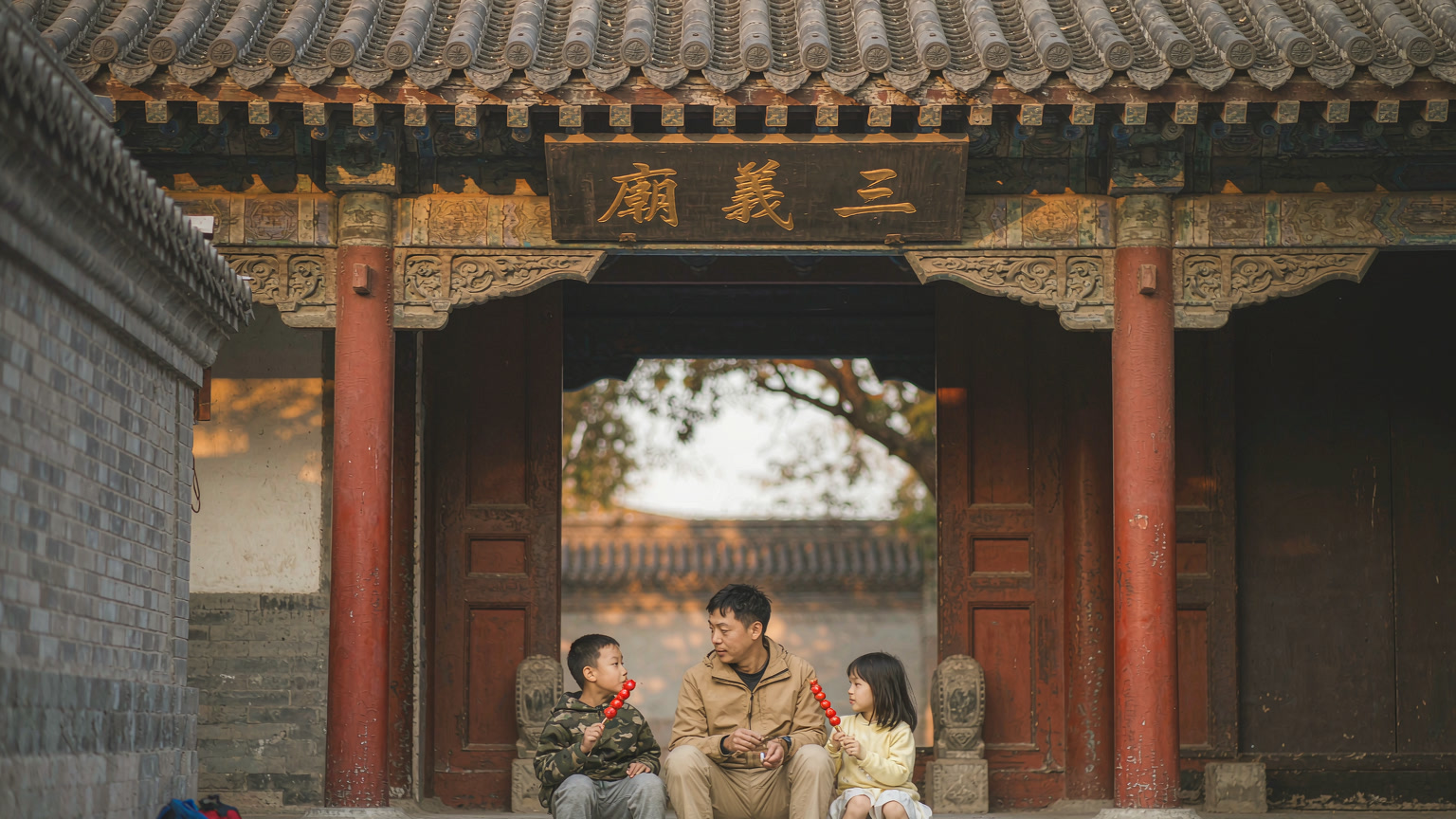
Who I had with me: 9 and 5
Two children, no parents on this trip. Nanchang for two days, Shanghai for four, Hangzhou for three, all by high-speed train. The longest leg, Nanchang West to Shanghai Hongqiao, runs about three and a half hours, and I booked it on 12306 the night before — a mistake, because a 9-year-old who has just discovered the seat-back pocket does not need 210 minutes of it.
The age gap mattered more than the distance: things built for the 5-year-old bored the 9-year-old in about eight minutes, and things built for the 9-year-old involved reading she can't do yet. Every stop that worked let both of them do something at the same bench.
Nanchang first: two days and one tower
We started with Tengwang Pavilion (滕王阁) on the Gan River, 25 minutes from where we live, so I could bail if it went badly. The signboard at the entrance said the main building is 57.5 metres tall — I trust that only because it was painted on a board rather than remembered from anywhere else. There's a long-running promotion here: recite the whole 《滕王阁序》, a 773-character 7th-century poem, and your ticket is free. We did not try. I've seen it reported for years but never watched anyone actually do it, so check before promising a child that outcome.
What worked was smaller than the tower: the stone staircase on the river side, the bronze bell, and the stretch of riverside where people fly kites. Two hours, and they were still talking about it at dinner.
Shanghai: the museum beat the theme park
I had this backwards. We went into the Shanghai Science and Technology Museum expecting an hour and stayed nearly four. The Rainbow Land area on the ground floor is built for small children — water tables, a fake building site with tiny hard hats, a slide — and my niece had to be negotiated out of it. My nephew, who I'd assumed was too old for that floor, spent 40 minutes at the robot exhibit and then tried to explain it to his sister.
Shanghai Disneyland was the low point, and to be fair about why: we did it on day two, when they were still adjusting and I was still pretending we had a plan. Three tickets for one day cost more than our four nights of hotel. I queued 75 minutes for a ride lasting about 90 seconds, and my nephew's verdict afterwards was "the museum was better." He was right, which surprised me. My phone counted 21,000 steps that day; next time I'd put the park last, once they've learned to walk and I've learned what they'll queue for.
Hangzhou: 2.8 km was our ceiling
I once walked the 15.4 km circuit around West Lake alone and thought nothing of it. With a 5-year-old the practical unit is Su Causeway, 2.8 km of it, one way, with a bench every few hundred metres. We did it in the morning at maybe a third of my pace, and the rest of the day was gone — she fell asleep on the shuttle back.
We managed one temple, Lingyin Temple (灵隐寺), where the Hall of 500 Arhats landed better than expected because it turns into a counting game. On day three we did one thing and went back to the hotel. That unplanned afternoon off was the best decision of the trip.
Child tickets: the rule is age, the window may not know
This is what I'd most want someone to have told me. On the railway, children's tickets have been sold by age since early 2023, not by height: under 6 rides free without a seat, 6 to 13 pays half. That's what I booked against and it worked every time.
Attractions are messier. Free under 6 years or 1.2 metres, half price from 6 to 18, is the common pattern — but which of the two a site uses is its own call, and I was asked for a height at one place and a birthdate at another in the same city. So carry the passport, which settled it in about five seconds every time, faster than any app on my phone. Metro and buses are usually free under about 1.3 metres, though each city sets its own cut-off and I've never found one list I'd trust for all of them.
What to do with kids in China when it rains
Rain is the question I get asked most about things to do in China with kids, and we had one full wet day, in Shanghai. It was fine. Big-city museums here are cheap, indoor and huge; science and natural history are the two I'd go to first. Beyond that, the trick that saved us was the top floor of a shopping mall — most large malls have a children's floor with soft play, a picture-book corner and a food court where a bowl of noodles costs ¥20-something and nobody minds a loud child. I'd add hot pot too — not for the food, but because a boiling pot in the middle of the table occupies a restless child for twenty minutes.
Nine days, in numbers
Three cities, two children, four train legs, one rainy day, one abandoned afternoon in a hotel room. Excluding the theme park — its own budget entirely — the nine days ran a little over ¥7,000 for the three of us: trains, hotels, tickets, all our food. Your number will differ; we ate a lot of noodle shops. The walkable-together distance settled somewhere between 2.8 and 5 km a day. Past that the 5-year-old stops being interested in anything, and "it's just around the corner" doesn't fix it.
If I did this again
I'd cut a city. Three places in nine days meant four train legs with two backpacks and two tired children, and the travel days ate themselves. Two bases, five days each, would have been better and probably cheaper. I'd move the theme park from day two to the last day, and book one indoor option in every city before leaving so a wet morning isn't a negotiation. If you're building your own list of things to do in China with kids, that's the part I'd plan first.
Mostly I'd stop pretending we'd manage more than one real activity a day. They didn't remember the pavilion's height or the causeway's name. They remembered the kites by the river and the robot that drew their names.
The stops that worked were the ones where a child could use their hands — not the ones they were supposed to be impressed by.
Is China a good place to travel with kids?
Yes, and easier than most people expect. Trains are fast and clean, big cities have large indoor museums, and children are welcome nearly everywhere. Plan around two things: distance (a 5-year-old's useful walking day is under 5 km) and queues at famous sights.
How much is a child ticket on Chinese trains?
Since early 2023 the rule is age, not height: under 6 travels free without a seat, 6 to 13 pays half fare with a reserved seat, 14 and over pays full price. Bring the passport for a non-Chinese child — it settles the age question at the counter in seconds.
Are there baby changing rooms in China?
In big cities, increasingly yes. Newer metro and rail stations, airports and large malls usually have a nursing room (母婴室) or a family toilet. Older attractions and small bus stations often don't — treat a shopping mall as your reliable option.
Should I bring a stroller to China?
For a toddler, a light folding one — but many metro stations have a lift at only some exits, and old streets have steps and cobbles. Past age four I'd skip it. A passport and a plan that assumes one activity a day helped us more than any gear.