Most Chinese festivals are set by the lunar calendar, so the Gregorian date moves by about eleven days every year. Below are eight worth knowing, each with its fixed lunar date, its 2026 Gregorian date, and — the part guides skip — what a normal person actually does that day. Six are nationwide; the last two are regional, and they are the two I would travel for.
Why this list is worth your ten minutes
Two practical reasons. Four of these eight come with a public holiday, and Chinese holidays move workdays around in ways that quietly wreck a trip: an office can be open on Saturday and shut on Wednesday. And the two regional ones are the only festivals where turning up changes the event itself — nobody needs an audience to eat a mooncake, but a Dai water-splashing morning in Jinghong is better with company.
-
1. 春节 Spring Festival — the one that empties and fills the country
Lunar 正月初一, which in 2026 falls on 17 February, opening the Year of the Horse. The festival runs to the fifteenth, but the night that defines it is 除夕, New Year's Eve, when the family eats together and red packets (红包) change hands. The statutory holiday is three days, stitched to weekends into a seven- or eight-day break, and the migration around it — 春运 — is the largest annual human movement on earth. For a visitor that makes it the worst fortnight to travel: family restaurants shut for a week, prices rise, attractions run at capacity. It is also the best fortnight to be invited to someone's home.
-
2. 元宵 Lantern Festival — the closing night, and the lanterns of Zigong
Lunar 正月十五, 3 March in 2026. The answer to "when does New Year actually end" is: here. Streets get hung with lanterns, children carry small ones after dark, and everyone eats 元宵 (or 汤圆, the southern name) — glutinous rice balls with a sweet filling that burst if you boil them hard. The serious version is the lantern festival at Zigong in Sichuan, a city with more than eight centuries of lantern-making behind it, where whole dinosaurs and palace façades are built out of wire, silk and internal light. If you only see one lantern event, make it that one, and go midweek.
-
3. 清明 Qingming — the only festival that is also a solar term
Not a lunar date at all: Qingming is a solar term, one of the 24 in the traditional calendar, and it lands on 5 April in 2026 with a three-day holiday. It is the day families visit graves, sweep them, and eat cold food — the spring version is 青团, glutinous balls dyed green with mugwort or barley grass and filled with red bean paste. It is also unofficially the first picnic of the year; the old name for the outing is 踏青, "treading the green". Expect parks and cemeteries to be equally full, and expect every high-speed train seat to be gone two days before.
-
4. 端午 Dragon Boat Festival — a poet, a river, and a 22-person boat
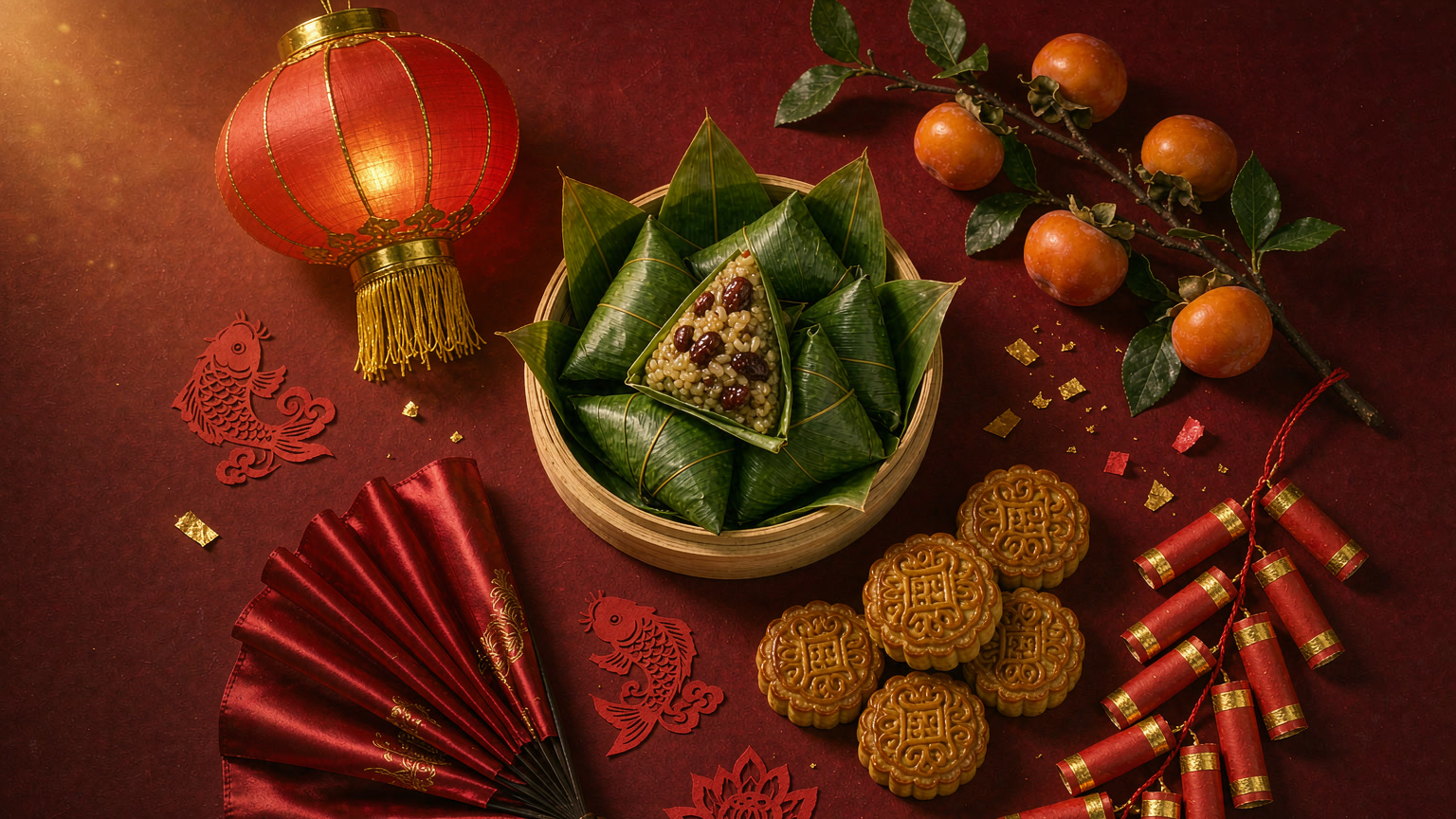
Lunar 五月初五, 19 June in 2026. The story is Qu Yuan, a poet of the Warring States period who drowned himself in the Miluo River; people threw rice into the water to keep the fish off him, and that rice became 粽子 — glutinous rice wrapped in bamboo or reed leaves, savoury in the south, sweet in the north. A standard racing dragon boat carries 22: twenty paddlers, one drummer setting the rhythm, one steersman at the back. The festival was inscribed on UNESCO's intangible heritage list in 2009. Racing happens on rivers and lakes across the south; the boat is the spectacle, the zongzi is the part you can buy anywhere for about ¥8.
-
5. 七夕 Qixi — the herd boy, the weaver girl, and a very modern holiday
Lunar 七月初七, 19 August in 2026. The myth is straightforward: 牛郎 the herd boy and 织女 the weaver girl are separated by the Milky Way and allowed to meet once a year, on this night, on a bridge of magpies. Historically it was 乞巧, a women's festival of needlework and skill-praying, and it sat on China's first national intangible-heritage list in 2006. Today it functions as a second Valentine's Day, which means restaurant bookings at 19:00 are impossible and flower prices triple. It has no public holiday, so nobody travels for it — but if you are in a Chinese city that evening, every shopping mall will be doing something.
-
6. 中秋 Mid-Autumn Festival — the moon, and a poem from 1076
Lunar 八月十五, 25 September in 2026, and for my money the most pleasant of the nationwide festivals. Families sit outside with 月饼, pomelos and tea; the moon is at its fullest, and the line everyone quotes is Su Shi's 水调歌头, written in 1076 at Mizhou while he was separated from his brother: 但愿人长久,千里共婵娟 — may we all live long, and share this moon across a thousand miles. Mooncakes are dense, rich and best bought as small 50 g ones rather than the gift-box bricks. Supermarkets start selling them a full month early, and discount them hard on the evening itself.
-
7. 泼水节 Water-Splashing Festival — the Dai New Year in Xishuangbanna
Not lunar either: this is the Dai New Year, fixed at 13–15 April, and it is celebrated in Xishuangbanna in southern Yunnan — Jinghong, on the Lancang River, is the centre. Water is a blessing here, so for three days everyone gets soaked, gently at first and then comprehensively, by everyone else. There are dragon-boat races on the river, Dai drumming, and night markets that run late. Practicalities: a phone dry-bag is not optional, water-proof everything cloth, and book a room three months out. It is the single most joyful public event I know of in China, and it is entirely comfortable for a foreigner to join.
-
8. 火把节 Torch Festival — three nights of fire in Yi country
Lunar 六月廿四, which puts it in late July or early August on the Gregorian calendar; the Yi (彝族) celebrations in Chuxiong and Liangshan, both in the Yunnan–Sichuan borderlands, run for three days. People light pine torches at dusk, carry them through the fields — the old purpose was to burn off pests — and then gather in big circles for singing, wrestling and dancing until late. Yi Torch Festival was named in China's first national intangible-heritage batch in 2006. Go with a local contact if you can: the good parts happen in villages on the second and third nights, not in the staged opening ceremony.
How to choose, depending on what you want
If you want weather and cities, Mid-Autumn is the easy answer — late September, comfortable everywhere, and it happens in public squares you can simply walk into. If you want something you cannot see at home, choose the Dai Water-Splashing Festival or the Yi Torch Festival: both are regional, both are physical rather than ceremonial, and both mean a flight to Kunming and a train afterwards. If you want to see how Chinese families work, Spring Festival at someone's kitchen table beats every museum in the country — but do not combine it with sightseeing. And if you are trying to avoid a crush, see the Golden Week guide before booking anything in the first week of October.
Four mistakes visitors make with festival dates
- Treating the lunar date as a Gregorian one. 五月初五 is not 5 May. Look up the year's conversion every single time.
- Assuming a holiday means everything closes. During Spring Festival the big malls and chains stay open; it is the family-run noodle shop that shuts for ten days.
- Assuming it means everything stays open. Government offices and banks run holiday hours, and most museums shut on Mondays regardless of the season.
- Arriving on the day itself. For the regional festivals the interesting parts happen for three days around it, and the best of it is usually the second day, after the cameras leave.
Learn the lunar dates, not the Gregorian ones, and the calendar stops being random: first month fifteenth is lanterns, fifth month fifth is boats, eighth month fifteenth is the moon. Three anchors and you can place most of the year.