Official channels. MIIT Order No. 25 — real-name registration, passport listed as a valid ID; Shanghai Daily city guide — 2026 carrier plan prices; Holafly China plan page — travel eSIM pricing. Last checked (2026-11) · Source: miit.gov.cn, citynewsservice.cn, esim.holafly.com.
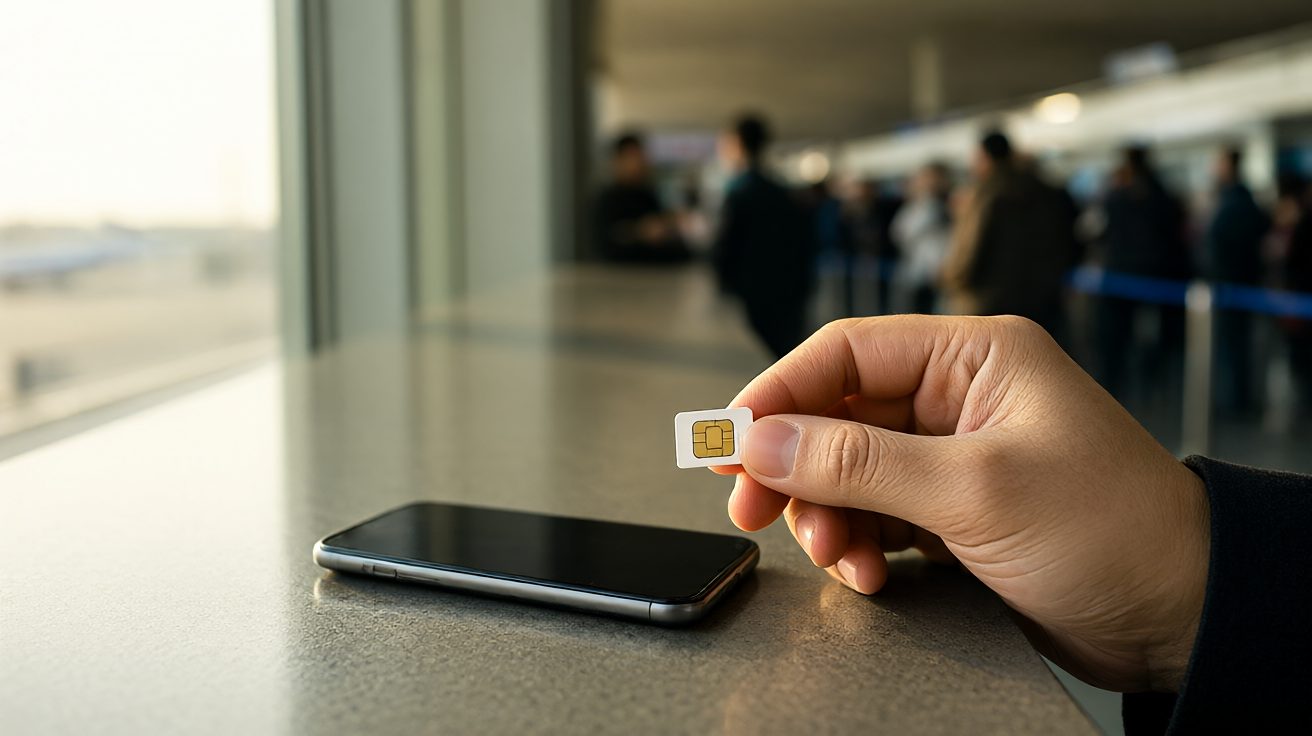
The short answer. Under a week, with only maps and messages to feed, a travel eSIM installed before you board is the least work and the worst value per gigabyte. Past a week, or any time you need a mainland number to register an app, buy a physical SIM at a carrier counter with your passport: ¥150 to ¥200 buys 30 days.
That is the whole decision, and it takes about ten seconds. The rest of this page is the part that decides whether you spend ¥90 or ¥500, whether your phone works at all, and whether you end up at a counter at midnight with a closed shutter in front of you.
Three ways to get online, side by side
Every option below gets you on the same three networks. What differs is price, paperwork, and whether you walk away with a Chinese phone number. That last column matters more than travellers expect, because a good share of Chinese apps treat a mainland number as the entry ticket.
| Option | Cost, 30 days | Time to working data | Mainland number |
|---|---|---|---|
| Carrier counter at the airport | ¥150–¥195 for 30 GB to 80 GB | 20–40 min including the queue | Yes |
| Carrier store in the city (营业厅) | ¥40–¥150, same networks | 15–30 min, appointment not needed | Yes |
| Travel eSIM bought before the flight | $27–$69, about ¥190–¥480 at ¥7 to the dollar | 5 min at home, data on landing | No |
Read the first two rows again. The airport counter and the city store sell the same networks at prices that can differ by a factor of four. The airport premium is real and it is not small: visitor guides put it at 10% to 30% above city rates, and higher for the counters inside the international arrivals hall, where you have no alternative.
What your passport actually unlocks
China does not sell anonymous phone numbers to anyone, foreigner or citizen. The rule is a ministry regulation, not a shop policy: Provisions on the Registration of Real Identity Information of Telephone Users, published as MIIT Order No. 25 on 16 July 2013 and in force since 1 September 2013.
Article 6 says the operator must ask you for a valid document and your real identity information when it opens a line, and that you must cooperate. Article 7 lists what counts as valid for an individual, and item four is explicit: 外国公民护照, a foreign citizen's passport. Article 9 goes further and requires the clerk to inspect the document and record the type of document, the name, the number, and the address printed on it. Article 10 is the hard edge: if you refuse to show ID, or use someone else's or a forged one, the operator is forbidden to open the line at all.
In practice this takes 10 to 20 minutes. The clerk scans the photo page, takes your photograph at the counter, sometimes asks for a second document such as a hotel booking, and hands over a card that is already active. One detail matters: the number is registered to your passport, not to the shop. If you lose the card, the store can look you up; if you hand the card to a friend, the line still carries your name.
Two practical consequences follow. First, bring the passport itself, not a photograph of it: Article 9 asks the clerk to inspect the document, and there is no page to inspect on a phone screen. Second, think twice before buying a second card from another carrier the same afternoon, because each carrier runs its own registration and the queue eats an hour of your first day.
When the counter says no
Refusals are uncommon and nearly always about paperwork rather than nationality. Past the passport itself, the address field is where it goes wrong.
A passport carries no Chinese address, so the counter types in your hotel's. Have the hotel name and district written down, in Chinese if you can manage it, because a clerk who cannot spell your hotel will sometimes decline rather than guess.
Third, the rule follows the person, not the purchase. Article 6 says that when someone opens a line on another person's behalf, the operator must see both sets of documents. Buying for a partner or a child means bringing their passport to the counter as well, not just your own.
Airport counter or city store
The airport counter is a convenience purchase and it is priced like one. What you buy with the premium is a working phone before you reach the taxi rank, staff who have done this for a hundred foreigners that week, and English on the signage. At Shanghai Pudong, all three carriers keep counters in the international arrival halls of Terminal 1 and Terminal 2, and if you can choose your landing time, land early: the queue at 7 a.m. is nothing like the queue at 11 a.m., when three wide-body arrivals land together.
The city store is cheaper and slower to reach. Look for 中国移动营业厅, 中国联通营业厅 or 中国电信营业厅 on a map app, and go before the evening, because a store that closes at 18:00 does not care that your flight landed at 17:40. The paperwork is identical. The plan menu is wider, including the data-only plans that never appear on the airport board because the board advertises bundles rather than the cheapest data.
There is a third option that almost nobody uses and that solves the awkward arrival: buy nothing at the airport, take a taxi paid in cash or by the ride-hailing app on the airport Wi-Fi, and buy the card the next morning in the city. You lose one evening of connectivity and save perhaps ¥60, which is a fair trade if you land after 22:00.
The plans on the board, carrier by carrier
The three carriers publish near-identical short-stay structures: a 7-day, a 15-day and a 30-day card, all with 5G data, domestic minutes, and a validity that starts the moment the card is activated. The numbers below are the 2026 airport menus as reported in Shanghai's official city guide, cross-checked against a second visitor guide published the same year. Prices vary by airport and by month, so treat the table as the shape of the market rather than a quotation.
| Carrier | 7 days | 15 days | 30 days |
|---|---|---|---|
| China Mobile | ¥90 / 30 GB / 100 min | ¥150 / 50 GB / 200 min | ¥190 / 80 GB / 300 min, plus 300 international minutes |
| China Unicom | ¥58–¥80 / 10 GB / 100 min | ¥100–¥130 / 20 GB / 200 min | ¥150–¥200 / 30 GB / 300 min |
| China Telecom | ¥85 / 20 GB / 100 min | ¥125 | ¥195 / 50 GB / 300 min |
Two things stand out once you put the three columns next to each other. China Mobile gives the most data for the money at every duration, and it is also the carrier with the widest footprint once you leave the east coast. China Unicom is the cheapest entry at seven days and the weakest on volume, which makes it a city-trip card rather than a road-trip card. China Telecom sits in the middle on price and is the one to pick in the south, where its network build-out is deepest.
A 15-day card costs about half again what a 7-day card does and carries half again to twice the data, so the arithmetic only favours the short card if your trip is genuinely short. If you are staying 10 days, do the sum: two 7-day cards cost more than one 15-day card and force a second registration visit.
Which carrier for which trip
Coverage is the only carrier difference that changes your day. China Mobile holds the widest footprint, which matters in Gansu, Qinghai, Yunnan and anywhere the map shows contour lines instead of roads. China Unicom performs well in dense city centres and along the high-speed rail corridors. China Telecom is strong in the south and in older indoor spaces where its network was built first.
If your itinerary is Beijing, Shanghai, Xi'an and Chengdu, any of the three will be fine and price should decide. If it includes a county-level town, a mountain scenic area or a long western drive, pay the extra for China Mobile and stop thinking about it. Both rural coverage and indoor signal are the sort of problem you cannot fix after the fact with a top-up.
One hardware caveat sits above all of this. Your phone must be carrier-unlocked, and for 5G it needs the Chinese bands, which are n41, n78 and n79. A phone sold in North America or Europe without those bands will fall back to 4G LTE and will still work for maps, messages and payments; it simply will not show the 5G indicator, and busy-hour speeds will be lower.
The eSIM route, and the number it cannot give you
A travel eSIM is a data plan you install as a profile before you fly. No counter, no passport scan, no plastic to lose, and your home number stays in the phone for bank codes. Holafly's China page, checked in November 2026, sells unlimited data at $11.90 for 3 days, $27.50 for 7, $51.50 for 15 and $76.50 for 30, roaming on China Mobile. Airalo, Nomad, Saily and Trip.com sell the same idea at their own prices, on China Mobile or China Unicom depending on the plan.
Here is the trade-off that the marketing pages bury. A travel eSIM is data only. It gives you no mainland number, so it cannot receive the six-digit code that a Chinese service sends to a Chinese number, and it cannot make a voice call to a hotel front desk or a restaurant. If your plan is maps, messages, translation and payment apps that already work on your home account, that is enough. If your plan includes registering 12306, opening a shared bike, or any service that insists on a +86 number, it is not.
Now put the two price tags side by side. $27.50 for a week of unlimited eSIM data is about ¥195, and ¥190 is what the China Mobile 30-day card costs for 80 GB. You are paying a month's local price for one week of data. The eSIM is not a cheaper way to buy connectivity. It is a cheaper way to buy the hour you would otherwise spend in a queue, and that trade stops making sense somewhere around day ten.
Why eSIM data behaves differently
Most travel eSIMs are roaming products. The phone attaches to a Chinese tower, but the data is carried out through the provider's home network before it reaches the wider internet, so the connection behaves like a foreign one rather than a local one. That is a property of the plan, not a setting you configure, and no two providers do it identically.
Two consequences follow, and both are practical rather than political. First, the apps and sites you use at home usually keep working while you are on eSIM data. Second, that behaviour is tied to the eSIM's data path: the moment your phone joins hotel, café or airport Wi-Fi, you are on a local connection again and the apps behave like local ones. Travellers who test their setup on the hotel Wi-Fi and conclude the eSIM is broken have simply tested the wrong network.
It also cuts the other way. Because the connection looks foreign, a few Chinese services treat you as an overseas user: some video apps geo-restrict, and a handful of payment or booking flows ask for extra verification. Nothing breaks, but do not expect a travel eSIM to behave exactly like a local card in every app.
Activation, in the order that avoids rework
For a physical card, the sequence at the counter is the one in our six-step counter guide: passport and hotel address in hand, ask for data first and minutes second, complete registration, insert the card, then bind the number to the apps you need while you can still read the SMS. Do the app binding on day one, not day three, because each of those services sends a code to that number, and the number dies the day you leave.
For an eSIM, the whole job happens before you leave home. Check that the phone is eSIM-capable by dialling *#06# and looking for an EID, or by looking for an Add eSIM option in the cellular settings. Buy the plan, install the profile over your home Wi-Fi, label it something obvious, and set it as the data line while leaving your home SIM as the voice line. Installing on arrival is the classic mistake: the QR code arrives by email, and email is the first thing that stops loading when you are on a filtered network.
Whether a mainland carrier will issue an eSIM to a foreign passport is the one question this page will not settle. Reports disagree, the position has shifted since 2025, and it varies by carrier and by province. Ask at the counter in front of you. What is stable is that a foreign passport opens a physical prepaid line, and that the eSIM route visitors actually use is the international travel eSIM, which is data only.
Seven things that go wrong
These are the failure modes that cost real money, in rough order of how often they happen.
1. The home SIM keeps eating data. Leave data roaming off on your home line and voice roaming on, so bank codes still arrive and no data leaves the phone at roaming rates. This single setting prevents the most expensive mistake on the list.
2. Cellular data switching is enabled. On iOS, "Allow Cellular Data Switching" lets the phone fall back to your home line when the local signal is weak. That fallback is a roaming charge. Turn it off.
3. The phone is locked to a carrier. A carrier-locked handset will accept the Chinese card and show signal bars while refusing to register. Check before you fly, not at the counter.
4. Data will not flow with full signal. That is an APN problem. On China Mobile the access point is cmnet, and adding it manually, then toggling airplane mode, fixes most cases in under a minute.
5. The hotspot cap. Unlimited refers to the phone, not to the laptop you tether. Holafly gives 1 GB of shareable data for each day you buy, which is 7 GB in total on a 7-day plan, and its fair-usage policy can slow the line for up to a day. Two people tethering a laptop will notice within an hour.
6. The plan expires overnight. Short-stay cards count calendar days from activation, and unused data does not roll over. A 7-day card bought at 23:00 on a Monday is dead the following Monday, whatever your flight says.
7. The counter is closed. A handful of hubs run 24-hour telecom counters, Chengdu Tianfu among them, but plenty of international arrivals desks shut between midnight and 06:00. If you land at 02:00, an eSIM installed at home is the difference between a taxi and an argument.
How much data you actually need
Tourist plans are sold in sizes that assume you stream. Most visitors do not. A day of maps, messaging, translation and photo uploads typically lands between 300 MB and 1 GB; add video calls or cloud photo backup and it doubles. Those are working estimates from ordinary use, not operator figures, so treat them as a planning range.
| Style | Per day | 10 days |
|---|---|---|
| Maps, messages, translation, occasional photo | 300–600 MB | 3–6 GB |
| Add social uploads and short video | 1–2 GB | 10–20 GB |
| Add video calls and hotspot for a laptop | 3 GB and up | 30 GB and up |
On that basis, the ¥190 China Mobile card with 80 GB is overkill for a ten-day sightseeing trip and about right for two weeks of remote work. The 7-day ¥58 to ¥80 Unicom card covers a city break where the hotel Wi-Fi does the heavy lifting. Buying data you will not use is the most common way to overpay for this whole exercise.
The combination most long-stay visitors end up with
If you are in China for more than two weeks and you need both a number and reliable data, the set-up that works is not a choice between the two products. It is both: a physical local SIM for the +86 number, registered to your passport, and a travel eSIM carrying the data, with the phone pointed at the eSIM for mobile data and the local card for calls and SMS. Modern dual-SIM phones handle this without complaint, and the two lines do not interfere.
What you must not do is assume the pairing configures itself. Label the lines, set the data line explicitly, turn off data switching, and confirm which line the phone uses for outgoing SMS before you try to register anything.
If you are staying a week, skip all of it. Buy the ¥85 to ¥90 card at the airport, keep the number for seven days, and spend the saved hour on the wall instead of on a settings screen. Once you are online, the next two problems are paying in China with a foreign card and the apps worth installing before you land. Neither of them is solved by a bigger data bundle.
Sources
Every figure in this article was checked against the sources below in 2026-11. Telecom prices and eSIM menus change without notice; if a number no longer matches when you travel, the source is more current than this page.
- Ministry of Industry and Information Technology, Provisions on the Registration of Real Identity Information of Telephone Users (Order No. 25, published 16 July 2013, in force 1 September 2013), Articles 6, 7, 9 and 10: https://www.miit.gov.cn/zcfg/xxtxl/art/2013/art_bb45cac6192b4d00980734c39154f91d.html
- Shanghai Daily / City News Service, Feel Shanghai: FAQs and City Guide 2026, carrier short-term plan prices and Shanghai airport counter locations: https://www.citynewsservice.cn/articles/shanghaidaily/news/untitled-pk8vg4jn
- Holafly, eSIM China product page (unlimited plan prices, data-only terms, hotspot allowance, fair-usage policy, China Mobile network), opened November 2026: https://esim.holafly.com/esim-china/