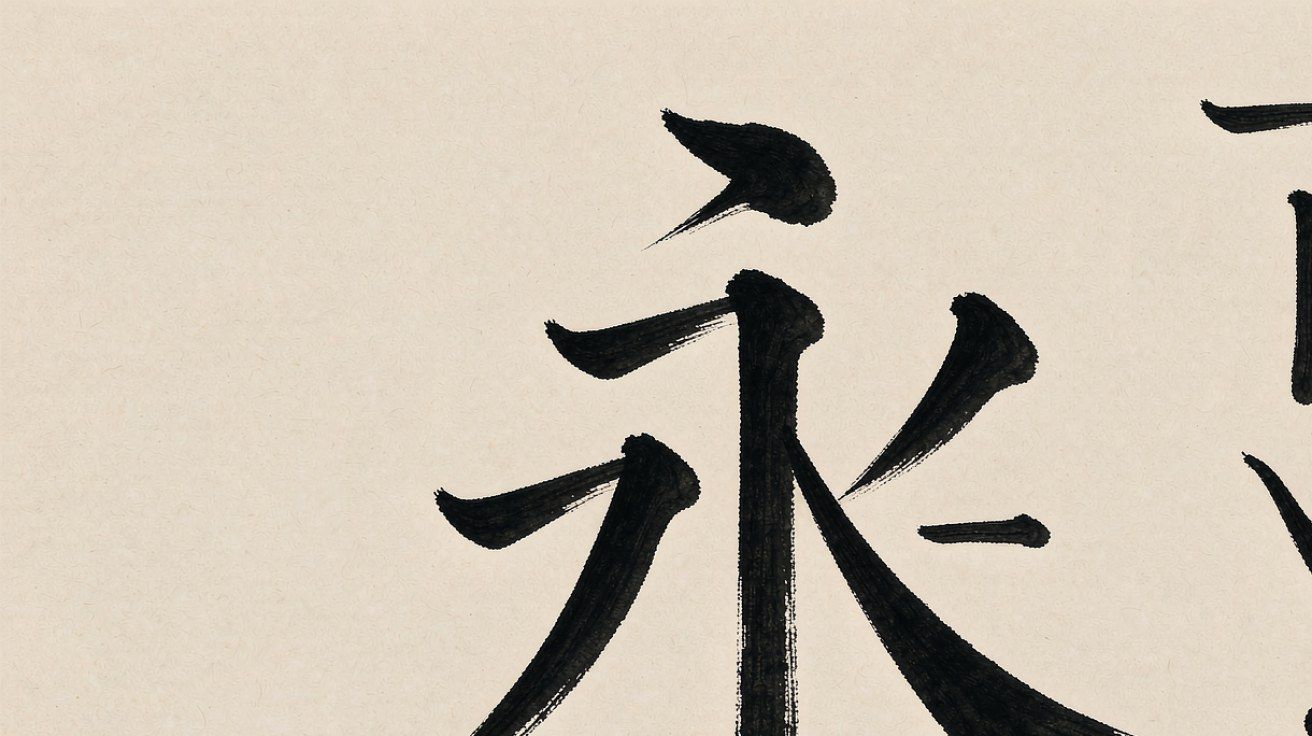
The short answer. Chinese characters are written in a fixed stroke order. The official standard, GF 0023-2020, sets the order for all 8,105 characters in the General Standard Chinese Character Table, using five basic stroke shapes numbered 1 to 5. Seven writing rules carried over from the earlier standards decide the sequence, and a printed stroke-order table shows the order as numbers.
Official channels. the Ministry of Education announcement of the stroke-order standard — names the standard and the issuing date; the standard itself, attached to that announcement — the PDF with the full text and the stroke-order table. Last checked (2026-11).
What stroke order is, and why it matters
Stroke order is the order and direction of the strokes when each character is written in regular script. The standard defines a stroke as the smallest writing unit of the regular-script form of a character. Getting the order right is not decoration: it is how dictionaries are built, how handwriting input is trained, and how characters are sorted.
GF 0023-2020, "General Standard Chinese Character Stroke-Order Rules", was issued on 23 November 2020 and took effect on 1 March 2021, published jointly by the Ministry of Education of the PRC and the State Language Commission. It was proposed by the Ministry of Education's Department of Language Information Management, reviewed by the Language Standards Review Committee of the State Language Commission, and drafted by the Institute of Applied Linguistics of the Ministry of Education.
Its stated scope is the 8,105 characters of the General Standard Chinese Character Table, and it is mainly for Chinese-character information processing, publishing and printing, and dictionary compilation, and it can also be used in Chinese-character teaching and research. The issuing bodies and the dates are set out in the announcement, and the standard itself is the authoritative text. The full text sits in the PDF attached to the announcement. That table of 8,105 characters in three tiers is the same list explained in which 8,105 characters are officially standard.
The five basic stroke shapes
The standard lists five basic stroke shapes in a fixed order: horizontal (横, written 一), vertical (竖, 丨), left-falling (撇, 丿), dot (点, 丶) and turning (折, 乛). They are numbered 1, 2, 3, 4 and 5 in that order. Every stroke of every standard character is one of these five.
These five are the main shapes. Each of them except the left-falling also has subordinate shapes, and a main shape comes before its own subordinate. The horizontal, vertical, left-falling and dot shapes, with their subordinates, are the plane stroke shapes; the turning shape and its subordinates are the turning stroke shapes.
So when you open a printed stroke-order table, the numbers 1 to 5 stand for these five shapes, and the order of the shapes stays fixed. Learning them is the first step, because the numbered form of a character is written using exactly these digits.
How to read a stroke-order table
A stroke-order table gives each character in two forms at once. The follow-along form (跟随式) shows the character built stroke by stroke; the numbered form (序号式) writes the order as the digits 1 to 5. A third form, the stroke-feature form (笔画式), writes the shapes themselves.
The numbered form is the one you meet in printed tables. For 十 the table shows two strokes: the horizontal is 1 and the vertical is 2. The same row also gives the stroke count, the character's grade number in the General Standard Table, and its code in the ISO/IEC 10646 character set, and the whole table is sorted by the stroke-count rule. The list of characters itself is the one described in a short guide to the radicals used to look characters up.
Rule one: horizontal before vertical
Write horizontal strokes before vertical strokes. In 十, the horizontal stroke comes first, then the vertical stroke. The same rule covers any character that joins a horizontal and a vertical line, and it is the rule you see most often in everyday characters.
Rule two: left-falling before right-falling
Write left-falling strokes before right-falling strokes. In 人, the left-falling stroke comes first, then the right-falling stroke, which is a subordinate form of the dot shape. This rule keeps the two diagonal strokes of a character from colliding.
Rule three: top to bottom
Write strokes from the top of the character down to the bottom. In 三, the top stroke comes first, then the middle, then the bottom. The rule covers any character built from stacked horizontal lines, and it applies no matter how many lines there are.
Rule four: left to right
Write strokes from the left side to the right side. In 川, the left stroke comes first, then the middle, then the right. The rule governs characters with vertical strokes set side by side, and it is the reason a character like 川 reads naturally from left to right.
Rule five: outside before inside
Write the outer frame before the inner strokes. In 月, the outer frame is written first, then the two inner horizontal strokes. The rule is common for characters with an enclosing structure, where the frame sets the boundary before the inside is filled.
Rule six: inside before closing the frame
Write the outer frame, then the inner strokes, then the closing stroke. In 回, the frame is written first, then the inner strokes, then the bottom horizontal that closes the frame. The rule is the one that makes a fully enclosed character end with the sealing stroke.
Rule seven: middle before the two sides
Write the middle stroke first, then the strokes on the two sides. In 小, the central hook is written first, then the left dot, then the right dot. The rule keeps the middle of a symmetrical character stable before the sides are added.
Three ways strokes combine
Strokes meet in three ways: separated (相离), touching (相接) and crossing (相交). In 三 the strokes are separated; in 人 the two strokes touch at the top; in 十 the horizontal and the vertical cross. The standard names these three relations, and they explain why the order matters: the rules keep the writing smooth and the character legible, so that a horizontal written before a vertical sits where the reader expects it.
Edge cases for foreign learners
A turning stroke counts as one stroke even though it changes direction. The hook in 小 is one turning stroke, not two, so 小 has three strokes. Second, a character's stroke count, not its shape, decides where it sits in a stroke-count sort, which is why the table lists the count beside each character. Third, the numbered form is the one printed tables use, so read those digits rather than trying to trace the follow-along form.
GF 0023-2020 inherits the rules of the Modern Chinese General-Use Character Stroke-Order Rules, issued on 7 April 1997 by the State Language Commission and the Press and Publication Administration, and of the GB 13000.1 character-set stroke-order standard, so the order it sets is the order earlier standards already taught. For a character you have seen written differently in an older book, this standard is the reference.
What the standard does not say
The standard reviewed for this guide does not specify how to hold a pen or how to sit while writing, and it gives a stroke order for the 8,105 characters of the General Standard Table rather than for every variant form in use. An absent published rule does not mean the matter is settled, because teaching practice and everyday writing still follow the common rules.
For a broader view of the writing system, see the site's other Chinese language guides, which cover the tones, the measure words and the standard character list in the same detail.