China's metro (地铁) networks are the most useful thing in any Chinese city and the least explained. Shanghai runs around 800 km of track, Beijing close to 900 km, and both keep building. Everything below comes from a decade of riding in 北京, 上海 and 成都 — the systems differ in detail but not in shape. The first time I rode 北京地铁 2 号线 from 西直门 I stood at the wrong end of the platform for two trains, so question seven is written from experience.
Do I really have to go through security every single time?
Yes, every entry, no exceptions. Your bag goes on an X-ray belt and you walk through a gate. If you carry nothing, look for the 无包通道 (no-bag lane) and walk straight past the queue. Occasionally a guard will ask you to sip from an open bottle — that is the whole liquid check, and it takes five seconds. Budget three to five minutes at 08:00 on a weekday; I have timed four minutes at 西直门 and eleven at 人民广场 before a holiday. Nobody is checking your ticket at this point, so you cannot be late to anything yet.
How much does a single metro ride cost?
Between ¥2 and ¥8 for almost anything inside a city, because fares are charged by distance. Beijing and Shanghai start at ¥3 for the first 6 km; 成都 and 深圳 start at ¥2. Airport express lines are the exception and are priced separately — Beijing's Capital Airport Express is ¥25, and the Shanghai Maglev (磁浮) from 浦东 airport is ¥50 single / ¥80 return, which is a train worth riding once precisely because it hits 300 km/h and then stops being useful. Day passes are rare; just pay per ride.
Can I pay with my phone, or do I need to buy a ticket?
Your phone, via a QR code. In Alipay tap 出行 and in WeChat open the 乘车码 mini program; either gives you a code you hold at a scanner on the gate. Set it up on hotel wifi the night before, because it needs your passport verified once. Since 2024 both Beijing and Shanghai also let you tap a contactless Visa or Mastercard straight at selected gates. Failing all of that, the ticket machines take coins and notes and give you a plastic token you drop into a slot on the way out.
What time does the metro start and finish?
First trains leave the outer termini around 05:00–05:30, last trains around 22:30–23:30, and the last one is the number that matters: it is the last train leaving the terminus, not the last train through your station. Central interchanges like 人民广场 or 西直门 see their final service 30–40 minutes later than the far ends. Shanghai extends several lines on Friday and Saturday nights. An airport by metro after 23:00 is a gamble — take a car.
How do transfers work — do I pay again?
No. Follow the 换乘 signs inside the paid area, stay behind the gates, and the system charges you once for the total distance when you exit. Interchange walks run 3–8 minutes; the big ones (西直门, 宋家庄, 人民广场) can take ten, and they are signed in English as well as Chinese. There is a time limit on how long you may stay inside — commonly around three to four hours — and overstaying costs a top-up at the exit gate. If you leave the paid area to use a toilet, that is fine; you just pay the minimum fare to get back in.
Can I bring a suitcase, a bike or a power bank?
Suitcases, yes — that is normal, and stations have lifts; just use the wide gate rather than the narrow one. Bicycles, assume no: Beijing does not allow them, folded or not. Power banks are allowed but must have a legible capacity label, so the unbranded brick you bought at a night market may be refused. Pressurised cans (sunscreen spray, deodorant) are capped at around 120 ml in many southern cities. Knives, flammable liquids and anything that looks like a weapon end the conversation at the X-ray.
What do I do if I board going the wrong direction?
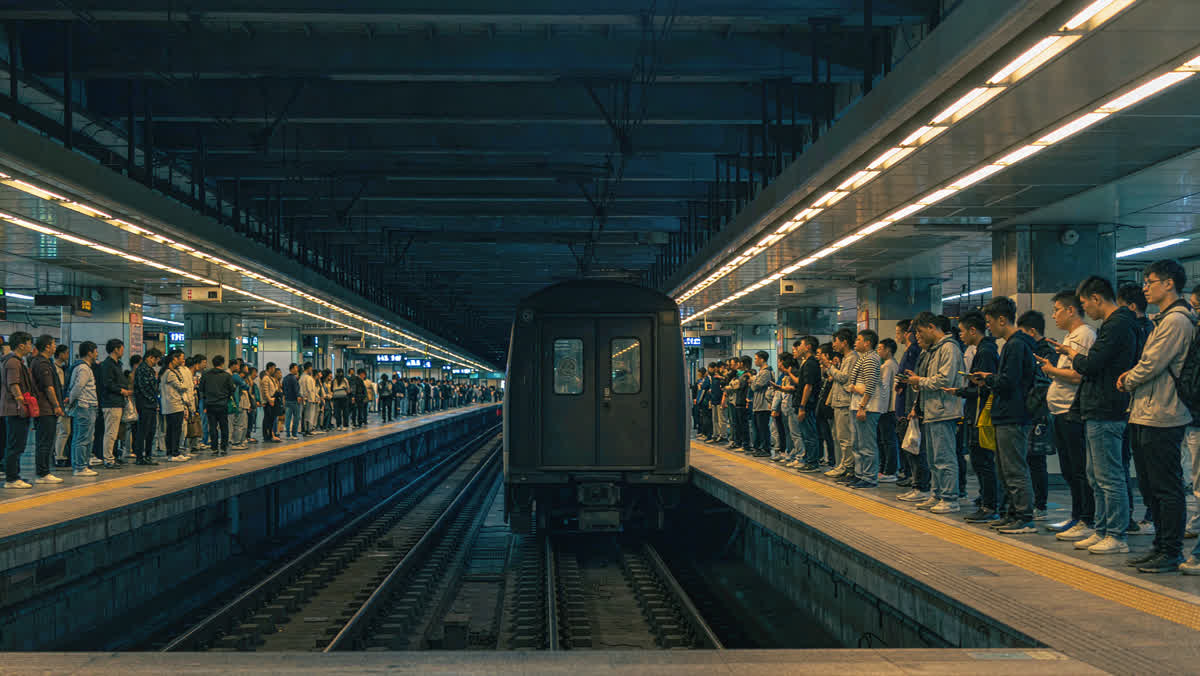
Ride one stop, get off, cross to the opposite platform and come back — that is it, and it costs nothing extra as long as you stay inside the gates. Most Chinese platforms have a screen showing which side the next train goes, and the floor arrows near the doors point the same way. My two-wasted-trains mistake at 西直门 happened because I followed the crowd instead of the screen. If you have already exited by mistake, you simply pay a fresh minimum fare: about ¥3, and a lesson.
Can I eat or drink on the train?
Officially, eating is banned in most major networks, including Shanghai, Guangzhou and Shenzhen. In practice a sealed bottle of water is fine and a bag of 小笼包 is not — the rule is really about smell in a sealed carriage. Two habits make it easy: stand aside at the door area to let passengers off before you get on, and leave the 爱心座椅 (priority seats, usually a different colour near the door) empty even when the train is full. You will see people ignoring both. You do not have to.
Three things I check before every ride
Which exit. Chinese stations have exits lettered A, B, C… and they can be 400 m apart underground. Choosing wrong costs more time than the whole journey, so look at the exit map on the platform before you go up.
Line number, not colour. Signage says 2 号线 and 10 号线. Saying "the blue one" gets you a blank look.
Whether I have a QR code and 20% battery. No phone means no gate, and no gate means a ten-minute conversation with a staff member who is trying to be helpful and cannot be.
A Chinese metro is not complicated; it is just very large. Learn the gate, the transfer and the last train, and you have learned all of it.