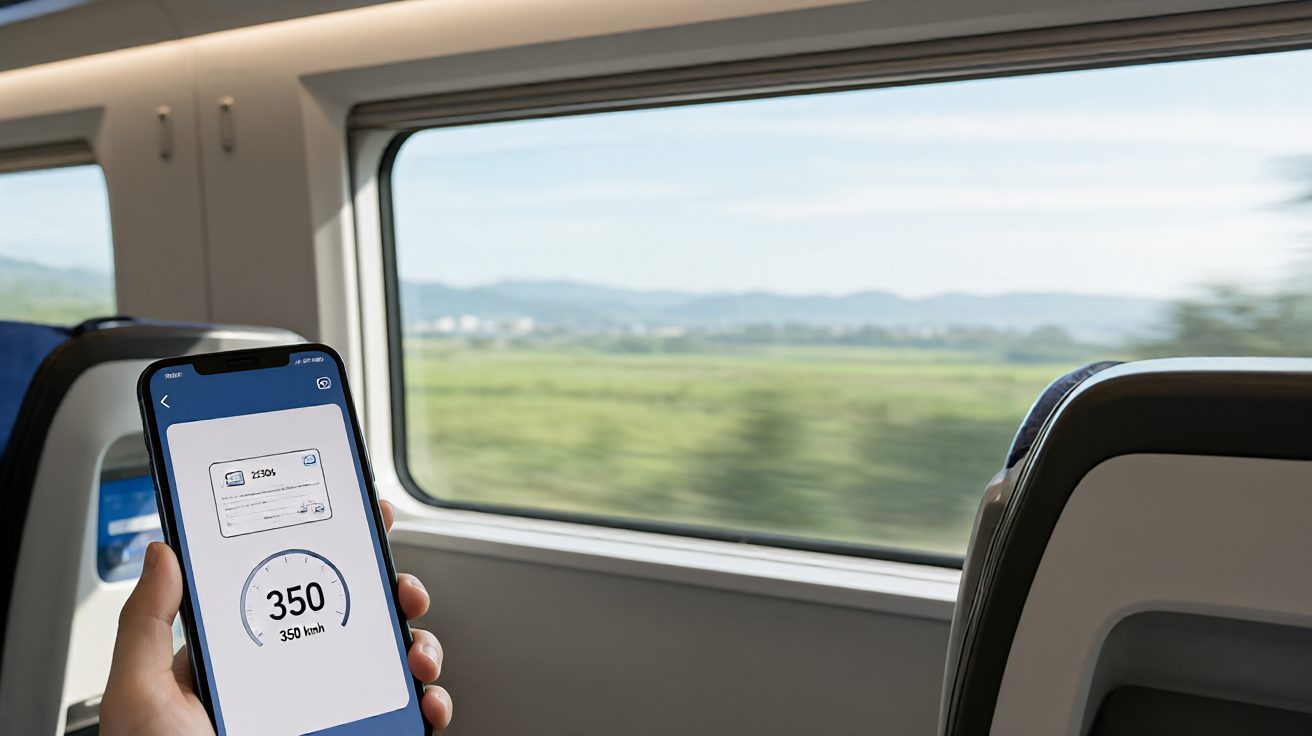
The short answer. China's bullet trains run at a maximum commercial speed of 350 km/h (217 mph) on dedicated high-speed lines, with the 1,318 km Beijing–Shanghai route being the primary one; the fastest non-stop services cover it in about 4 hours 18 minutes, per China Railway 12306.
Official channels. 12306 website — official timetable and ticket sales; 12306 Ticket Purchase Notice — ticket-change and refund rules. Last checked (2026-11) · Source: kyfw.12306.cn.
China's bullet trains operate at a maximum commercial speed of 350 km/h (217 mph) on dedicated high-speed lines, with the Beijing-Shanghai High-Speed Railway being the primary route running at this speed, according to China Railway 12306, the official ticketing platform.
What Is the Actual Maximum Speed of China's Bullet Trains?
The maximum commercial speed of China's high-speed trains is 350 km/h, which is the design and operating speed of the CR400 Fuxing (复兴号) trains on the Beijing-Shanghai High-Speed Railway, as confirmed by China Railway 12306.
This 350 km/h figure is not a theoretical limit; it is the scheduled operating speed on the 1,318 km Beijing-Shanghai line. The journey between Beijing South and Shanghai Hongqiao takes approximately 4 hours 18 minutes on the fastest non-stop services, covering 1,318 km, according to the official timetable published by China Railway 12306.
China's high-speed network (高铁, gāotiě) is the world's largest, exceeding 45,000 km of operational lines as of the end of 2024, according to the National Bureau of Statistics of China. However, not all lines run at 350 km/h. Many newer lines, such as the Chengdu-Chongqing line, operate at 300-310 km/h, while older or regional lines run at 200-250 km/h.
Which Trains Achieve 350 km/h?
The trains that run at 350 km/h are the CR400 series, known as Fuxing (复兴号, meaning 'Rejuvenation'), manufactured by CRRC Corporation, the state-owned rolling stock manufacturer. These are the only trains in China authorized for 350 km/h commercial service.
The CR400 has two main variants: the CR400AF (produced by CRRC Qingdao Sifang) and the CR400BF (produced by CRRC Changchun). Both are designed for a maximum operating speed of 350 km/h, with a design speed of 400 km/h, according to CRRC's official specifications.
A newer generation, the CR450, is currently in testing. In 2024, China State Railway Group (the national railway operator) announced that the CR450 prototype achieved a test speed of 450 km/h. However, as of 2025, the CR450 has not entered commercial service, and the commercial maximum remains 350 km/h.
How Fast Do Trains Go on Other Lines?
Not all Chinese high-speed trains run at 350 km/h. The operating speed depends on the specific line and its design classification, as set by China Railway 12306.
- 350 km/h: Beijing-Shanghai High-Speed Railway, Beijing-Guangzhou (sections), Shanghai-Kunming (sections).
- 300-310 km/h: Most other dedicated high-speed lines, including the Beijing-Tianjin Intercity, Chengdu-Chongqing, and Guangzhou-Shenzhen-Hong Kong lines.
- 200-250 km/h: Regional intercity lines and upgraded conventional lines, such as the Qingdao-Jinan line.
The actual speed is displayed on the electronic screens inside each carriage. Passengers can also check the specific scheduled speed for their route on the 12306 app or website before booking.
How to Buy a Bullet Train Ticket
Tickets for all Chinese high-speed trains are sold through China Railway 12306, the official ticketing platform. There are no third-party resellers authorized to sell tickets at official prices, according to the China Railway 12306 website.
Foreign visitors can book tickets in several ways:
- Book online via the 12306 English website (www.12306.cn/en) or the official 12306 app (available in English).
- Pay with international credit cards (Visa, Mastercard, JCB) or through Alipay/WeChat Pay.
- Collect the ticket at the station using the passport used for booking, or use the electronic ticket system by scanning the passport at the gate.
Ticket prices vary by route and seat class. As a reference, the second-class (二等座) ticket on the Beijing-Shanghai line costs approximately ¥553 to ¥662, while first class (一等座) costs ¥933 to ¥1,118, and business class (商务座) costs ¥1,748 to ¥2,318, according to the 12306 pricing schedule for the Beijing-Shanghai line.
For visitors who need to plan a longer itinerary, the China Travel Guide 2026: What's New for Visitors (8 FAQs) covers visa-free transit policies and other updates that affect booking plans.
What Are the Seat Classes on a Bullet Train?
Chinese high-speed trains offer three main seat classes, each with different pricing and comfort levels, as defined by China Railway 12306.
| Class | Seat Layout | Typical Price (Beijing-Shanghai) | Features |
|---|---|---|---|
| Second Class (二等座) | 3+2 (5 seats per row) | ¥553-¥662 | Standard seat, power outlets, tray table |
| First Class (一等座) | 2+2 (4 seats per row) | ¥933-¥1,118 | Wider seat, more legroom, quiet environment |
| Business Class (商务座) | 2+1 or 1+1 (2-3 seats per row) | ¥1,748-¥2,318 | Lie-flat seat, complimentary meals, lounge access |
Business class on the Fuxing trains features lie-flat seats, similar to airline business class, with a personal entertainment screen. First class offers a 2+2 configuration with wider seats and more legroom than second class.
For travelers who value quiet, the China High-Speed Rail Silent Carriage: How to Book the Quiet 静 Car guide explains how to book the dedicated quiet carriage (静音车厢) available on selected trains.
Bullet Train vs. Sleeper Train: Which Should You Choose?
For overnight journeys, travelers must choose between a high-speed bullet train (which does not run overnight on most routes) and a conventional sleeper train (Z, T, or K series) that runs overnight with beds.
The decision depends on the route and time available. On the Beijing-Shanghai route, the fastest bullet train takes 4 hours 18 minutes, while the overnight sleeper train takes approximately 11-12 hours, according to the China Railway 12306 timetable.
The Bullet Train or Sleeper Train? Choosing a China Route guide provides a route-by-route comparison. For a route under 1,300 km, the bullet train is usually the better choice; for routes over 2,000 km, the sleeper train saves a hotel night.
What Are the Luggage Rules on a Bullet Train?
Each passenger is allowed to carry luggage with a maximum length of 130 cm (51 inches) on high-speed trains, according to the luggage rules published by China Railway 12306. The total weight limit is 20 kg per adult passenger.
Larger luggage can be stored in the designated luggage racks at the end of each carriage, but it must not exceed the 130 cm dimension. There is no separate checked baggage service on Chinese high-speed trains, so all luggage must be carried on board.
Is the 350 km/h Speed Safe?
China's high-speed rail network has an excellent safety record. The China State Railway Group (国铁集团) reports that the network has carried over 20 billion passengers since the first high-speed line opened in 2008, with no fatal accidents on high-speed lines.
The safety systems include the CTCS-3 (Chinese Train Control System Level 3), which automatically controls train speed and prevents collisions. Trains are also equipped with automatic train protection (ATP) that enforces the speed limit and can stop the train automatically if the driver fails to respond, according to the official specifications published by China Railway 12306.
The 350 km/h speed is only used on lines designed for that speed, with the track, signaling, and catenary systems all rated for 350 km/h operation. Trains running at lower speeds on other lines are limited by the line's design speed, not by the train's capability.
How Does China's Bullet Train Compare to Other Countries?
China's 350 km/h commercial speed is among the highest in the world. Japan's Shinkansen operates at 320 km/h on the Tohoku line, while France's TGV operates at 320 km/h on the LGV Est, according to the respective national railway operators (JR East and SNCF).
Germany's ICE operates at 300 km/h on the Cologne-Frankfurt line, according to Deutsche Bahn. Spain's AVE operates at 310 km/h on the Madrid-Barcelona line, according to Renfe. China's 350 km/h is the highest scheduled commercial speed of any country's high-speed rail network.
What Should You Check Before Booking?
Before booking a bullet train ticket, travelers should verify the following on China Railway 12306:
- Route: Confirm the exact departure and arrival stations (e.g., Beijing South, not Beijing Station).
- Date and time: Check the departure time and the expected duration, as some trains make more stops than others.
- Seat class: Compare prices for second, first, and business class to match your budget.
- Station transfer time: Allow at least 60 minutes for security checks and boarding at major stations.
- Passport validity: Ensure your passport is valid for the entire duration of your stay in China.
What Changes Should You Expect in 2026?
China's high-speed rail network continues to expand. The China State Railway Group has announced plans to open new lines in 2026, including the Shanghai-Suzhou-Huzhou line and the Chongqing-Kunming line, which will add approximately 2,500 km of new track.
New Fuxing trains are also being introduced, with the CR450 series expected to enter service in the near future. The CR450 has a test speed of 450 km/h, but the commercial speed will likely remain at 350 km/h initially, according to China State Railway Group.
Ticket prices on existing lines are adjusted periodically. The 12306 platform uses a dynamic pricing system for some routes, where prices can vary by up to 20% depending on demand and time of booking. Travelers should book as early as possible to secure a lower fare.
For the latest updates, the China Travel Guide 2026: What's New for Visitors (8 FAQs) provides a comprehensive overview of changes affecting travelers in 2026.
Final Checklist Before Your Bullet Train Journey
Before boarding a Chinese bullet train, verify these points on China Railway 12306:
- Your ticket is booked for the correct date and time.
- Your passport matches the name on the ticket.
- You arrive at the station at least 60 minutes before departure.
- Your luggage does not exceed 130 cm in length.
- You know the exact platform and departure time from the station screens.
Following this checklist ensures a smooth journey on China's 350 km/h high-speed rail network.