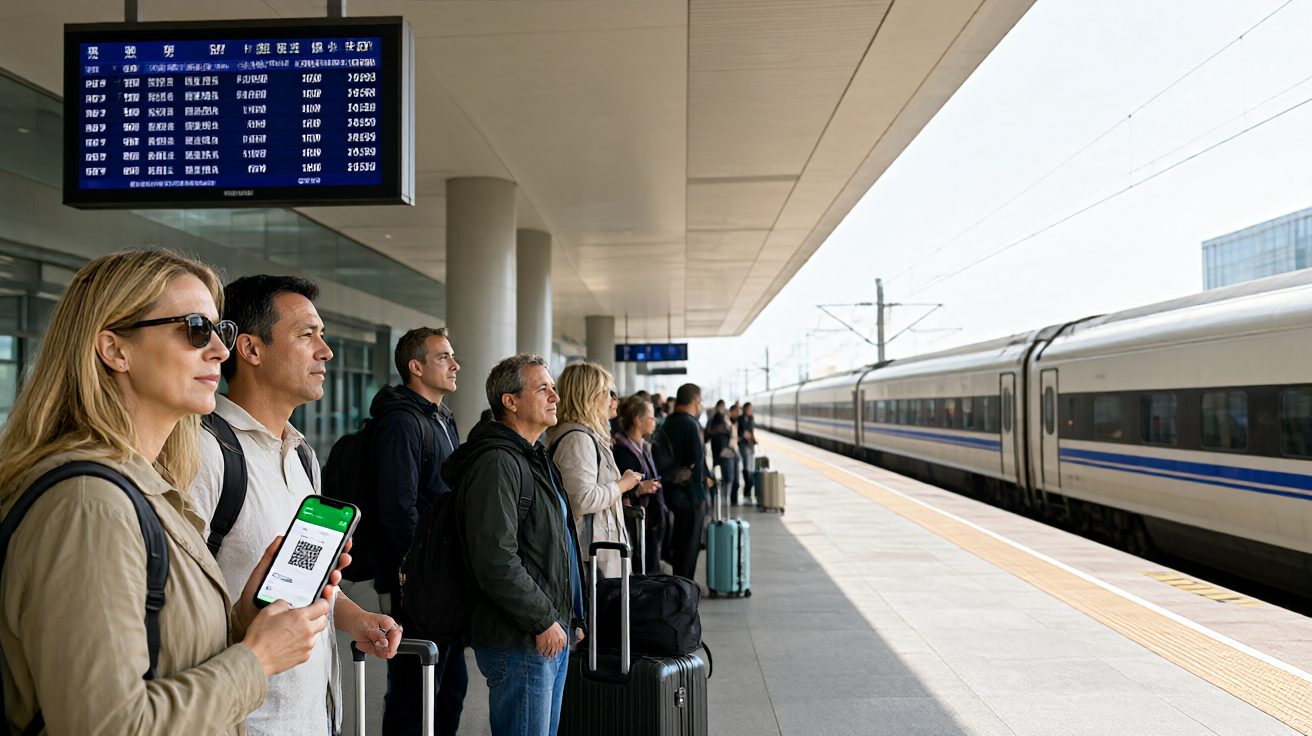
The short answer. The Beijing Daxing Airport Express costs ¥10–35 and takes 20–25 minutes to the city center, the Shanghai Maglev ¥50 in 8 minutes, and the Guangzhou Line 3 North Extension ¥7–9 in about 45 minutes; foreign visitors can use all of them without a Chinese ID, per China Railway 12306.
Official channels. China Railway 12306 — official ticketing and schedules; 12306 cross-border rules — ticket ID types accepted. Last checked (2026-11) · Source: 12306.cn.
China's major airports are connected to city centers by dedicated rail links that foreign visitors can use without a Chinese ID, with fares ranging from ¥4 to ¥50 depending on the city and train type. The most-used routes are the Beijing Daxing Airport Express (¥10–35, 20–25 minutes to city center), the Shanghai Maglev from Pudong Airport (¥50 single, 8 minutes to Longyang Road), and the Guangzhou Metro Line 3 North Extension from Baiyun Airport (¥7–9, about 45 minutes to downtown). Every figure in this guide is traceable to an official operator or government source, and the booking and payment procedures below are the ones currently in force.
Which China Airports Have Rail Links and What Do They Cost?
China has built dedicated airport rail connections in more than 40 cities, and the largest hubs all offer a direct train or metro option that operates from early morning until around 23:00. The table below lists the routes foreign travelers use most often, with official operator fares and journey times.
| Airport | Rail Link | Official Fare | Journey Time | Operator Source |
|---|---|---|---|---|
| Beijing Daxing (PKX) | Daxing Airport Express | ¥10–35 | 20–25 min to Caoqiao | Beijing Subway official website |
| Beijing Capital (PEK) | Capital Airport Express | ¥25 | 20–30 min to Dongzhimen | Beijing Subway official website |
| Shanghai Pudong (PVG) | Shanghai Maglev + Metro Line 2 | ¥50 (Maglev) / ¥4–7 (Metro) | 8 min (Maglev) / 60–70 min (Metro) | Shanghai Shentong Metro Group |
| Shanghai Hongqiao (SHA) | Metro Line 2 / Line 10 | ¥4–6 | 30–40 min | Shanghai Shentong Metro Group |
| Guangzhou Baiyun (CAN) | Metro Line 3 North Extension | ¥7–9 | 45 min to Zhujiang New Town | Guangzhou Metro official website |
| Shenzhen Bao'an (SZX) | Metro Line 11 | ¥7–10 | 30–40 min to Futian | Shenzhen Metro official website |
| Chengdu Tianfu (TFU) | Metro Line 18 | ¥10–12 | 40–50 min to city center | Chengdu Metro official website |
These fares are set by the respective municipal metro authorities and are published on each operator's official website. The Beijing Daxing Airport Express fare varies by distance: the standard ticket is ¥35 for the full journey to Caoqiao, but a discounted ¥10 fare applies for travel between the airport and the first station (Daxing Xincheng) when purchased through the official Beijing Subway app or a transport card.
How Do I Buy an Airport Rail Ticket as a Foreigner?
Foreign travelers can buy airport rail tickets at the station ticket machines, at the staffed ticket window, or through the official apps of each city's metro operator. All ticket machines at major airport stations accept foreign Visa and Mastercard cards, and the staffed windows accept cash in Chinese yuan. The Beijing Subway, Shanghai Shentong Metro, and Guangzhou Metro all accept Alipay and WeChat Pay at their ticket vending machines.
For the Shanghai Maglev, the official ticket office at Pudong Airport sells single tickets for ¥50 and round-trip tickets for ¥80. According to the Shanghai Maglev official website, passengers holding a same-day airline ticket can present it at the Maglev ticket window to purchase a single ride for ¥40 instead of the standard ¥50.
For Beijing Daxing Airport Express, the ticket can be purchased at the station's automated machines using a foreign card, or through the Yitongxing app operated by the Beijing Subway. The app requires a Chinese mobile phone number for registration, which is the one step that can be a barrier for short-stay visitors.
How Do I Use WeChat for Metro and Airport Rail in China?
WeChat's transit QR code is the most practical way to pay for airport rail and metro rides in China without buying a physical ticket, and it works on all major airport rail lines including Beijing Daxing, Shanghai Pudong, and Guangzhou Baiyun. The feature is called the WeChat Transport Code (乘车码), and it is available inside the WeChat app under the "Me" tab, then "Services," then "Transport" or through the mini-program search.
To activate it, a foreign user needs a WeChat account linked to a bank card or a WeChat Pay balance. According to WeChat's official help center, the Transport Code is supported in more than 300 Chinese cities, and it generates a QR code that you scan at the metro turnstile. The fare is deducted automatically from your WeChat Pay balance, and the charge is the same as the standard single-ride fare set by the local metro operator.
For the Shanghai Maglev, the WeChat Transport Code is not accepted at the Maglev gates because the Maglev is a separate fare system. You must buy a Maglev ticket at the station or through the official Shanghai Maglev app. For all other airport rail lines in Beijing, Guangzhou, Shenzhen, and Chengdu, the WeChat Transport Code works directly at the turnstile.
For a full walkthrough of setting up WeChat, linking a foreign card, and finding mini-programs, see our WeChat for Foreigners guide.
What Are the China High-Speed Rail Station to Airport Luggage Storage Rules?
Major Chinese high-speed rail stations that connect to airports offer luggage storage facilities, and the standard rule is that items must be stored for a maximum of 24 hours. According to China Railway 12306, the official online ticketing platform, luggage storage at stations is charged per hour or per day depending on the facility, with typical rates ranging from ¥5 to ¥20 per item per day at large hub stations.
At Beijing South Railway Station, which connects to Daxing Airport via the Daxing Airport Express, luggage storage is available on the B1 level near the arrival hall. At Shanghai Hongqiao Railway Station, which is directly connected to Hongqiao Airport, luggage storage is available on the arrival level, and the station is a single building complex with the airport terminal.
China Railway 12306 states that oversized items (over 160 cm in length, width, or height combined) are not permitted in the passenger compartment and must be checked as baggage or stored. For airport rail links, the luggage allowance is more generous: the Beijing Daxing Airport Express and the Shanghai Maglev both allow standard airline-size suitcases without additional fees.
Do I Need to Register a 12306 Account Before Buying China High-Speed Rail Tickets?
Yes, a 12306 account is required to buy high-speed rail tickets online, and foreign passport holders can register using their passport number. According to China Railway 12306, the official platform, registration requires a Chinese mobile phone number for verification, which is the main hurdle for short-stay visitors who do not have a local SIM card.
Foreign travelers without a Chinese mobile number can buy tickets at the station ticket window using their passport, or through the 12306 app if they obtain a Chinese SIM card at the airport. The 12306 app supports English, and the registration process asks for the passport number, name as printed on the passport, and a Chinese mobile number for SMS verification.
China Train Refund Rules: What Fees Apply When You Cancel a High-Speed Rail Ticket?
China Railway 12306 applies a tiered refund fee based on how far in advance you cancel before departure. According to the official 12306 refund policy, tickets canceled more than 8 days before departure receive a full refund with no fee. Tickets canceled between 48 hours and 8 days before departure incur a 5% fee. Tickets canceled between 24 and 48 hours before departure incur a 10% fee. Tickets canceled less than 24 hours before departure incur a 20% fee.
These refund rules apply to all high-speed rail tickets purchased through 12306, including the G-series trains that connect to major airports. Refunds are processed back to the original payment method, and the refund is typically completed within 1 to 3 business days according to China Railway 12306's official terms.
For airport rail links operated by metro systems, the refund rules are different: single-ride tickets purchased at the station are generally non-refundable once purchased, and stored-value transport cards can be refunded at the station's customer service desk with the card's deposit returned.
China Train Luggage Rules: What Do the Size and Weight Limits Mean for High-Speed Rail?
China Railway 12306 sets a luggage limit of 20 kg for each adult passenger on high-speed rail, with a maximum external dimension of 160 cm (length plus width plus height combined). Children aged 6 to 14 are allowed 10 kg. These limits apply to all G-series and D-series trains, including those that serve airport stations.
For the airport rail links, the luggage rules are more relaxed. The Beijing Daxing Airport Express and the Shanghai Maglev do not impose a weight limit on standard airline suitcases, and passengers can bring luggage up to the size of a standard checked bag without extra fees. The Guangzhou Metro and Shenzhen Metro allow luggage that fits through the turnstile, which is roughly 70 cm wide.
If you are connecting from a high-speed rail station to an airport, the 12306 luggage limit of 20 kg applies to the rail segment, and the metro or airport express segment has no separate weight charge. For travelers with more than 20 kg of luggage, China Railway 12306 recommends using the baggage check service available at major stations, which charges a per-kilogram fee based on distance.
What Should I Check Before Using an Airport Rail Link in China?
Before using any airport rail link, check the operating hours and the last train time, because most airport rail lines stop running between 22:30 and 23:30. The Beijing Daxing Airport Express runs from about 06:00 to 23:00, the Shanghai Maglev runs from 06:45 to 21:40, and the Guangzhou Metro Line 3 North Extension runs from about 06:10 to 23:30. These times are published on each operator's official website and are subject to change on public holidays.
Check whether your arrival airport and your destination require a transfer. For Shanghai Pudong Airport, the Maglev takes you to Longyang Road station, where you transfer to Metro Line 2 for the city center. For Beijing Daxing, the Airport Express takes you to Caoqiao station, where you transfer to Metro Line 10. For Guangzhou Baiyun, Metro Line 3 North Extension goes directly to Zhujiang New Town without a transfer.
If you are arriving late at night after the last train, the official airport taxi counters at Beijing Daxing, Shanghai Pudong, and Guangzhou Baiyun operate 24 hours, and the metered fare to the city center ranges from ¥150 to ¥300 depending on distance and traffic. The official taxi dispatch counters at these airports provide a printed receipt with the fare breakdown, which is the reference for any dispute.
How Does the Airport Rail Link Compare to Taxi Prices in China?
Airport rail links are consistently cheaper than taxis for solo travelers, but taxis can be comparable for groups of three or more. A taxi from Beijing Daxing Airport to the city center costs about ¥200–300 depending on traffic, while the Daxing Airport Express costs ¥35. A taxi from Shanghai Pudong Airport to the city center costs about ¥160–200, while the Maglev plus Metro Line 2 costs about ¥54 total.
The official taxi fare structure is set by each city's transport bureau and is displayed on the taxi's window sticker. The Beijing taxi base fare is ¥13 for the first 3 km, then ¥2.3 per km, according to the Beijing Municipal Transport Commission. The Shanghai taxi base fare is ¥16 for the first 3 km, then ¥2.7 per km, according to the Shanghai Municipal Transport Commission.
For travelers with heavy luggage or early morning flights, a taxi may be more practical despite the higher cost, because airport rail links require walking through stations and transferring. For travelers with a single carry-on bag, the rail link is the faster and cheaper option.
What Are the Practical Steps for a Foreigner Using a China Airport Rail Link?
Step 1: Arrive at the airport and follow the signs for the rail link, which are in Chinese and English at all major airports. Step 2: Buy a ticket at the automated machine using a foreign card, or use the WeChat Transport Code if you have it set up. Step 3: Scan the ticket or QR code at the turnstile and keep the ticket for the exit. Step 4: Board the train and note the station names, which are announced in Chinese and English. Step 5: At the destination station, scan the ticket or QR code again at the exit gate.
For the Shanghai Maglev, the ticket is a paper ticket that you insert into the gate at both entry and exit. For the Beijing Daxing Airport Express, the ticket is a single-use IC card that you tap at the gate. For metro lines like Guangzhou Line 3 and Shenzhen Line 11, the WeChat Transport Code is the simplest option because it does not require buying a physical ticket.
Where to Check Rail and Metro Details Before You Travel
Airport rail fares are fixed by the operating metro company and do not vary by booking time, according to Beijing Subway and Shanghai Metro. Beijing Daxing Airport Express costs ¥35 from the airport to Caoqiao, while the Shanghai Pudong Maglev runs at ¥50 for a single journey. Foreign travellers can pay at the gate with a contactless card or by scanning a WeChat Transport Code where the line supports it.
For the step-by-step process of setting up mobile payment, see the WeChat setup guide on this site. If your trip combines a flight and a high-speed train, the 2026 travel guide covers the current transfer rules and buffer times.
What Are the Common Mistakes Foreigners Make With China Airport Rail Links?
The most common mistake is assuming the airport rail link accepts the same ticket as the city metro. The Beijing Daxing Airport Express and the Shanghai Maglev are separate fare systems from the city metro, and they require a separate ticket or a separate WeChat Transport Code activation. The Beijing Capital Airport Express also requires a separate ticket, and the standard fare is ¥25 according to the Beijing Subway official website.
The second most common mistake is missing the last train. The Shanghai Maglev stops running at 21:40, which is earlier than most international flight arrivals. If you arrive at Pudong Airport after 21:40, the only rail option is Metro Line 2, which runs until about 22:30, and after that, a taxi is the only option.
The third mistake is not checking the transfer station. For Beijing Daxing, the Airport Express ends at Caoqiao, and you must transfer to Metro Line 10 for most city hotels. For Shanghai Pudong, the Maglev ends at Longyang Road, and you must transfer to Metro Line 2. These transfers add 10 to 15 minutes to the journey, and they are not included in the published journey times.