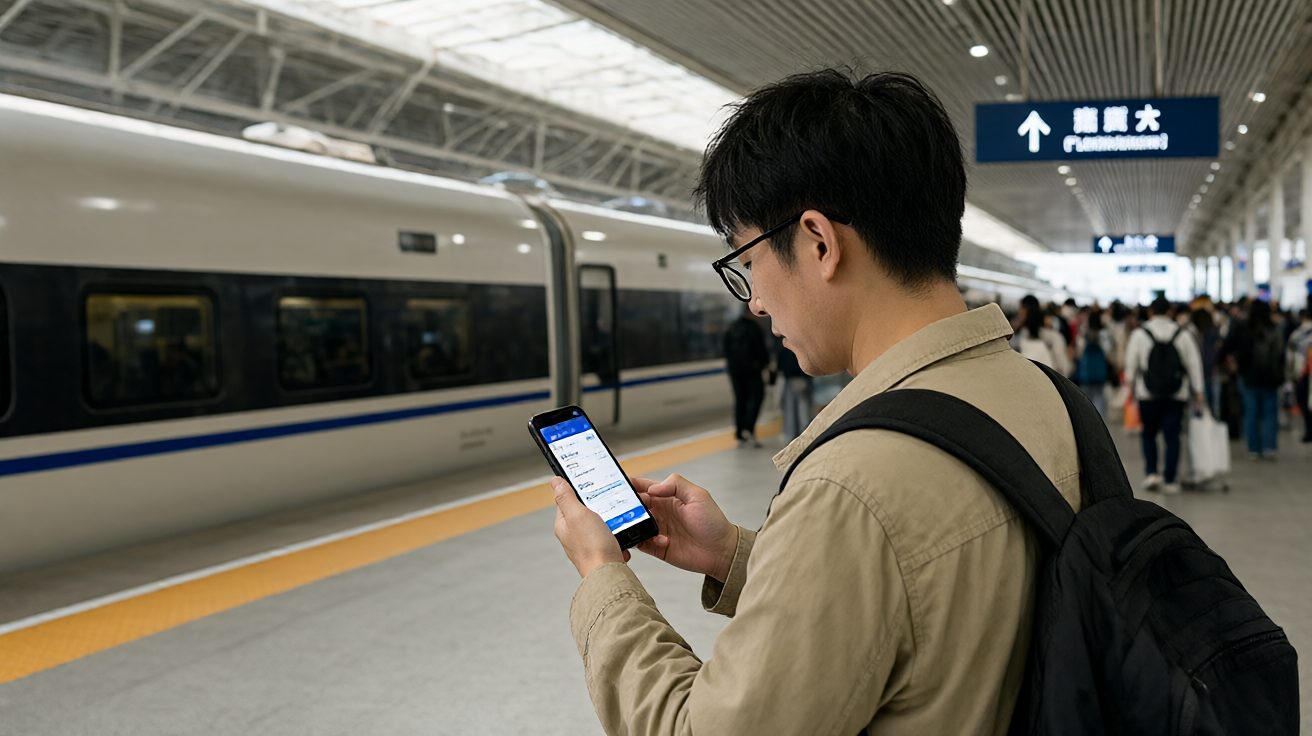
Beijing to Shanghai high-speed rail tickets cost between CNY 553 (second class) and CNY 1,748 (first class) for the fastest G-series trains, according to China Railway 12306. The journey covers approximately 1,318 km on the Beijing-Shanghai high-speed railway, taking between 4 hours 28 minutes and 6 hours 22 minutes depending on the specific train number, with second-class tickets being the most common purchase for international visitors managing daily budgets.
Official Ticket Prices and Class Breakdown
The official fare structure for the Beijing-Shanghai high-speed rail line is published by China Railway 12306 and remains fixed per class without dynamic pricing for standard G-series trains. Second class offers basic seating with 1+2 configuration, while first class provides wider seats and power outlets at each seat, and business class includes reclining leather seats with lounge access. The price differential reflects both seat comfort and service level, with second class being the baseline for most travel plans.
- Second class: CNY 553 (standard G901-G998 trains)
- First class: CNY 862 (standard G901-G998 trains)
- Business class: CNY 1,748 (standard G901-G998 trains)
- Emu D-series trains: Second class CNY 538, First class CNY 853
According to the Ministry of Finance and National Development Commission joint regulation on railway fare standards, these prices are set by the state and do not fluctuate seasonally for high-speed intercity trains. The slight variation between G-series and D-series trains reflects different power and speed characteristics, with G-series trains reaching 350 km/h maximum speed and D-series trains operating at 250 km/h maximum speed.
Travel Times and Frequency on the Beijing-Shanghai Route
The fastest G901 and G902 trains complete the 1,318 km journey in 4 hours 28 minutes, departing Beijing South at 09:00 and arriving Shanghai Hongqiao at 13:28, while G903 and G904 depart at 09:00 and 10:00 respectively with similar duration. China Railway 12306 schedules over 50 G-series and D-series trains daily between Beijing South and Shanghai Hongqiao, providing departure options from 07:00 to 20:00, with average travel times ranging from 4 hours 28 minutes to 6 hours 22 minutes. The most frequent service interval is approximately 30-45 minutes during peak morning and evening hours.
Train G901 departs Beijing South at 09:00, stops at Jinan West, Xuzhou East, and Nanjing South before arriving Shanghai Hongqiao at 13:28. Train G981 departs at 09:00 with similar route but different stop schedule. The Beijing-Shanghai high-speed railway is one of the busiest high-speed lines in China, carrying over 80,000 passengers daily according to the Ministry of Railways 2024 annual report. For visitors planning a 2-day Beijing itinerary, taking the morning G901 allows arrival in Shanghai before lunch, maximizing usable afternoon time. For a 3-day Shanghai itinerary with Disneyland, the evening G985 train arriving at 19:40 provides a buffer without sacrificing full evening hours.
What is the difference between G-series and D-series trains on this route?
G-series trains (Gaotie) operate at 300-350 km/h maximum speed with travel times under 5 hours, while D-series trains (Dongche) operate at 200-250 km/h with travel times between 5-6.5 hours. According to China Railway 12306, G-series tickets cost CNY 553 for second class versus CNY 538 for D-series, a difference of only CNY 15 for the 30-40 minute time saving. G-series trains have newer carriages with power outlets at all seats and generally more comfortable seating pitch. For most travelers, the 15-minute to 40-minute time difference does not justify the small price difference, but G-series trains have higher punctuality rates and more consistent departure times according to the National Bureau of Statistics 2024 railway performance report.
Booking Procedures and Required Documents
International visitors must book Beijing-Shanghai high-speed rail tickets through China Railway 12306 using a valid foreign passport, which is the only acceptable identification document for non-Chinese residents. The 12306 system allows purchases up to 15 days in advance, with international travelers able to use their passport number directly without requiring a Chinese phone number verification. According to the Ministry of Public Security border management regulations, the passport must be valid for at least 6 months beyond the travel date for the booking to be processed. The 7-minute booking procedure on 12306 involves entering departure station (Beijing South), arrival station (Shanghai Hongqiao), travel date, and passenger passport details, with payment accepted in RMB via international credit cards or Alipay. Detailed step-by-step instructions are available in the guide on how to buy a high-speed rail ticket in China in 7 minutes.
Children under 1.4 meters require a child ticket at CNY 277 (half price for second class), while those over 1.4 meters pay full fare. Infants under 2 years old traveling on a lap are free but do not get a dedicated seat. A refund is free when you cancel 8 days or more before departure; from 48 hours to 8 days it costs 5% of the fare, from 24 to 48 hours 10%, and inside 24 hours 20%, with a CNY 2 minimum charged in CNY 0.5 units, according to China Railway 12306 refund rules. Once the train leaves, the ticket cannot be refunded at all — it can only be changed to another train departing from the same station that same day. For visitors following a 5-day Shanghai itinerary with Disneyland, booking the return train 3-5 days in advance during peak season is recommended to avoid sellout situations on G-series trains, which frequently sell out on Fridays and Mondays.
Can you buy Beijing-Shanghai high-speed rail tickets without a Chinese phone number?
Yes, international travelers can purchase Beijing-Shanghai high-speed rail tickets without a Chinese phone number by using the 12306 international interface with a valid foreign passport as the identification document. The Ministry of Public Security confirms that passport registration in the 12306 system does not require phone verification for foreign nationals, only passport number, name, and nationality. The 12306 international website and app allow the entire booking process in English, with payment in RMB via international credit cards. However, ticket collection at the station still requires the physical passport for entry verification, and the electronic ticket QR code on the app may require manual station attendant assistance if the system fails to recognize foreign passport format.
Station Transfers and Connectivity in Beijing and Shanghai
Beijing South Railway Station is located in Fengtai District, 12 km south of the city center, and connects to Beijing Daxing International Airport via the Daxing Line, with a 37-minute express service and a 14-minute connection to the airport rail link according to the Capital Metro Corporation. The Beijing-Shanghai high-speed rail line terminates at Beijing South, not Beijing West, so visitors must plan transfers accordingly. In Shanghai, Shanghai Hongqiao Railway Station integrates with Hongqiao T2 airport terminal, allowing air-to-rail transfers in under 15 minutes without exiting the secure zone, as documented by the Shanghai Transportation Commission. For visitors arriving at Beijing Daxing Airport, the high-speed rail station connection requires taking Metro Line 4 to Beijing South, a 52-minute journey with one transfer, costing CNY 6-9 based on distance according to the Beijing Municipal Transport Commission fare schedule.
The Shanghai Hongqiao station to Shanghai Disney Resort transfer takes 45 minutes via Metro Line 11, costing CNY 6, or 30 minutes by taxi at CNY 80-120 depending on traffic, according to the Shanghai Metro official fare table. For a 2-day Beijing itinerary followed by Shanghai travel, the morning G901 train departing 09:00 allows arrival in Shanghai Hongqiao at 13:28, with the Disney Resort reachable by 15:00, providing 5-6 hours of usable time. For a 3-day Shanghai itinerary with Disneyland, taking the evening G985 train arriving 19:40 preserves the full afternoon for other attractions before the day trip to Disney the following day.
Silent Car Options and Seating Considerations
Since 2020, China Railway has introduced silent carriage (静车) sections on select G-series trains, including some Beijing-Shanghai services, where passengers are asked to keep phones on silent and avoid loud conversations. The silent car is typically car 5 or 9 on G901-G998 trains, and booking these seats requires selecting the silent carriage option during the 12306 booking process, which costs the same as standard seats. According to the China Railway 12306 customer service announcement, silent carriages operate under voluntary compliance with no penalties, but signage and announcements encourage quiet behavior. For visitors working on laptops or seeking rest during the 4.5-hour journey, the silent car provides a quieter environment without additional cost. The process for booking the quiet 静 car is detailed in the China high-speed rail silent carriage guide, which explains how to identify and select these seats in the 12306 app.
Seat selection on G-series trains follows a 1+2 second class layout with aisles on both sides of the central seat, and a 1+1 first class layout with more legroom and power outlets at every seat. Business class seats convert to lie-flat positions and include complimentary meal service. For visitors with mobility limitations, car 8 on G-series trains typically has space for wheelchairs and strollers, and station staff at Beijing South and Shanghai Hongqiao assist with boarding. The 12306 system allows selecting specific seats 7 days before departure, with unselected seats assigned randomly by the system. For groups of 4 or more, the 12306 group booking feature allows reserving adjacent seats, which is particularly useful for family travel or business delegations.
What are the luggage limits on Beijing-Shanghai high-speed rail trains?
According to China Railway 12306 luggage regulations, each passenger may carry up to 20 kg of luggage for second class, 30 kg for first class, and 50 kg for business class, with each item not exceeding 130 cm in total dimensions. Luggage must be placed in overhead racks or designated floor spaces without obstructing aisles. The National Railway Group stipulates that oversized luggage requires prior purchase of a luggage ticket, with rates of CNY 0.5 per kg per 100 km for the Beijing-Shanghai route, totaling approximately CNY 66 for 20 kg of excess luggage. Liquids are permitted in checked luggage but not in carry-on items over 100 ml, and prohibited items include flammable liquids, sharp objects, and compressed gas canisters according to the Ministry of Emergency Management railway safety regulations.
Planning Around the Route: Itinerary Integration and Cost Context
For visitors using this route as part of a broader China travel guide for Shanghai, the CNY 553 second-class ticket represents approximately 15-20% of a mid-range daily budget, making it a cost-effective alternative to air travel when accounting for airport security waits and check-in time. A typical 2-day Beijing itinerary covers the Forbidden City, Temple of Heaven, and Qianmen Street, with the afternoon G985 train at 17:00 departure allowing morning attractions followed by evening arrival in Shanghai at 21:28. For a 3-day Beijing itinerary including the Summer Palace and Ming Tombs, the G901 morning departure at 09:00 requires early wake-up or skipping one major attraction, while the 10:00 G903 departure provides more morning flexibility. The Beijing-Shanghai high-speed rail price structure remains fixed throughout 2026, with no planned fare increases announced by the National Development Commission as of Q1 2026. For context, a comparable domestic airfare from Beijing to Shanghai typically ranges from CNY 800-1,500 with budget carriers and CNY 1,500-3,000 with full-service airlines, making the CNY 553 rail ticket substantially cheaper when factoring in the 1,318 km ground distance and zero airport transfer costs within the integrated Hongqiao terminal.
The China highway service area comparison highlights that the high-speed rail avoids the 10-15 hour driving time on the Jinghu Expressway, with service areas offering limited food and rest options versus the consistent in-train dining car service at CNY 20-40 for meals according to China Railway dining service standards. For budget-conscious travelers, the CNY 553 ticket price allows allocating more to accommodation, where a mid-range hotel in Shanghai costs CNY 300-500 per night according to the National Bureau of Statistics 2024 accommodation survey, making the rail journey a predictable fixed cost versus variable airfare prices that fluctuate with demand. The convenience of not requiring 2-hour advance airport arrival and not dealing with luggage checked-in fees further reduces total trip cost when comparing the two transport modes for the same 1,318 km distance.