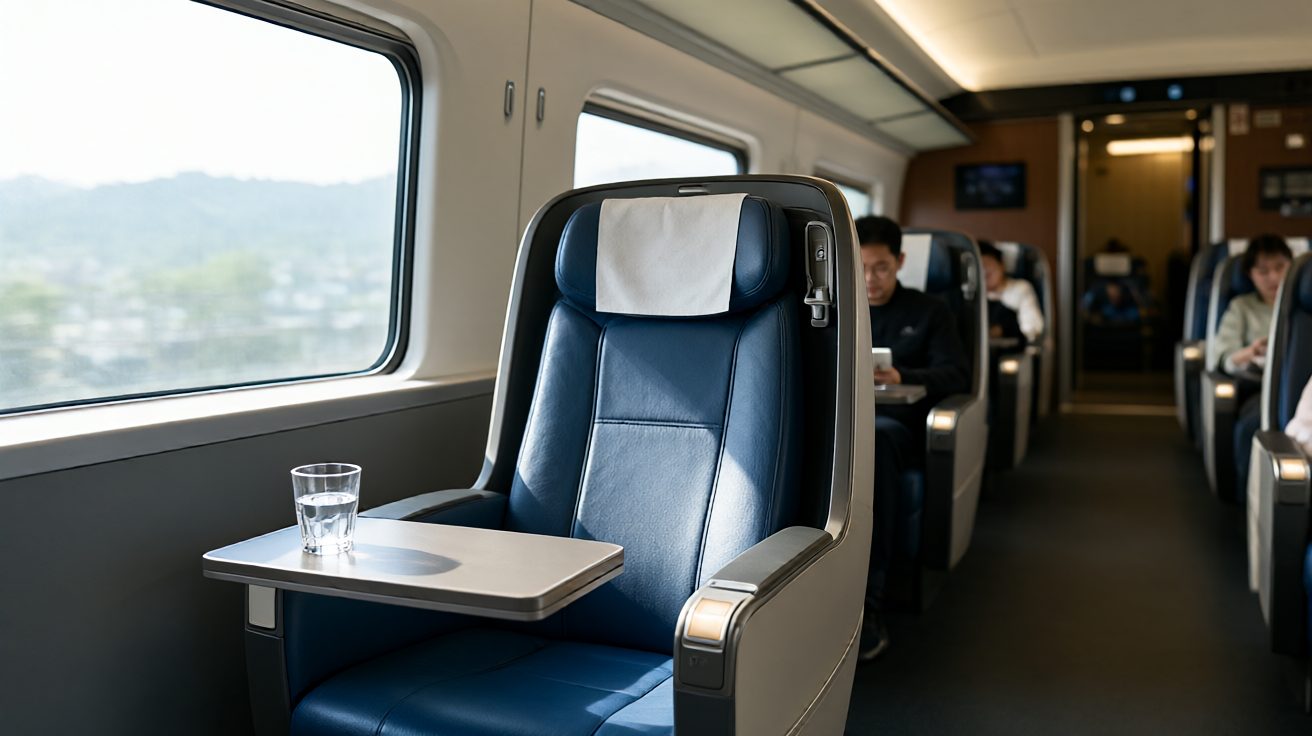
China's high-speed rail network, operated by China Railway, offers three main seat classes on G-series trains: second class, first class, and business class. According to China Railway 12306, the official ticketing platform, prices are set by distance and train type, with second class the standard choice, first class adding legroom, and business class providing lie-flat seats. This guide explains each class, real prices, and how to book.
What seat classes are available on China high-speed rail?
China Railway 12306 lists three seat classes on most G-series high-speed trains: second class, first class, and business class, with soft sleeper available on overnight D-series trains. The class you choose determines your seat configuration, legroom, and price.
What is second class on China high-speed rail?
Second class is the standard economy option on China high-speed rail, with a 3+2 seating configuration. According to China Railway 12306, second class seats measure approximately 43 centimeters wide with about 97 centimeters of legroom. This is the most economical choice and the default for most travelers. On the Beijing-Shanghai route, second class costs ¥553 per ticket.
What is first class on China high-speed rail?
First class uses a 2+2 seating configuration, with wider seats measuring about 50 centimeters and legroom of about 110 centimeters, according to China Railway 12306. The cabin is quieter and less crowded than second class. On the Beijing-Shanghai route, first class costs ¥933 per ticket, about 69% more than second class.
What is business class on China high-speed rail?
Business class is the higher-tier option, with a 2+1 or 1+1 seating configuration and lie-flat seats. According to China Railway 12306, business class passengers receive a meal service and access to lounges at major stations. On the Beijing-Shanghai route, business class costs ¥1,748 per ticket, about three times the price of second class.
How much does each seat class cost on China high-speed rail?
On the Beijing-Shanghai route, the most heavily traveled high-speed line, China Railway 12306 lists second class at ¥553, first class at ¥933, and business class at ¥1,748. Prices scale with distance, and G-series trains cost more per kilometer than D-series trains.
| Seat class | Beijing-Shanghai price | Seat configuration | Key features |
|---|---|---|---|
| Second class | ¥553 | 3+2 | 43cm seat width, 97cm legroom |
| First class | ¥933 | 2+2 | 50cm seat width, 110cm legroom |
| Business class | ¥1,748 | 2+1 or 1+1 | Lie-flat seats, meal service, lounge access |
Prices are calculated by China Railway based on distance, with a base rate per kilometer that varies by train type. The 12306 platform shows exact prices for each train when you search. For shorter routes, such as Shanghai to Hangzhou (about 160 kilometers), second class costs approximately ¥73, according to 12306 pricing.
How do I choose the right seat class for my trip?
The right seat class depends on your budget, trip duration, and comfort needs — second class suits short trips, first class suits 3-4 hour journeys, and business class suits long-distance or overnight travel. Here is a decision framework based on journey length.
Short trips under 2 hours
Second class is sufficient for journeys under 2 hours. The trip is brief, so extra legroom and quiet cabins matter less. On routes like Shanghai to Hangzhou or Beijing to Tianjin, second class is the practical choice for most travelers, according to China Railway 12306.
Medium trips of 2 to 4 hours
First class offers better value for medium-length journeys. The wider seats and quieter cabin make a noticeable difference on a 3-hour trip. On the Beijing-Shanghai route, first class costs ¥933 compared to ¥553 for second class — a ¥380 difference for significantly more comfort.
Long trips over 4 hours
Business class provides lie-flat seats, making it worth the extra cost for very long routes or overnight travel. On the Beijing-Guangzhou route (about 2,300 kilometers), business class costs approximately ¥2,724, according to 12306 pricing. The lie-flat seat allows you to sleep, which is valuable on a 8-hour journey.
Budget travelers
Second class is the standard choice for budget travelers. It is the most economical option and perfectly adequate for most journeys. If you book in advance, you can often find second class tickets at the base price, while first and business class prices remain fixed.
How do I book a silent carriage seat on China high-speed rail?
China Railway offers silent carriages on select G-series trains, bookable by selecting the '静' (quiet) icon in the 12306 app when choosing seats. No additional fee applies on most routes. The silent carriage was introduced by China Railway in 2022 and has expanded to more routes since.
Rules in the silent carriage include no phone calls, no loud conversations, and quieter announcements, according to China Railway 12306. Available routes include the Beijing-Shanghai and Beijing-Guangzhou lines. To book, search your route in the 12306 app, select a train with the silent carriage option, and choose the '静' icon when selecting seats.
What does the China high-speed rail network cover?
China's high-speed rail network exceeded 45,000 kilometers by end of 2024, according to China Railway, connecting all provincial capitals except Lhasa and most major cities. The network is the world's largest, and new lines continue to open.
Major hubs include Beijing, Shanghai, Guangzhou, Shenzhen, Chengdu, Wuhan, and Xi'an. The Beijing-Shanghai line is the most heavily traveled, with trains running every few minutes during peak hours. The 12306 platform shows the full network map and lets you search any route.
How do I book a high-speed rail ticket in China?
Book through the official 12306 app or website, with e-tickets standard on all high-speed lines. Passports are used for identification, and seat selection is available. Here is the booking procedure according to China Railway 12306.
- Download the 12306 app or use the website (12306.cn)
- Register with your passport number
- Search for your route and date
- Select your train and seat class
- Choose your seat using the seat selection feature
- Pay online with international credit cards (Visa, Mastercard) or Alipay/WeChat Pay
- Receive an e-ticket — no paper ticket needed
- Arrive at the station and go through security with your passport
What changes can I expect in 2026?
China Railway continues to expand its high-speed network, with new lines opening in 2026 and continued rollout of smart ticketing features through the 12306 platform. The network exceeded 45,000 kilometers by end of 2024, according to China Railway.
E-tickets are now standard on all high-speed lines — no paper tickets needed. Seat selection is available on the 12306 app. The 12306 platform has been adding features like silent carriages and smart ticketing. For more on what's new for visitors, see our China Travel Guide 2026: What's New for Visitors.
Practical tips for different travelers
Different travelers have different needs when choosing a seat class on China high-speed rail. Here are practical considerations for families, international visitors, and food-focused travelers.
Traveling with family
Traveling from India
Indian citizens need a visa to enter China, obtained through the Chinese Visa Application Service Center. Processing typically takes about 4 working days, according to the Chinese Embassy in India. Once in China, the high-speed rail network connects Beijing, Shanghai, and Guangzhou, making it easy to travel between major cities. For visa application details, see our guide to getting a family visit China visa.
Finding food at stations and on board
Frequently Asked Questions
How do I book a silent carriage seat on China high-speed rail?
Select the '静' (quiet) icon in the 12306 app when choosing seats. Available on select G-trains on major routes including Beijing-Shanghai. No additional fee applies.
What is the difference between first class and business class on China high-speed rail?
First class has 2+2 seating with more legroom (110cm). Business class has lie-flat seats, meal service, and lounge access. Business class costs about 2-3x more than first class.
How much does a high-speed rail ticket cost from Beijing to Shanghai?
Second class ¥553, first class ¥933, business class ¥1,748, according to China Railway 12306. Prices vary by train and booking time.
Can I change my seat class after booking on 12306?
Yes, you can change your ticket before departure through the 12306 app. A change fee applies, calculated as a percentage of the ticket price based on time before departure.
What is the luggage allowance on China high-speed rail?
Each adult passenger can bring up to 20kg of luggage. Total dimensions must not exceed 130cm. No checked baggage on most high-speed trains.
How early should I arrive at the station for a high-speed rail trip?
Arrive 30-60 minutes before departure. Security checks and ticket verification take about 15-20 minutes at most stations, according to China Railway 12306.