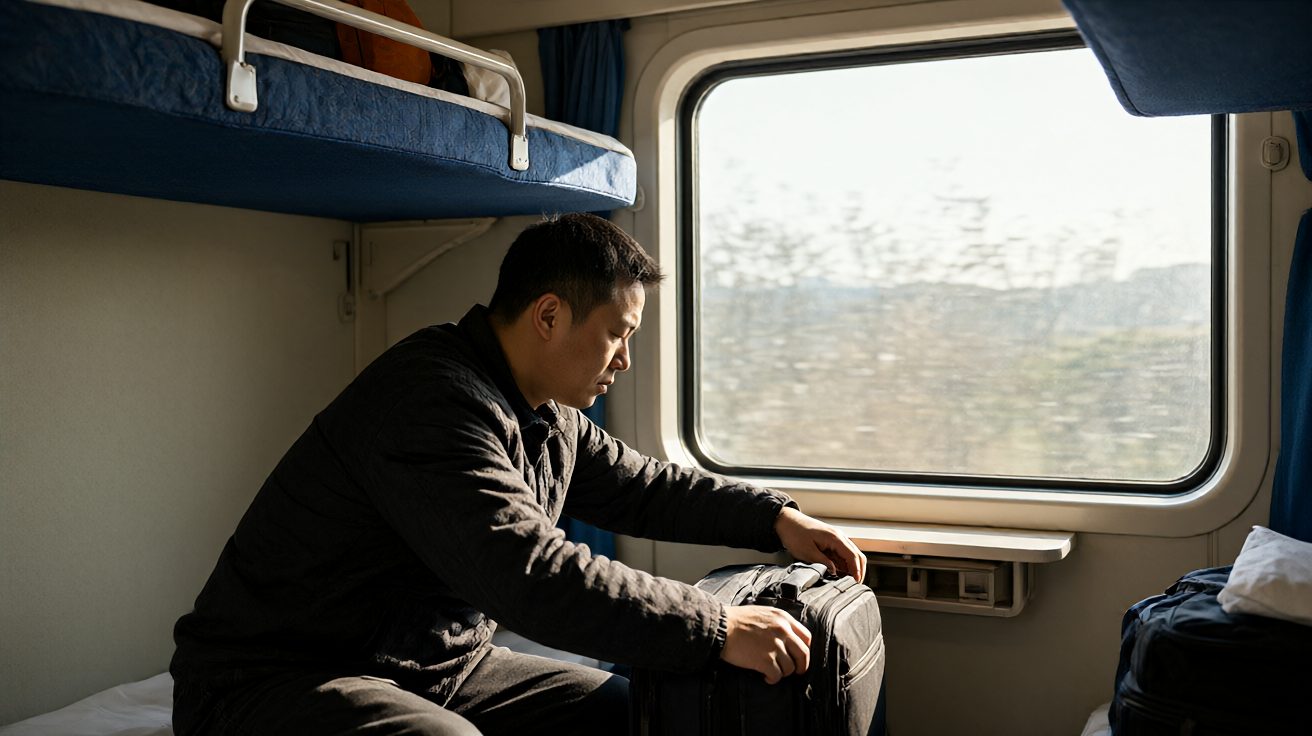
Berths on China's overnight sleeper trains sell out fast, berth position is often assigned by the system, and foreigners can book every sleeper class with a passport on 12306. An overnight sleeper train is a conventional K/T/Z or an EMU D-series train with sleeping berths, priced from about ¥177 (hard seat) to ¥644 (first-class sleeper) on the Beijing–Shanghai corridor for the 2025–2026 timetable. You book through the 12306 English website or app, register your passport, and board with that passport at the gate.
What Are China's Overnight Sleeper Trains?
China runs two families of overnight sleeper trains. Conventional sleepers (K, T, Z series) are slower and cheaper, with open 6-berth hard sleeper bays and 4-berth soft sleeper compartments with a lockable door. EMU sleepers (D-series, also called 动卧 or dongwo) are faster, quieter, and offer first-class sleeper (一等卧) and second-class sleeper (二等卧) compartments.
On the Beijing–Shanghai corridor, conventional T109 and Z281 take about 14–15 hours, while D-series EMU sleepers take 11–12.5 hours. The overnight EMU network is national, not limited to Beijing–Shanghai. Verified corridors include Chengdu–Beijing, Chongqing–Beijing, Guiyang–Beijing, Chengdu–Shanghai, Chongqing–Shanghai, Yibin–Shanghai, Chengdu–Shenzhen, and Chengdu–Zhuhai, per China Railway Chengdu Group timetable notices. Many run daily, but some operate only on specific weekdays—check the train's operating days on 12306 before planning.
How Much Does an Overnight Sleeper Train Cost?
Prices are set by China Railway 12306 and do not surge like airline fares. The National Development and Reform Commission approved a market-pricing pilot in 2016 that allows discounts off base fares on selected routes and times, but not holiday increases. For example, midday departures on Beijing–Shanghai may be discounted up to 10%, but Spring Festival or Golden Week does not raise published fares—availability tightens, not price.
| Route & Train | Class | Price (¥) | Duration |
|---|---|---|---|
| Beijing–Shanghai T109 / Z281 | Soft sleeper | 476.5 | 14–15 h |
| Beijing–Shanghai T109 / Z281 | Hard sleeper | 304.5 | 14–15 h |
| Beijing–Shanghai T109 / Z281 | Hard seat | 177.5 | 14–15 h |
| Beijing–Shanghai D17 | First-class sleeper | 610 | ~11–12.5 h |
| Beijing–Shanghai D17 | Second-class sleeper | 447 | ~11–12.5 h |
| Beijing–Shanghai D7 | First-class sleeper | 601 | ~11–12.5 h |
| Beijing–Shanghai D7 | Second-class sleeper | 440 | ~11–12.5 h |
| Beijing–Shanghai D9 | First-class sleeper | 603 | ~11–12.5 h |
| Beijing–Shanghai D9 | Second-class sleeper | 476 | ~11–12.5 h |
| Beijing–Shanghai D5 | First-class sleeper | 644 | ~11–12.5 h |
| Beijing–Shanghai D5 | Second-class sleeper | 474 | ~11–12.5 h |
Fares listed above are from 12306 for the 2025–2026 timetable, verified on 2026-11-18. For comparison, a daytime high-speed train from Beijing to Shanghai costs ¥553–¥598 for second class and ¥933–¥998 for first class. An overnight sleeper saves a hotel night (typically ¥300–600), so the effective cost is often lower than a day train plus hotel.
Hard Sleeper vs Soft Sleeper: Which Berth Should You Choose?
Hard sleeper (硬卧) is a 6-berth open bay with no door, while soft sleeper (软卧) is a 4-berth compartment with a lockable door. Soft sleeper costs more—on the Beijing–Shanghai T109, soft sleeper is ¥476.5 versus ¥304.5 for hard sleeper. Within hard sleeper, berth prices follow a fixed multiplier: lower berth is approximately 1.3 times the base fare, middle berth 1.2 times, and upper berth 1.1 times, per China Railway fare rules. On a ¥300 hard sleeper, a base of ¥300 gives about ¥390 for the lower berth, ¥360 for the middle, and ¥330 for the upper. Lower berths are more expensive because they are easier to access and have more headroom.
For solo travelers, soft sleeper or a lower berth in hard sleeper is generally safer and more comfortable. Sleeper cars have CCTV and patrols, and soft sleeper compartments lock from inside. For families, note that children do not get automatic lower-berth priority; you must request it at the station window or via the app's berth preference.
Can Foreigners Book Sleeper Trains on 12306?
Yes. Foreigners can book all sleeper classes—hard seat, hard sleeper, soft sleeper, and EMU sleeper—using a passport on the 12306 English website or app. The process is the same as for Chinese citizens: register your passport, search for trains, pay with Visa, Mastercard, JCB, or Amex, and receive an e-ticket tied to your passport. At the station, you board by scanning your passport at the gate; no paper ticket is needed. The 15-day advance sale window applies, so book as early as possible for popular routes.
How to Book an Overnight Sleeper Train: Step-by-Step
- Create a 12306 account using your passport number and a valid email or phone number.
- Search for your route and date, then filter for overnight trains (K, T, Z, or D-series with sleeper classes).
- Select your preferred berth class (hard sleeper, soft sleeper, first-class sleeper, etc.) and, if available, choose a berth position (lower, middle, upper) using the online berth selection feature.
- Enter passenger details exactly as they appear on your passport.
- Pay with an accepted international card. Your e-ticket is issued immediately.
- Arrive at the station 30–40 minutes before departure (40 minutes in peak periods at major hubs); gates close 5 minutes before departure.
If you need to change or refund, the rules are clear on 12306. You can change once before departure with no change fee, paying only the fare difference. More than 48 hours before departure, you may move to any train within the 15-day sale window; within 48 hours, only same-day or earlier departures. After departure, no refund is given, but one same-day change is allowed with fare difference only. Refund fees are: 0% if more than 8 days before departure, 5% from 48 hours to 8 days, 10% from 24 to 48 hours, and 20% within 24 hours. Rail-caused cancellations are refunded in full. For more details, see the refund rules and change rules pages.
Berth Selection: How to Get a Lower Berth
Since 2026, the 12306 app supports online berth self-selection for sleeper tickets (卧铺在线选铺). The system auto-assigns lower berths to passengers aged 60 and above first, when inventory allows. Families with children do not get automatic priority; to secure a lower berth, buy at a station ticket window (the clerk will issue a lower berth if available) or tick the "lower berth" preference in the app. If none remain, the order returns a different berth. Important: cancelling 3 or more orders in one day on one account triggers a same-day purchase restriction, so do not cancel repeatedly to try for a lower berth. Berth assignment for foreigners works exactly as for Chinese citizens.
What to Expect Onboard
Every sleeper car provides a pillow, blanket, and sheets, changed between trips. Hot water dispensers are available in every car. Dining cars on conventional trains serve meals priced ¥20–50. Most Z-series and EMU sleepers have western-style toilets. Power sockets are available per berth on Z-series high-speed sleepers—check the 12306 carriage detail page for the specific train. Wi-Fi availability varies by train number, so do not rely on it; download entertainment beforehand.
Luggage allowance is 20 kg per adult, with total dimensions not exceeding 130 cm, per China Railway luggage rules. Store large bags under lower berths or in end-of-car racks. For full details, see the luggage rules page.
Which Overnight Route Should You Pick?
Pick the corridor first, then the train type. Beijing–Shanghai has the densest overnight offer: three conventional trains (T109, Z281, and the K-series on parallel routes) plus four D-series EMU sleepers (D5, D7, D9, D17) every evening, so a missed booking on one train usually means another departure within an hour. Chengdu–Beijing, Chongqing–Beijing, and Guiyang–Beijing run daily EMU sleepers, while Chengdu–Shenzhen, Yibin–Shanghai, and Chengdu–Zhuhai operate on set weekdays only, so confirm the train's running days on 12306 before you lock a hotel. Conventional trains stop at central stations such as Beijing and Shanghai, while several D-series services arrive at Shanghai Songjiang or Shanghai South — check the arrival station, not just the city, because a 30 km difference changes your morning transfer.
Is the Overnight Sleeper Right for Your Trip?
The sleeper earns its place when the journey is longer than 8 hours and you would otherwise pay for both a flight and a hotel. On Beijing–Shanghai, a hard sleeper at ¥304.50 replaces a ¥300–600 hotel night and a 4.5–6 hour day train, so the total trip cost drops while you gain a night of sleep; the trade-off is a fixed evening departure of 19:10–21:21 and an early-morning arrival between 07:25 and 09:27. Choose the D-series EMU sleeper if you value quieter carriages and shorter rides (11–12.5 hours), or the conventional T/Z trains if budget comes first. If your connection onward depends on a same-day flight or meeting before 09:00, the sleeper is the wrong tool — build a buffer instead.
What If Berths Sell Out?
Soft sleeper berths on popular overnight trains are usually the first to go, often before the 15-day sale window closes. Three fallbacks work in order: enable the 12306 waiting-list (候补) option when no berth is left, which queues your order and issues the ticket automatically if someone refunds; widen by one class — hard sleeper to soft sleeper or the reverse — because the classes sell at different speeds; and check the D-series EMU departures on the same corridor, since their release times differ from conventional trains. Repeat bookings help only if you cancel before the account limit: three cancellations on the same day restrict that account for the rest of the day, so switch trains inside a single search instead of re-ordering.
Common Misconceptions About Sleeper Trains
- "Foreigners can't book soft sleeper"—false. Passport booking works for all sleeper classes.
- "Prices rise 10–20% at Spring Festival"—false. Fares are published base fares with off-peak discounts only; availability tightens, not price.
- "Berth position is randomly assigned forever"—false. 12306 now supports online berth selection, and passengers 60+ get lower-berth priority.
Edge Cases and Practical Tips
If you miss your train, you get no refund, but you may make one same-day change (fare difference only). Overnight arrivals mean you will reach your destination early in the morning; stations are open, but plan your transit to your hotel or first meeting. Keep your passport ready for ticket checks and station gates.
For children, tickets are age-based: under 6 years old travel free without a seat, and ages 6–14 pay half price (since 2023-01-01). However, children do not receive lower-berth priority, so book early or request at the window.
In 2026, the CR200J EMU sleeper fleet has expanded. Notably, the D7 and D8 Beijing–Shanghai trains moved from peak-only to daily service after Spring Festival 2026, and overnight EMU corridors continue to extend. Always verify the train's operating days on 12306, as some run only on specific weekdays.
All prices and rules in this article come from China Railway 12306 for the 2025–2026 timetable, verified on 2026-11-18, plus the berth-selection policy stated by 12306 customer service in July 2026. Check the official China Railway 12306 site for the latest schedules and fares before booking.