
The first time I was handed baijiu I was at a wedding in Chengdu, holding a glass the size of a thimble, and the man next to me said 干杯 and waited. It was 52% alcohol and it went down like water and tasted like a warm grain field. Everyone laughed at my face. What nobody told me that night is that the little glass is not a courtesy — it is arithmetic, and the arithmetic is the reason this spirit is the way it is. Here are eight dates that explain the bottle.
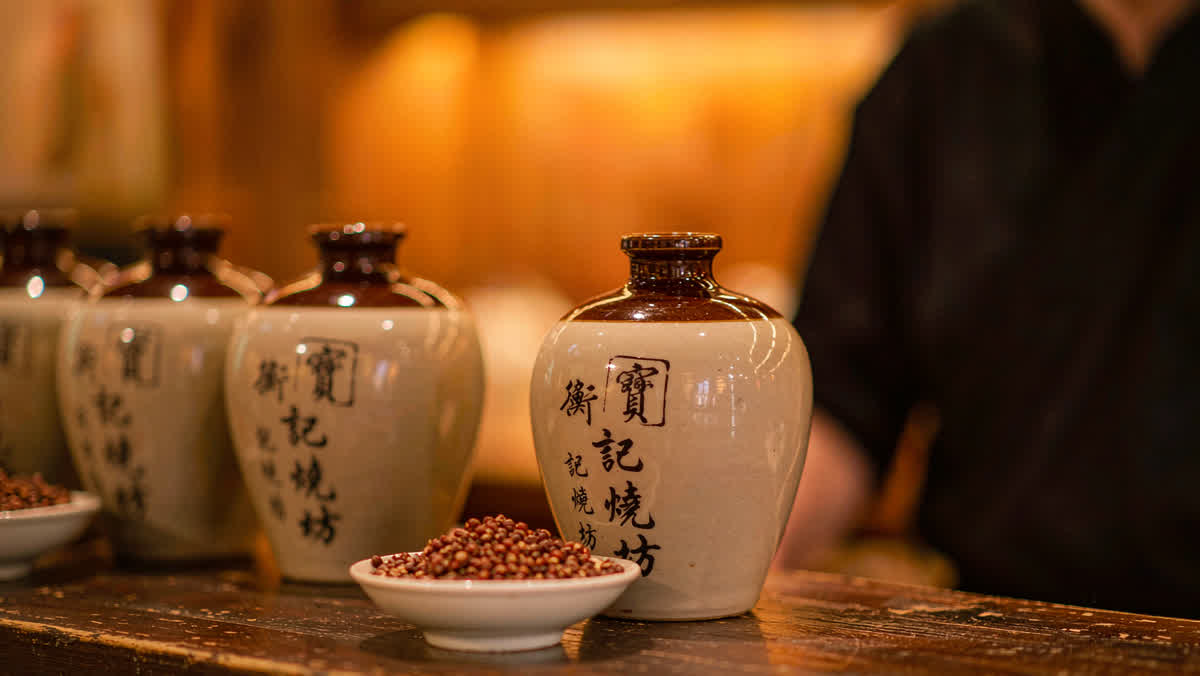
1573–1578: the earliest dates you can actually stand on
Grain alcohol in China long predates distillation: the old drink was 黄酒, a brewed, amber, 10–20% rice wine, served warm and drunk from bowls. Distilled spirit — 烧酒 — is a different technology, and the standard account of when it arrived comes from 李时珍's 本草纲目, completed in 1578, which states plainly that distilling was not an ancient method and began in the Yuan dynasty (1271–1368). That is the sentence every history of baijiu quotes, and it is still the honest answer: somewhere in the Yuan, someone put a still on top of a grain ferment.
Five years before the book, in 1573, a set of fermentation pits was dug in Luzhou, Sichuan that has been in continuous use ever since — the 国宝窖池群 that 泸州老窖 (Luzhou Laojiao) still brews from today. Unlike a wooden barrel, the pit's value is its microbiology: the mud walls carry a bacterial community that only exists because it has been fed, undisturbed, for four and a half centuries. A spirit's flavour in China is not only a recipe. It is an address.
1915: Maotai goes to San Francisco
茅台 (Maotai) comes from 茅台镇 (Maotai town) on the 赤水河 (Chishui River) in Guizhou, and its international story starts at the Panama-Pacific International Exposition in San Francisco in 1915. The tale the company tells is that nobody looked at a plain brown bottle until someone knocked one over and the hall filled with the smell; the part that is not in dispute is that Maotai came home with a medal. A century later that bottle is the reference point for the entire category, and the town is still the only place it can be made the same way.
1952: the first national tasting names four
In 1952 the new state ran the 第一届全国评酒会 (first national liquor appraisal) in Beijing and named four "famous" spirits: 茅台酒, 汾酒 (Fenjiu) from 杏花村 in Shanxi, 泸州大曲 and 西凤酒 (Xifeng) from Shaanxi. This matters more than a prize list suggests: before 1952, Chinese spirits were regional products judged locally. After 1952 there was a national standard to aim at, and a national market to sell into. Every bottle you see ranked or compared today descends from that meeting.
1963: four becomes eight
The second appraisal in 1963 widened the list to eight: 五粮液 (Wuliangye), 古井贡酒, 泸州老窖特曲, 全兴大曲, 茅台酒, 西凤酒, 汾酒 and 董酒. Notice what the list is not: it is not eight versions of one taste. Fenjiu is a clean, light sorghum-and-barley spirit from the north; Wuliangye from Yibin is a five-grain bomb of fruit and esters; 董酒 is herb-infused. The category was being mapped, not ranked, and the map had regions on it.
1979: aroma types become official
The third appraisal in 1979 did the thing that still shapes how Chinese people order a drink: it judged spirits by 香型 (aroma type) rather than against each other. The core four were 酱香型 (sauce-aroma, the Maotai style), 浓香型 (strong-aroma, Wuliangye and Luzhou), 清香型 (light-aroma, Fenjiu and 二锅头) and 米香型 (rice-aroma), with 其他香型 as the bucket for everything else.
The sauce-aroma process is where the numbers get strange. Maotai-style baijiu follows what is called the 12987 cycle: one full year of production, two feedings of sorghum, nine steaming, eight fermentation rounds and seven distillations — starting with 端午制曲 (starter made around the Dragon Boat Festival) and 重阳下沙 (the first sorghum added around the Double Ninth Festival). The grain is not cooked into a drink in a week. It is worked for a year, then aged for years more.
1980s–2000s: how 53% became the number on the label
Baijiu is sold by 度数 — ABV, printed on the front. 飞天茅台 is 53%, the classic 五粮液 is 52%, 红星二锅头 is 56%, and 衡水老白干 has long sold a 67% bottle for people who want the ceiling. Those numbers are not arbitrary: at Maotai's strength, water and alcohol molecules bind most tightly, so the spirit smells rounded rather than sharp, and distilleries blend down to exactly that point instead of to a round 50. Low-alcohol versions at 38–42% exist and are easier to drink; connoisseurs treat them as a different product.
2012: a 100 ml bottle for people who had said no
For years the industry's problem was that young drinkers did not want it — too strong, too tied to banquets and toasting seniors. In 2012, 江小白 (Jiangxiaobai) appeared out of Chongqing with a light-aroma spirit in a 100 ml bottle, plain packaging, and a sentence printed on the label. Not a status object: a drink you buy alone. It sold to people who had previously refused baijiu altogether, and the big houses have been chasing that customer ever since with smaller formats and softer styles.
2022: baijiu leaves the glass
In 2022 Maotai began selling baijiu ice cream, and the queue was the news. A spirit that had spent a century being poured into a thimble at weddings was suddenly being eaten from a small cup by people who would never order it in a restaurant. That is the current direction of travel: baijiu as a flavour, not as a ritual. Whether it lasts is a different question — the banquet bottle is still where the industry makes its money.
What eight dates left behind
Three things stuck. Place is still the recipe — pits, river water and local microbes cannot be moved, which is why 1573 still matters commercially. Aroma type is the vocabulary: say 酱香 or 清香 in a shop and you have said something meaningful, where saying "strong" tells nobody anything. And the strength is deliberate, blended to a number rather than diluted to a price.
And then there is the arithmetic from my first wedding. A 500 ml bottle at 52% holds 260 ml of pure alcohol — roughly the same as 15 or 16 cans of 330 ml beer at 5%. That is why the glass is the size of a thimble, why 干杯 is done in sips rather than pints, and why the correct answer when someone pours for you is not to prove anything. Baijiu is not a drink you catch up on. It is a drink you keep up with.
Four centuries of pits, one national tasting in 1952, and a blending target of 53%: baijiu is the only spirit I know where the strength on the label is a decision about chemistry, and the size of the glass is a decision about arithmetic.
Frequently asked questions
When did baijiu actually start in China?
Grain alcohol predates distillation: the old drink was 黄酒, a brewed amber 10 to 20 percent rice wine; the 1573 to 1578 dates are the earliest you can actually stand behind.
Where does Maotai come from?
Maotai comes from Maotai town on the Chishui River in Guizhou, and its international story starts at the Panama-Pacific Expo in 1915.
Why do bottles say 53 percent?
Baijiu is sold by 度数, ABV printed on the front; Feitian Maotai is 53 percent, classic Wuliangye 52, Hongxing Erguotou 56.
How many famous baijiu were named in 1952?
The first national appraisal in 1952 named four; the 1963 second appraisal widened the list to eight, adding Wuliangye, Luzhou Laojiao and others.