
Here is the one-line answer before anything else: if you have five days or more, go to Dali; if you have 48 hours and want the most photographed old town in Yunnan, go to Lijiang. They are only 80 minutes apart by train, which is exactly why people try to see both and end up remembering neither. The two towns are not variations on a theme — one is built around a lake and open sky, the other is built around a snow mountain and a maze of canals. What follows is the comparison I wish someone had given me before I booked.
Altitude, air and what your body notices
Dali Old Town sits at roughly 1,970 metres; Lijiang Old Town is at about 2,400 metres. Four hundred metres does not sound like much until you climb a staircase. In Lijiang I was noticeably short of breath on the steps up to Wanggu Lou (万古楼), and the temperature dropped hard the moment the sun went behind Jade Dragon Snow Mountain (玉龙雪山), whose highest peak, Shanzidou (扇子陡), reaches 5,596 m. Dali, at the foot of Cangshan (苍山) — 19 peaks and 18 streams, tallest at 4,122 m — feels milder and drier, and I slept better there on every visit.
If you are arriving straight from sea level, this is the practical consequence: plan nothing strenuous on your first afternoon in Lijiang, and drink more water than you think you need. Neither town is high enough for real altitude sickness, but 2,400 m is enough to ruin the first evening of a trip if you sprint up a hill to catch a sunset.
What you actually look at
Dali's centrepiece is water. Erhai Lake (洱海) runs about 42 km north to south and covers roughly 250 km², and the whole town is arranged between it and Cangshan. The best hour I spent there was not in the old town at all: it was cycling a stretch of the lakeside road at 07:40, when the only other people out were two fishermen and a woman washing vegetables. Inland, the Three Pagodas of Chongsheng Temple (崇圣寺三塔) date back to the Nanzhao kingdom of the 9th century, and the tallest of them, Qianxun Pagoda, stands 69.13 m.
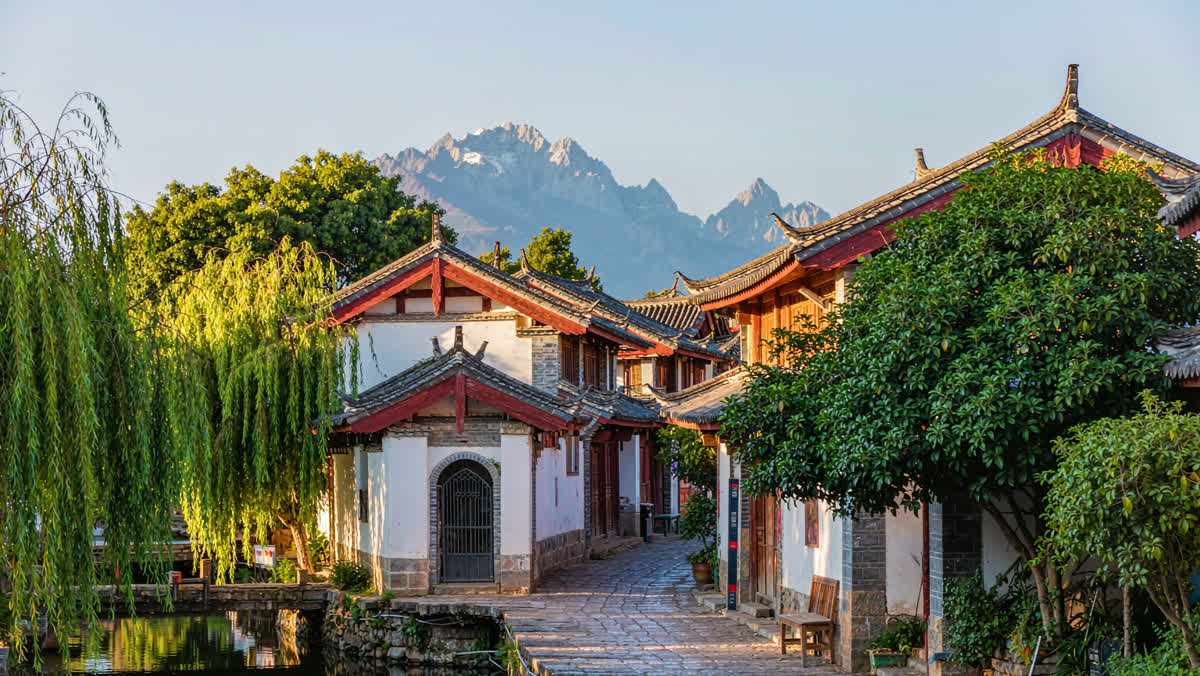
Lijiang's centrepiece is texture. The old town was inscribed on the UNESCO World Heritage list in 1997, it is criss-crossed by canals fed from Black Dragon Pool (黑龙潭), and it belongs to the Naxi (纳西族) people, whose Dongba script (东巴文) is often described as the only pictographic writing system still in use anywhere. You will see it on shop signs and door couplets. Twenty minutes north, Shuhe (束河古镇) is a smaller, quieter old town on the same water system — if Lijiang's main streets feel like a shopping mall, Shuhe is where you go to remember why you came.
Crowds, and the hour that saves you
Both towns are busy, but they are busy differently. Lijiang's old town concentrates visitors into a small area, so at 15:00 the main squares are shoulder to shoulder, while at 07:00 the same stones are empty and the shop shutters are still down. Dali spreads people out along the lake and the mountain paths, so even at midday you can be alone within a fifteen-minute walk of the town gate. If you are going to do one thing right in either town, it is this: be outside before 08:00. In Lijiang that single decision is the difference between a postcard and a queue.
One local detail worth knowing in Dali: the Third Month Fair (三月街), held from the 15th day of the third lunar month, has been a Bai trading gathering for over a thousand years, and the town fills with horse traders and herb sellers. It is the best week to be there and the worst week to want a quiet hotel.
Money: what a day actually costs
On my last stays, a courtyard guesthouse inside Dali Old Town was ¥160 a night; the equivalent room in Lijiang was ¥220, largely because the old town is smaller and UNESCO-listed. A bowl of cross-bridge noodles (过桥米线) or a plate of Naxi baba runs ¥15–25 in both; a flat white in a Dali café was ¥18, and Dali has far more of the cheap, good coffee that has spread across Yunnan. Lijiang's hidden cost is the mountain: a day up Jade Dragon Snow Mountain — park entry, shuttle bus and the glacier cable car — easily clears ¥200 per person, which is more than most people spend on a whole day in Dali. Note also that Lijiang has historically charged a ¥50 old-town maintenance fee, collected at some gates and not others; in practice most casual wandering never triggers it, but budget for the possibility.
The comparison table
| Dali 大理 | Lijiang 丽江 | |
|---|---|---|
| Altitude of old town | ~1,970 m | ~2,400 m |
| Train from Kunming | ~2 hours | ~3 hours 20 min (or 2 h + 80 min change) |
| Main landscape | Erhai Lake, 250 km², and Cangshan's 19 peaks | Jade Dragon Snow Mountain, 5,596 m |
| Culture | Bai 白族; Three Pagodas, 9th century | Naxi 纳西族; Dongba script, UNESCO 1997 |
| Guesthouse, mid-range | ¥140–220 / night | ¥200–320 / night |
| Extra entry costs | Three Pagodas ~¥75; lake path free | Snow mountain day ¥200+; ¥50 maintenance fee possible |
| Crowd pattern | Spreads out; alone in 15 min | Concentrated; empty only before 08:00 |
| Best for | 4–7 days, slow travel, cycling, remote work | 1–2 days, first-time visitors, photographers |
The row that decides it for most people is the last one. Dali rewards time; Lijiang rewards a short, well-timed visit. If you try to do Lijiang in five days you will walk the same six streets forty times. If you try to do Dali in one day you will see a lake and a pagoda and miss the point entirely.
Choose Dali if…
- You have four days or more and want to stop moving. Dali is one of the few places in China where doing nothing all afternoon is a legitimate plan.
- You want to cycle. The Erhai lakeside path is the single best day ride I have done in Yunnan — flat, signed, and lined with small villages that are not tourist attractions.
- You are working remotely. Cafés with real coffee and a spare socket are far easier to find here, and monthly guesthouse rates are negotiable in a way they are not in Lijiang.
- You are travelling with older relatives or small children. Lower altitude, flatter streets, fewer stairs.
Choose Lijiang if…
- You have one or two days and want the strongest single impression. The canals, the cobblestones and the snow mountain behind them deliver in 24 hours.
- You care about photography at dawn. Empty streets plus mountain light is a combination Dali cannot match, precisely because Dali's beauty is spread wider.
- You want the UNESCO-listed old town specifically, and the Dongba culture that comes with it.
- You are continuing north towards Tiger Leaping Gorge (虎跳峡), which is a straightforward onward hop from Lijiang and a very long detour from Dali.
What I would do with five days
Four nights in Dali, one night in Lijiang. Take the 80-minute train between them, sleep near Shuhe rather than in the middle of Lijiang old town, and be out on the cobblestones at 07:00. That split gives you the slow part of the trip and the spectacular part without making either one feel rushed. Doing it the other way round — one night in Dali, four in Lijiang — is the version I see people regret.
Same province, 80 minutes apart: Dali is where you stay for a week, Lijiang is where you spend 24 hours and wish you had gone to bed earlier so you could be up at seven.
Frequently asked questions
Which is higher, Dali or Lijiang?
Lijiang is higher. Dali Old Town sits at roughly 1,970 metres, Lijiang Old Town about 2,400 metres, and the 400-metre gap shows up when you climb a staircase.
What is the centrepiece of Dali?
Water. Erhai Lake runs about 42 km north to south and covers roughly 250 square kilometres, with the whole town set between it and Cangshan.
Which is cheaper per day?
Dali, on my last stays: a courtyard guesthouse inside Dali Old Town was 160 yuan a night; the equivalent in Lijiang was about 220 yuan, because the old town is smaller.
How do I do both in five days?
Four nights in Dali, one in Lijiang. Take the 80-minute train between them, and sleep near Shuhe rather than in the middle of Lijiang old town.